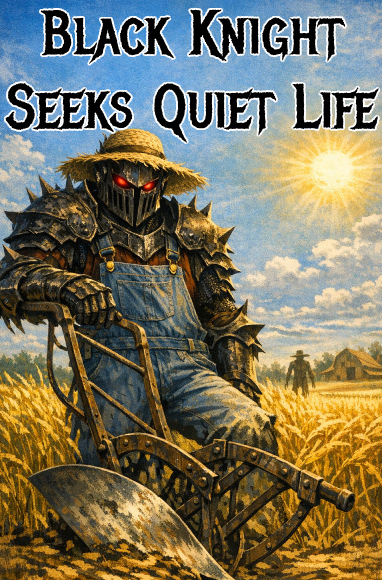
The Bloody Wight was once the most feared man in the continent. Relentless and seemingly indestructible, he waged a bloody war of conquest in the name of Emperor Novos. Until, one day, he was slain. At least, that was what he wanted the world to believe when he faked his death. In reality, tired of being a monster, he fled to the mysterious lands of the east where the cultivators and the yokai reign supreme. All in a bid to live the peaceful life of a farmer. How hard can it be to keep out of trouble?
Black Knight Seeks Quiet Life is an East-meets-West progression fantasy about a legendary war criminal who fakes his death, crosses the world to become a farmer, and discovers that laying down a sword is much easier than becoming the kind of man who no longer needs it.
WHO THIS BOOK IS FOR
This serial is particularly well suited to readers who enjoy overpowered protagonists but have grown tired of heroes whose strength functions only as a machine for producing victories, humiliation scenes and increasingly large explosions.
The Bloody Wight is unquestionably powerful. He enters the eastern lands with the experience, reflexes and reputation of a man who once served as an empire’s most terrifying weapon. Yet the central question is not whether he can defeat the people foolish enough to provoke him. In most confrontations, the answer is obvious.
The real question is whether he can solve a problem without becoming the monster he is trying to bury.
That makes the story a strong recommendation for readers interested in antihero redemption, secret identities, cultivation settings, retired-warrior narratives, martial arts, dry humor and slice-of-life fantasy interrupted by sudden violence. It should also appeal to fans of “dangerous man attempts domestic normality” stories in which farming, land ownership, neighbors and local obligations become more psychologically difficult than killing.
Readers who enjoy genre collisions may find the setting especially attractive. The protagonist comes from a recognizably Western high-fantasy world of emperors, armored knights, conquest and institutional warfare, then relocates into a region shaped by cultivators, sect politics, yokai and eastern martial traditions. The result is not simply a magician-versus-cultivator tournament premise. It is also a collision between different ideas of honor, authority, violence and spiritual power.
The novel will work best for readers comfortable with tonal contrast. One chapter may involve land, milk, animals or farm labor; another may remind the audience that the protagonist built his old identity through mass violence. The comedy does not erase the darkness. It exists beside it.
It is also a good fit for readers who prefer a protagonist with a personality beyond tactical competence. The Bloody Wight’s sarcasm, impatience and exhausted distrust give him a recognizable voice. He does not become gentle simply because he wants peace. His attempt at retirement is compelling precisely because his instincts remain those of a soldier, enforcer and predator.
WHO THIS BOOK IS NOT FOR
This is not the right serial for readers seeking a genuinely pacifist farming fantasy.
Although the protagonist dreams of a quiet agricultural life, farming currently functions more as the emotional destination and recurring comic framework than as the exclusive focus of the plot. Trouble repeatedly reaches his land, and the narrative remains invested in combat, political pressure, sect conflict and the consequences of his former life.
Readers expecting detailed crop systems, seasonal planning, agricultural economics or a long uninterrupted stretch of cozy homesteading may find that the “quiet life” remains largely aspirational.
It may also frustrate readers who dislike heavily familiar cultivation conventions. The story uses recognizable material: arrogant local powers, people who underestimate the outsider, an animal companion, escalating challengers, secret strength and the protagonist’s repeated failure to avoid attention.
The author often handles these conventions with humor and competent action, but the serial does not pretend they are entirely new. Readers who are already exhausted by young masters courting death or side characters misunderstanding the protagonist’s power may occasionally feel that the story is repainting old furniture.
This is also not an ideal choice for readers who require an immediately complex supporting cast. The protagonist is sharply defined from the opening chapters, while several secondary characters initially appear through broad roles, quirks or genre functions. Some gain texture as the story progresses, but the imbalance is noticeable.
Finally, readers uncomfortable with graphic violence or profanity should take the content warning seriously. The protagonist may want to become a better person, but the story does not sanitize what he is capable of doing.
THREE REASONS TO RECOMMEND IT
1. ITS REAL POWER FANTASY IS NOT INVINCIBILITY, BUT THE POSSIBILITY OF MORAL CHANGE
The Bloody Wight begins where many progression-fantasy protagonists hope to end.
He is already feared. He has already mastered violence. He has already influenced the fate of nations and proven himself nearly impossible to kill. There is no meaningful uncertainty about whether he can become powerful enough to dominate his enemies.
This allows the novel to ask a more interesting question: what happens when power has fulfilled every promise it made and the person possessing it still hates what he has become?
His retirement is not merely exhaustion. It is a crisis of identity.
For years, he served Emperor Novos as an instrument of conquest. The title “Bloody Wight” is not simply a dramatic nickname attached to a misunderstood hero. It is the public record of what he did. His past usefulness depended on his capacity to become inhuman whenever authority required it.
Faking his death therefore functions as more than an escape plan. It is an attempted funeral for a manufactured self.
The difficulty is that identities built through repeated violence do not disappear because a man changes clothes, buys land and introduces himself differently. His body still remembers how to kill. His judgment remains shaped by military necessity. His patience is calibrated for battlefields rather than neighbors.
The story’s strongest dramatic moments occur when the protagonist recognizes that he can end a threat instantly but hesitates over what that solution would mean.
This is an unusually productive use of an overpowered main character. In weaker OP fiction, overwhelming strength removes tension because every obstacle becomes mechanically trivial. Here, physical superiority transfers the tension from outcome to ethics.
The suspense is not “Can he win?”
It is “What will winning awaken in him?”
That distinction gives even predictable confrontations a second layer. A foolish aggressor may deserve defeat, but the protagonist’s response still matters. Does he use the minimum force required? Does he protect people because he values them or because they have become part of his territory? Does he intervene from compassion, pride, habit or the old pleasure of being feared?
The serial is particularly perceptive when it suggests that remorse and goodness are not identical.
The Bloody Wight is tired of being a monster, but self-disgust alone does not make him virtuous. Hatred of one’s past can become another form of self-absorption. It can produce withdrawal rather than responsibility.
Becoming a better man requires more than refusing to serve another emperor. It requires learning how his choices affect ordinary people and accepting that he cannot erase the consequences of his history by disappearing.
The fantasy is therefore not that a violent man deserves peace because he has suffered enough. It is that he might slowly become capable of participating in peace without destroying it.
2. THE EAST-MEETS-WEST PREMISE WORKS BEST AS A COLLISION OF MORAL SYSTEMS
The obvious appeal of the setting is mechanical.
A Western black knight enters a world of cultivators and yokai. Armored warfare encounters martial sects. One supernatural vocabulary confronts another. Readers are invited to compare strength systems, tactics and cultural assumptions.
The novel delivers that pleasure, but its more interesting contrast lies beneath the combat.
The protagonist comes from a world in which violence was centralized. His brutality served an emperor, an army and a campaign of conquest. It was organized, named and politically justified. He became monstrous through obedience to a recognizable imperial structure.
The eastern lands are not free of violence; they merely organize it differently. Power is distributed through sects, cultivators, local reputations, spiritual traditions and informal hierarchies. Arrogance may be personal rather than bureaucratic, but it remains backed by force.
This means the protagonist has not escaped violent society. He has entered another culture with its own rituals for legitimizing domination.
That is a useful complication.
A lesser version of the story would portray the West as crude and oppressive while treating the East as spiritually enlightened, or reverse the hierarchy by presenting cultivation society as ridiculous beside the practical superiority of the knight. Black Knight Seeks Quiet Life is more promising when neither system receives automatic moral authority.
The Bloody Wight can see the absurdity of eastern customs because he is an outsider. The eastern characters can reveal the brutality hidden beneath his own ideas of duty, efficiency and order.
His secret identity sharpens this dynamic. Because the local population does not know who he was, they judge him through unfamiliar categories. They may mistake restraint for weakness, silence for ignorance or agricultural ambition for harmlessness.
This generates comedy and action, but it also exposes how societies read power.
People often behave ethically toward someone only after discovering that he can punish them. The protagonist’s presence repeatedly tests whether courtesy is a genuine value or merely submission to concealed strength.
The familiar “you underestimated the OP stranger” setup can become repetitive, but it has thematic relevance here. The Bloody Wight wants to stop being feared, yet fear remains the language most people understand when they refuse his boundaries.
His dilemma is therefore almost political: how can a man who possesses overwhelming coercive power participate in a community without making that power the foundation of every relationship?
The farm matters because it offers a different model of authority.
Military conquest takes. Farming depends on tending, repetition, patience and limits imposed by land rather than ego. A commander can order people to advance. He cannot command soil to become fertile overnight.
That contrast has not yet been explored to its full potential, but it gives the series a strong conceptual foundation. Cultivation traditionally promises transcendence through mastery. Farming demands acceptance of processes that cannot be hurried by intimidation.
For a man addicted to decisive force, that may be the most foreign discipline of all.
3. THE COMEDY DOES NOT COME FROM MAKING THE PROTAGONIST HARMLESS
Many retired-villain stories soften their leads so quickly that the violent past becomes decorative.
The feared warlord turns out to be secretly adorable, misunderstood or almost entirely innocent. His crimes become exaggerated rumors, and domestic life reveals the harmless man he supposedly was all along.
Black Knight Seeks Quiet Life takes a more convincing approach.
The protagonist can be funny, sarcastic and unexpectedly caring without ceasing to feel dangerous. The comedy comes from friction between his intention and his nature, not from pretending his history never mattered.
He wants to buy land like an ordinary person, but he assesses danger like a campaign veteran. He wants neighbors, yet his instincts make social misunderstandings feel like reconnaissance. He wants to avoid heroism, but he is surrounded by people whose problems activate habits he has spent a lifetime refining.
This is why the quieter scenes are essential. Without them, the Bloody Wight would be another grim warrior who occasionally expresses regret between battles. The mundane tasks reveal the scale of his maladjustment.
Violence is easy because it belongs to a world he understands. Normal life is difficult because it requires vulnerability without domination.
The humor also protects the story from becoming self-important. A protagonist contemplating monstrosity, redemption and imperial guilt can easily become exhausting if every scene treats him as a monument to masculine suffering. His dry irritation and the absurd people around him puncture that grandeur.
The recurring gap between his desired retirement and the chaos surrounding him creates a dependable comic engine. The title itself is a joke: a man known as the Bloody Wight believes he can simply become anonymous in a genre universe designed to recognize concealed power.
Yet the joke contains melancholy.
The quiet life keeps receding because he does not fully know what quiet means. At first, he imagines it as the absence of orders, war and enemies. Gradually, the story suggests that peace is not emptiness. It consists of obligations freely chosen rather than violently imposed.
Neighbors, animals, land and local problems threaten his solitude, but they may also be the very things capable of turning escape into a life.
The best supporting characters do not merely give him people to rescue. They inconvenience his isolation. They force him to care when caring offers no strategic advantage.
That is the beginning of community, and for this protagonist, community is far more dangerous than combat because it gives him something he might once again be capable of losing.
ONE REASON TO SKIP IT
THE STORY SOMETIMES USES THE VERY TROPES ITS PREMISE SHOULD BE INTERROGATING
Black Knight Seeks Quiet Life is strongest when it examines violence, guilt and the difference between escaping one’s identity and changing it. It is weaker when it settles for familiar progression-fantasy gratification.
The arrogant challenger who misunderstands the protagonist, the reckless local who “courts death,” the convenient animal companion and the repeated revelation that the quiet stranger is vastly stronger than expected are proven genre devices. They are readable, often funny and effective at producing momentum.
They can also reduce the protagonist’s moral struggle to a sequence of opportunities for justified domination.
If every opponent is stupid, cruel or theatrically arrogant, restraint becomes too easy to admire. The Bloody Wight never has to confront the hardest version of his problem because the narrative continually provides targets whom readers are invited to enjoy seeing punished.
A genuine redemption story requires moral situations that cannot be solved by identifying the most obnoxious person in the room.
The protagonist should eventually face people who have legitimate reasons to fear or hate him. He should encounter victims who do not care that he is tired of his old identity. He should be forced to act where mercy carries a cost and violence would be effective but ethically corrupting.
The early chapters point toward that depth, especially through the lingering shadow of Emperor Novos and the protagonist’s struggle not to return to old habits. But the serial has not yet fully escaped the comfortable structure of wish fulfillment.
There is also a risk that the East-meets-West concept will become a catalogue of recognizable symbols rather than a developed cultural encounter. Cultivators, yokai, sects, young masters and martial hierarchies create immediate genre legibility, but familiarity is not the same as world-building.
The story’s future quality will depend on whether the eastern setting develops its own internal history, social contradictions and moral logic, rather than serving mainly as an exotic arena where the Western antihero can surprise everyone.
At present, the novel is promising enough to deserve patience. But readers looking for a radical reinvention of cultivation fantasy may find it more comfortable with convention than its premise initially suggests.
EDITOR’S VERDICT
Black Knight Seeks Quiet Life understands something that many redemption stories avoid: people who have committed terrible acts often imagine that leaving is the same thing as changing.
The Bloody Wight fakes his death and travels east because he no longer wants to serve as Emperor Novos’s monster. From his perspective, disappearance feels almost moral. If the weapon removes itself from the battlefield, fewer people will suffer.
But retirement is not restitution.
The people harmed by his campaigns do not recover because he grows vegetables under another name. The political machine he helped build does not dissolve because one general becomes tired. His exhaustion may explain his escape, but it does not absolve him.
The novel’s most compelling possibility lies in this unresolved tension.
The protagonist wants a quiet life, and the reader naturally wants him to have it. He is charismatic, funny and visibly damaged by what he became. Yet the story should not confuse our sympathy with his innocence.
That contradiction gives the book sharper edges than the cozy-farming presentation suggests. We are not following a good man unfairly burdened by a dark reputation. We are following a man attempting to construct goodness after participating willingly—or at least effectively—in atrocity.
The difference matters.
Redemption fiction often depends on emotional accounting. The character suffers, regrets and performs enough heroic acts that the audience feels the moral debt has been paid. Black Knight Seeks Quiet Life is more interesting when it resists that arithmetic.
No number of rescued villagers can make conquest mathematically disappear. Good deeds do not cancel bad ones like opposing entries in a ledger. The protagonist’s future actions matter because they define what he becomes next, not because they can retroactively purify what he was.
This is why the farm is such an intelligent destination.
A farm produces life through sustained care. It cannot be created through one grand act of sacrifice. It demands that a person return every day, perform repetitive work and accept responsibility for vulnerable things whose survival depends on consistency.
The Bloody Wight’s former identity was built through spectacular violence. His possible new identity must be built through unremarkable reliability.
That is a far more difficult transformation.
The novel also plays with the cultural fantasy of the retired warrior. Audiences like to imagine that the most dangerous man in the world secretly wants simplicity. It reassures us that violence is a burden carried by the noble rather than a form of power they may have enjoyed.
Black Knight Seeks Quiet Life does not entirely dismantle that fantasy, but it occasionally exposes its vanity.
The protagonist assumes he can choose normality because he is strong enough to leave. Yet ordinary life is not an empty field waiting for him. It already contains people, customs, conflicts and obligations. He cannot simply occupy it without affecting everyone around him.
Even his desire to be left alone may contain traces of entitlement. He wants peace on his own terms, without scrutiny, judgment or demands from the world he helped damage.
The eastern setting complicates this entitlement because it denies him cultural mastery. He is powerful, but he is not fully literate in the society around him. He must observe, misunderstand and adapt.
This is where the East-meets-West framework has the potential to become more than aesthetic fusion. The Bloody Wight’s journey can force him to recognize that power is not universal fluency. Being able to defeat a person does not mean understanding them.
The early serial occasionally falls into the opposite trap. Because the protagonist is experienced and sarcastic, local customs can become objects of comedy while his own assumptions remain comparatively unexamined. Future chapters will need to give the eastern characters enough intelligence and interiority to challenge him rather than merely underestimate him.
The supporting cast is beginning to move in that direction. Early characters can feel broad, but their gradual development mirrors the protagonist’s own limited attention. A soldier trained to evaluate threats notices functions before personalities. As he becomes more involved in the community, people become harder to reduce to categories.
That is a subtle but effective potential character device. The world may seem populated by types because the Bloody Wight initially treats most people as types: civilian, threat, fool, superior, dependent. Moral growth requires him to see persons where he once saw tactical roles.
The action writing supports this arc because it is generally direct and readable. The protagonist’s competence is communicated through movement and consequence rather than endless numerical explanation. The reader understands that he is dangerous because scenes behave differently when he enters them.
The risk, as with all overpowered fiction, is repetition.
Once readers know he can dominate nearly any local confrontation, each new challenger must offer something beyond scale. Larger explosions and stronger cultivators will eventually become empty if the protagonist’s internal decisions remain unchanged.
The most effective opponents will not be those capable of killing him. They will be those capable of forcing him to choose between incompatible versions of himself.
What happens when protecting his new community requires exposing his identity?
What happens when the empire’s victims recognize him?
What happens when someone he cares about concludes that the Bloody Wight does not deserve retirement?
What happens when his former emperor offers a problem that only the old monster can solve?
Those questions are already latent in the premise, and the recent chapter titles suggest that the past is beginning to look eastward. The story’s long-term success will depend on whether that approaching conflict deepens the moral argument or simply supplies stronger enemies.
At its present stage, Black Knight Seeks Quiet Life is an engaging, well-written and unusually self-aware version of a familiar web-serial formula. It offers dynamic combat, readable prose, dry humor and a protagonist whose emotional problem cannot be solved through further advancement.
Its limitations are visible. Some conventions arrive too predictably. Several supporting figures begin as sketches. The farming element is still less developed than the title may lead readers to expect. Its critique of violence sometimes competes with the audience’s pleasure in watching violence expertly administered.
But that competition is also what makes the story worth following.
The Bloody Wight wants to believe that the monster died when the world heard of his death. The novel understands that this is only the first lie he tells himself.
A man can fake a funeral in a day.
Becoming someone worthy of the life that follows may take the rest of the story.
EDITORIAL RATING: 4.1/5 FOR THE SERIAL SO FAR
A promising antihero cultivation fantasy that combines sharp action and dry comedy with a serious question: can a man built for conquest learn to protect a life without claiming ownership of it?




 千斤顶
千斤顶











 English
 简体中文
简体中文 繁體中文
繁體中文 한국 사람
한국 사람 日本語
日本語 Deutsch
 русский
 بالعربية
 TÜRKÇE
 português
 คนไทย
คนไทย french