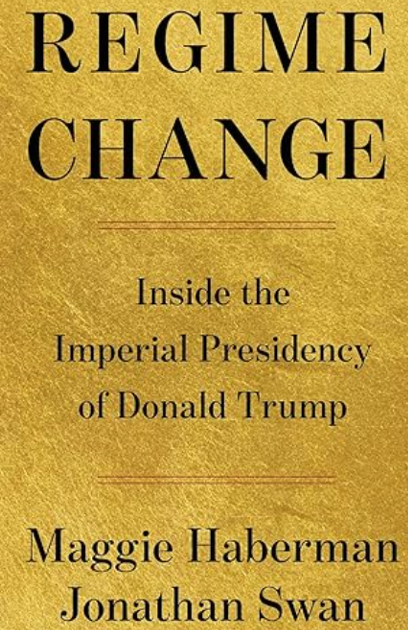
From the two reporters who have covered him more closely than perhaps anyone else over the past decade comes this definitive portrait of Donald Trump in the White House. Regime Change covers the first year of Trump’s second presidency—a term liberated from every constraint that defined his first. The generals who once told him “no” are gone, and the lawyers who remain have learned to pick their battles. His administration has flouted court orders and he has claimed powers that Congress once checked. What remains is a President willing to take enormous risks that have upended global markets and toppled heads of state; an imperial President operating almost entirely on instinct alone. Based on hundreds of interviews and unprecedented reporting from deep within the administration’s most closely guarded rooms, Regime Change takes the reader inside the Situation Room and into the secret Oval Office deliberations that have launched a new war in the Middle East and seen Trump seal the border, surge National Guard troops into cities, and send immigration agents into deadly clashes with protestors. Maggie Haberman and Jonathan Swan bring us behind the scenes of a presidency that has transformed the culture, turned the Justice Department into an agent of retribution against the President’s enemies and the office itself into a brazen vehicle for profit. They reveal a second term propelled by a historical irony that Trump himself has come to understand: that the indictments, the convictions, the assassination attempts, and four years of exile made him not weaker but far more powerful, more vengeful, and more willing to gamble than any President in modern history. This is the story of how Trump has used that power, who has tried to stop him, and why nearly all of them have failed. It is also the story of something American journalists are more accustomed to chronicling in distant capitals than in their own: a President who has fundamentally altered the nature of the office he holds—and, with it, how the rest of the world understands American power. It is an account of Regime Change right here in America—a landmark real-time history of a modern presidency like no other.
Regime Change is not a conventional political biography so much as a real-time autopsy of executive power: a tense, access-heavy, deeply reported chronicle of what happens when a president returns to office less restrained, more vengeful, and more fluent in the machinery of domination.
Who This Book Is For
This is for readers who want inside-the-room political nonfiction with narrative velocity: White House watchers, Trump-era historians, journalists, policy readers, and anyone interested in how institutions bend when the person at the center learns exactly where the old guardrails used to be.
It will especially land with readers who liked Confidence Man, Peril, Fire and Fury, or The Divider, but want something more operational than gossip and more immediate than retrospective history.
Who This Book Is Not For
It is not for readers looking for ideological comfort, campaign punditry, or a clean moral fable where every institutional failure is neatly explained. It also is not ideal for anyone fatigued by Trump books as a genre; Regime Change adds new reporting, but it still requires a high tolerance for the familiar ecosystem of chaos, loyalty tests, grievance politics, and palace intrigue.
Three Reasons to Recommend It
1. The reporting gives the book its force, not the outrage.
The strongest thing about Regime Change is that Haberman and Swan do not need to shout. The material is already loud. The book’s central argument is built through accumulation: court orders ignored or tested, lawyers choosing which battles are still survivable, foreign policy shaped by impulse and spectacle, and a Justice Department portrayed as increasingly fused with personal retaliation.
That is what separates the book from a standard anti-Trump broadside. Its power is granular. It makes the second presidency feel less like a sequel and more like an evolved system: the same protagonist, but with fewer brakes, fewer adults in the room, and a much sharper understanding of how fear, access, money, media, and bureaucracy can be made to orbit him.
2. It understands spectacle as a governing technology.
The book is at its best when it shows that spectacle is not decoration in Trump’s world. It is infrastructure. The reported scenes around Mar-a-Lago, military deliberations, donor theater, social media rhythm, image-making, and ritualized loyalty all point to a presidency where performance is not separate from power. It is how power announces itself, disciplines subordinates, and confuses the public record.
This is the book’s sharpest insight: the “imperial presidency” here is not only about legal expansion. It is about atmosphere. The presidency becomes court, stage, brand, weapon, and grievance machine at once. Haberman and Swan’s eye for detail makes that transformation legible without needing to turn every paragraph into a civics lecture.
3. It arrives before history has cooled, which gives it urgency.
Most presidential histories benefit from distance. Regime Change benefits from heat. Published into the very political weather it describes, the book has the unnerving quality of a dispatch from inside a moving vehicle whose brakes may or may not still work.
That immediacy is also why early public reaction is media-driven rather than reader-driven: formal reader reviews are still thin at launch, while coverage has focused on the book’s access, its claims about secrecy and decision-making, and its portrait of a White House shaped by loyalty, hubris, and narrowed counsel. In that sense, the book is already functioning less as a quiet shelf object and more as a political event.
One Reason to Walk Away
The same access that makes the book compelling can also make it feel claustrophobic.
If you distrust insider political reporting as a genre, Regime Change may not convert you. The book depends heavily on the reader’s willingness to accept anonymous sourcing, reconstructed scenes, and the logic of elite access journalism. Haberman and Swan are experienced reporters, but the format inevitably raises the old question: when you are this close to power, are you exposing the court, or also preserving its mystique?
That tension does not sink the book, but it is real. The palace-intrigue machinery can sometimes make structural collapse feel like a series of vivid rooms, whispered quotes, and personality conflicts. Readers looking for deeper legal theory, grassroots political analysis, or a broader economic account of authoritarian drift may find the book’s lens too West Wing-centered.
Editor’s Verdict
Regime Change is a frighteningly effective work of first-draft history. Its best pages do not merely ask whether Donald Trump changed the presidency; they ask whether the presidency, once changed, can still be meaningfully changed back.
Haberman and Swan’s central achievement is tonal discipline. They resist the lazy version of the Trump book, the one that survives on freakish anecdotes and theatrical disbelief. Instead, they build a portrait of power after consequence has failed. The Trump of this book is not simply erratic, narcissistic, or vindictive; he is a political actor who has learned from survival. Impeachment, prosecution, scandal, exile, and near-mythic comeback do not appear here as restraints. They become proof of concept.
That is what makes the book disturbing. It is not really about one man becoming more extreme. It is about an ecosystem becoming more compliant. The generals are gone. The lawyers are selective. The party is disciplined. The donors understand the transaction. The media knows the rhythm. The bureaucracy has learned fear. The old institutional immune system is not absent, but it is tired, partial, and often late.
As a reading experience, Regime Change is gripping, sour, and hard to shake. It has the pace of a thriller and the moral residue of a document dump. Its weakness is that it occasionally risks being trapped by its own access: the reader sees the rooms of power vividly, but may still want a fuller explanation of the country that allowed those rooms to operate this way.
Still, as a portrait of the second Trump presidency’s first year, it is likely to become one of the defining books of the period. Not because it explains everything, but because it captures the texture of a government learning to behave like a court around a ruler who no longer mistakes restraint for strength.
Source basis: Amazon and Simon & Schuster listings, Google Books preview, Goodreads launch data, Vanity Fair interview coverage, and Daily Beast reporting.




 千斤顶
千斤顶











 English
 简体中文
简体中文 繁體中文
繁體中文 한국 사람
한국 사람 日本語
日本語 Deutsch
 русский
 بالعربية
 TÜRKÇE
 português
 คนไทย
คนไทย french