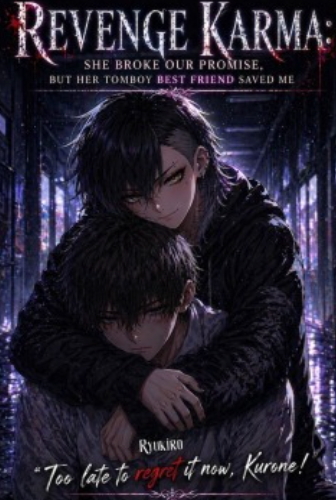
[TRIGGER WARNING: May contain NTR-Themes, NSFW Sexual Scenes, 18+] "Hey, Shin? When we grow up… you're going to marry me, right? So promise me! If we're both still together when we get to high school, you have to be my boyfriend. Promise!" A locked pinky finger under a summer sunset. For seven years, Shin held onto that childhood promise like a lifeline. He was her shadow, her protector, and her most devoted "best friend", spending every moment of his life ensuring her happiness, waiting for the day they would finally be more. But on Valentine’s Day, Kurone shattered it all. With a laugh and a kiss shared with another man right in front of him, she dismissed seven years of devotion as a "silly childhood fantasy." Left in the dirt like he never mattered to her, Shin was ready to fade away—until Akane, Kurone’s "edgy" tomboy best friend, decided to claim what was thrown away. But Akane wasn't an angel. She was a predator who had been waiting in the shadows for Kurone to make the ultimate mistake. "She wanted you as a servant, Shin. I want you as mine. Let’s show her exactly what she lost."
A psychologically charged revenge romance that begins with a broken childhood promise, then evolves into a darker examination of emotional dependency, possessive love, and the seductive fantasy of being rescued by someone who has always been watching.
Who This Book Is For
This novel is for readers who enjoy emotionally intense web fiction, betrayed-protagonist stories, assertive tomboy heroines, early romantic payoff, multiple viewpoints, and relationships that hover deliberately between healing and obsession. It will particularly appeal to readers who like their romantic catharsis mixed with jealousy, erotic tension, public humiliation, and a female lead who is protective enough to be comforting but possessive enough to be dangerous.
Who This Book Is Not For
It is unlikely to work for readers seeking understated literary realism, a genuinely impartial love triangle, restrained prose, or a slow and clinically credible recovery from trauma. Readers sensitive to suicidal ideation, sexual content, cheating and NTR-adjacent themes should also take the content warnings seriously. This is not a gentle coming-of-age romance wearing a dark jacket; it is an adult melodrama that uses emotional extremity as both its engine and its aesthetic.
Three Reasons to Recommend It
1. The revenge is more psychological than procedural
The title promises karma, but the novel’s strongest idea is that Shin’s real enemy is not simply Kurone. It is the identity he constructed around serving her.
For seven years, he has mistaken usefulness for intimacy. Kurone does not merely reject him; her rejection exposes how little selfhood he has preserved outside their childhood promise. That distinction gives the story more weight than the usual “betrayed nice guy becomes desirable” fantasy. Its most satisfying moments are not necessarily the scenes in which Kurone suffers. They are the moments in which Shin begins to understand that devotion without reciprocity is not romantic nobility. It is self-erasure.
This is also why the novel works best when it delays straightforward revenge. Several readers have noticed that the story is less interested in punishing Kurone than in showing Shin confront seven years of wasted emotional labor. That is the sharper book hiding inside the sensational title: not “How do I make her regret losing me?” but “Why did I need her approval badly enough to disappear inside it?”
2. Akane is compelling because she is both the cure and the warning label
Akane is the novel’s commercial masterstroke. She sees Shin when everyone else sees a convenient background character. She gives him attention, physical reassurance and a language for understanding his mistreatment. Her tomboy confidence and open desire reverse the original relationship’s power dynamic, making her instantly satisfying as a romantic lead.
But the story is more interesting when it refuses to call her simply healthy.
Akane has waited in the shadows for years. She understands Shin’s vulnerabilities with almost surgical precision, and her desire to “claim” him is not disguised as conventional sweetness. She rescues him, but she also gains access to him at the moment when he is least capable of distinguishing safety from surrender. Her love can feel nourishing and predatory in the same scene.
That ambiguity is the novel’s richest tension. Shin may be escaping one form of emotional ownership only to enter another, more pleasurable one. Akane offers him affection rather than neglect, but affection alone does not make possession harmless. The romance succeeds because readers can sincerely root for the couple while still wondering whether Shin is rebuilding his identity or merely transferring it to a more attentive keeper.
3. It understands the emotional appetite of serialized romance
The story knows when to provide pain, comfort, erotic heat and vindication. Its emotional contrasts are blunt but highly effective: Kurone’s ornamental concern against Akane’s fierce attention, Shin’s earlier passivity against his emerging boundaries, public degradation against private intimacy.
The prose frequently uses sensory motifs such as perfume, darkness, moths, fire and artificial light to turn teenage emotions into something almost gothic. At its best, this heightened language makes the characters’ longing feel physical. The recurring moth imagery around Akane is especially apt: she is not a bright, uncomplicated savior but a nocturnal figure whose devotion contains the possibility of self-destruction.
The frequent viewpoint changes also allow the novel to turn romantic scenes into contested psychological territory. Shin experiences comfort; Akane experiences fulfillment and fear; Kurone experiences the collapse of a social arrangement she assumed would always remain available. Even when the perspectives become repetitive, the underlying technique is sound: every character is living in a different version of the same relationship.
One Reason to Walk Away
The novel sometimes rigs its own moral trial too aggressively.
Kurone is often written less as a flawed adolescent who took another person’s devotion for granted and more as an exhibit assembled for the prosecution. Her vanity, indifference and lack of self-awareness are repeatedly emphasized until the reader has little room to discover them independently. This makes the catharsis immediate, but it can also make the revenge feel pre-approved.
The multiple-POV structure compounds the issue. Important emotional conclusions are sometimes restated from several perspectives, slowing the central protagonist’s momentum. Readers who want to remain anchored in Shin’s development may become frustrated when the narrative repeatedly pauses to explain what other characters think about events whose meaning is already clear.
The language can likewise cross from lyrical intensity into overstatement. Nearly every wound becomes catastrophic, every touch transformative and every glance diagnostic. That excess is part of the book’s appeal, but it reduces contrast. When everything is presented as emotionally seismic, genuinely pivotal moments have to compete with the surrounding volume.
Editor’s Verdict
Revenge Karma is not subtle, and pretending otherwise would undersell what it does well. It is emotionally maximalist web fiction: wounded, sensual, vindictive, sincere and engineered for compulsive reading. Its premise offers the clean satisfaction of romantic replacement, but its better chapters complicate that fantasy by asking whether being intensely wanted is the same thing as being genuinely known.
The story’s central insight is surprisingly unforgiving. Shin was not betrayed only because Kurone broke a promise. He was betrayed because both of them accepted a relationship in which his devotion was treated as an inexhaustible public utility. Kurone benefited from that arrangement, but Shin also helped preserve it by turning sacrifice into his entire personality. His growth therefore cannot end with acquiring a better girlfriend. It must involve learning that love should not require him to become someone else’s shadow.
Akane makes that lesson both possible and precarious. She is the character most willing to protect Shin, yet she is also the character most tempted to possess him. That contradiction gives the romance its electricity. The novel becomes less convincing whenever it treats her as an uncomplicated angel, because her darkness is precisely what makes her memorable.
The book would benefit from tighter viewpoint discipline, greater restraint in its metaphors, and a version of Kurone whose humanity makes her culpability more uncomfortable rather than less certain. Nevertheless, its emotional intelligence is real beneath the melodrama. It recognizes that recovery can begin for the wrong reason, that comfort may come with conditions, and that revenge is often only the first language available to someone who has not yet learned self-respect.
The result is messy but gripping: a revenge fantasy with the uneasy heart of a dependency drama. Readers may arrive to watch Kurone lose. The ones who stay will be watching to see whether Shin can finally belong to himself.




 千斤顶
千斤顶











 English
 简体中文
简体中文 繁體中文
繁體中文 한국 사람
한국 사람 日本語
日本語 Deutsch
 русский
 بالعربية
 TÜRKÇE
 português
 คนไทย
คนไทย french