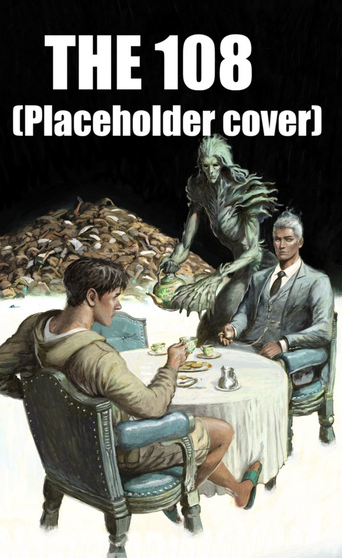
Every thousand cycles, the 108 gods select their avatars among the most deserving champions of the galaxy for a grand game to decide who will next bear the crown of archon. This time, however, even the mightiest tremble, for the twin arbiters have entered the fray. While Space and Time usually decline to participate, this time they have invested their whole resources into fearsome candidates. To represent her, Space has picked Lilth Seranne Kerentis: empress, conqueror, warrior, and scholar. She who commands untold legions, an undisputed genius of brawn and magic.
The 108 is a sharp, darkly comic time-loop progression fantasy that gives an ordinary London cellist infinite chances to defeat a galactic demigod, then asks what “cannot lose” means when every lesson must be purchased through failure, pain, and death.
Who This Book Is For
This is for readers who enjoy the strategic iteration of Mother of Learning, the escalating experimentation of The Perfect Run, and the enormous imaginative scale of science fantasy, but prefer lighter LitRPG mechanics and a protagonist who begins as an intelligent, frightened civilian rather than a concealed combat prodigy.
It should also appeal to readers who value alien cultures, gradual competence, cosmic mysteries, gallows humor, and progression based on retained knowledge rather than conveniently rising numbers. Familiarity with Mecanimus’s previous fiction is unnecessary, although readers of The Calamitous Bob, Changeling, or A Journey of Black and Red will recognize the author’s taste for capable outsiders navigating worlds whose rules are only slowly revealed.
Who This Book Is Not For
It is not ideal for readers who require polished prose from the first page, dislike first-person present tense, or want every important event dramatized in full. The opening moves at an almost breathless speed, compressing deaths, discoveries, relationships, and long stretches of time into Steve’s retrospective narration.
Readers who need death to remain permanent before it can feel consequential may also struggle with the premise. Steve possesses a protected soul and a loop that guarantees eventual progress, so the novel cannot build suspense primarily around whether he will survive. Its real stakes concern what survival costs, what he becomes willing to experience, and whether the people he meets can remain emotionally real when time repeatedly converts them into temporary versions of themselves.
Three Reasons to Recommend It
1. It understands that a time loop is not merely a power but a theory of value
The premise contains an apparent contradiction: Steve cannot permanently lose, yet he is competing against beings incomparably stronger than himself. A weaker story would treat this as a license for painless experimentation. The 108 instead makes experience itself the currency.
Steve receives “qualia” for meaningful experiences. Violence can produce points, but so can learning, connection, cultural immersion, and genuine discovery. This is a clever adjustment to familiar LitRPG economics. The system does not simply reward killing or repetitive training; it places a measurable value on consciousness encountering something new.
That has unsettling implications. If suffering produces useful experience, then pain becomes an exploitable resource. If relationships generate growth, other people can become progression opportunities. If a life will be erased by the next reset, morality becomes harder rather than easier: Steve may remember everything, but everyone else is forced to become disposable unless he actively refuses to treat them that way.
The result is a progression system with thematic relevance. Its mechanics are not decorative numbers pasted onto a fantasy adventure. They ask the central question of the book: does an experience retain its meaning when only one person is allowed to remember it?
The loop also creates an elegant asymmetry between Steve and his eventual rival. Space chooses an empress who already possesses armies, scholarship, magic, and conquest. Time chooses a musician with almost nothing except unlimited duration. Lilth begins as the superior being; Steve begins as accumulated possibility. The competition is therefore not simply strength against strength. It is completed power against endless revision.
2. Steve is ordinary in a way that serves the story
“Average protagonist” is often marketing shorthand for a hero whose extraordinary talents appear five chapters later. Steve is different. He is physically capable by ordinary human standards, observant, sarcastic, musically trained, and able to think under pressure, but none of those qualities make him remotely competitive in his new environment.
His greatest initial advantage is temperament. He asks questions. He notices social structures. He accepts humiliation when pride would get him killed. He searches for teachers, languages, allies, and practical information rather than assuming that the universe has summoned him because he is secretly its most important person.
His background as a cellist is more than a quirky biographical detail. A serious musician already understands repetition, incremental improvement, muscle memory, correction, and the strange discipline of performing the same material until it becomes instinctive. The time loop turns that artistic discipline into a survival method. Steve is not chosen because he is the strongest candidate. He is chosen because his existing life has quietly taught him how to become something through repetition.
His humor is equally important. He reacts to cosmic horror with profanity, British understatement, complaints about interfaces, and an almost ceremonial attachment to coffee and tea. This makes him accessible without making him oblivious. The jokes do not erase the horror; they are his temporary means of containing it.
Some readers have found him plain or overly reactive, and that criticism is understandable in the earliest chapters. His voice arrives before his deeper motivations do. Yet this apparent blankness may be structurally useful. The story begins with a man defined less by destiny than by habits and decency, leaving enormous space for the loop to write upon him. The meaningful question is not whether Steve has an impressive personality on his first death. It is whether he can preserve an ordinary human center after the hundredth.
3. The setting feels larger than the game system
The most promising element of The 108 may be its space-fantasy world. Its societies are not presented as futuristic Earth with differently colored citizens. Languages must be learned. Bodies are modified. Magic, technology, soul development, social class, military power, corporate influence, and theology overlap without becoming easily interchangeable.
The setting is full of systems Steve does not understand and people who do not care that he is the protagonist. Being Time’s champion grants him cosmic importance in theory, but in daily life he is an unawakened foreigner with no money, status, identification, or credibility. This gap between metaphysical privilege and social power is fertile ground. He may be cosmically unstoppable and still unable to persuade an official to listen to him.
The patron gods are particularly effective. Chronos does not behave like a tutorial window wearing a divine costume. His patience can read as compassion, manipulation, or simply the detachment of a being for whom urgency has lost its meaning. His gestures carry significance precisely because they are unnecessary. That makes his apparent kindness difficult to trust.
The broader contest of 108 divine champions also supplies a scale the opening arc has only begun to explore. Each patron may define power differently, and each avatar could embody a different answer to the relationship between mortal agency and divine selection. If the story fully develops that premise, the title will become more than a number of future opponents. It will describe 108 competing philosophies of what makes a life worthy of authority.
One Reason to Walk Away
The early prose is the book’s most substantial weakness.
Steve’s narration can feel like a rapid internal monologue that refuses to pause. Events are sometimes summarized precisely when they would benefit from being experienced as scenes. Weeks or months may pass through a handful of transitions, while exposition, jokes, observations, and system analysis compete for space in the same paragraph.
The first-person present tense magnifies this problem. Present tense normally creates immediacy, but abrupt temporal compression can make the narration feel dislocated: the reader is supposedly living alongside Steve while simultaneously being hurried through his memories. Several readers have also identified tense slips, awkward constructions, typographical errors, and inconsistent names. These are not fatal defects, but they are noticeable enough that the current serial would benefit from a firm editorial pass.
There is also a related dramatic risk. Because Steve’s loop and soul are unusually secure, physical death can quickly become administrative. The novel must therefore keep finding consequences that cannot be erased by resetting: moral compromise, loneliness, distorted attachment, lost trust, and changes within Steve himself. If it relies too heavily on bodily suffering, the horror will depreciate with repetition.
Editor’s Verdict
The 108 has the architecture of an exceptional time-loop serial and the finish of an ambitious early draft.
Its hook is excellent, but the deeper attraction is not the joke that Time selected Steve, a 25-year-old cellist, to oppose Space’s seemingly perfect empress. It is the philosophical imbalance beneath that joke. She has everything except infinity. He has infinity except everything else.
That distinction gives the story a genuine identity within an overcrowded genre. Most progression fantasies promise that effort will eventually produce supremacy. The 108 asks what endless effort does to the person making it. A loop is the ultimate meritocratic fantasy because failure never closes the door. It is also a nightmare of invisible labor because nobody else sees the failed attempts that make success possible.
Steve’s victories will eventually appear miraculous to people living through a timeline only once. They will not see the abandoned versions in which he misunderstood a language, trusted the wrong person, arrived too late, or died before learning anything useful. His competence will be built from suffering that history does not record. That makes him potentially heroic, but it also separates him from everyone he saves.
This is where the novel can become much more than a clever progression vehicle. The most serious danger to Steve is not an enemy capable of killing him. It is instrumentalization. Chronos has already turned his life into a divine investment. The system converts experience into spendable value. The loop encourages him to view people, catastrophes, and even his own body as variables in an experiment. Every mechanism around him insists that existence is material for optimization.
His resistance to that logic may become the true measure of his character.
The novel is also wise to make Steve’s immortality imperfectly comforting. A protected soul prevents one familiar form of psychological collapse, but it does not automatically answer grief. He can form relationships with people who will vanish at reset while he retains an intimacy they never experienced. He can know someone for years and meet a version of them who considers him a stranger. In such a world, memory is both his greatest weapon and the condition of his isolation.
At this early stage, The 108 has not yet earned every implication of its enormous setup. The divine tournament remains distant, its central rival is still more concept than character, and several supporting figures function primarily as guides into the setting. The prose needs room to breathe, the timeline needs clearer handling, and Steve’s interior life must eventually grow beyond panic, jokes, planning, and endurance.
Still, the foundations are unusually strong. The alien world is imaginative, the mechanics reward curiosity rather than slaughter alone, and the central contrast between Space’s perfected champion and Time’s indefinitely revisable amateur is powerful enough to sustain a long serial.
The 108 is therefore easy to recommend with one qualification: readers are currently buying potential as much as payoff. What exists is energetic, intelligent, funny, occasionally rough, and already capable of raising questions that most time-loop stories postpone indefinitely.
Steve cannot lose. That does not mean he cannot be ruined. The distance between those two facts is where this novel may find its greatness.




 千斤顶
千斤顶










 English
 简体中文
简体中文 繁體中文
繁體中文 한국 사람
한국 사람 日本語
日本語 Deutsch
 русский
 بالعربية
 TÜRKÇE
 português
 คนไทย
คนไทย french