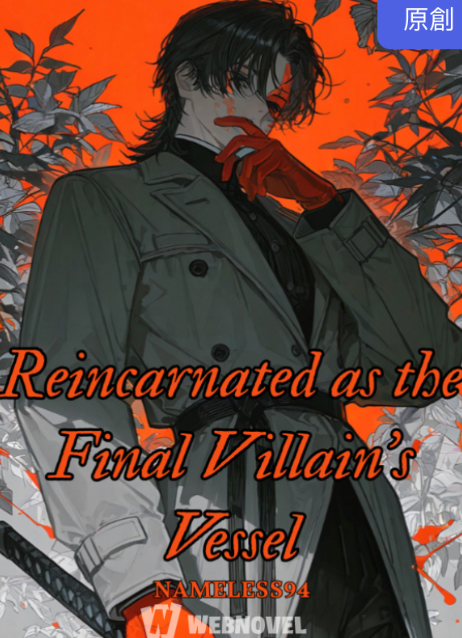
Some are reincarnated as the shining, pure character known as the hero of the story. Others find themselves as secondary, unknown characters, carrying no weight in the flow of events. And then there are those who are reborn as villains… villains meant to be struck down, forming the very foundation of the hero’s growth. As for me? I was neither a hero, nor an ordinary villain. I was merely a cursed soul, reborn as an experiment within an organization that worships an unknown entity. Am I just a third-rate villain? … I wished it were so. Because the truth is far worse. I am the character who appeared in the very first scene of the game, even before the hero made his entrance. I am… the Vessel.
Reincarnated as the Final Villain’s Vessel is a dark, fast-moving reincarnation fantasy that takes the overused “I became the villain” premise and gives it a sharper hook: the protagonist is not the final boss, not the hero’s rival, but the disposable experimental body meant to make the story’s real nightmare possible.
Who This Book Is For
This is for readers who like villain-reincarnation stories but are tired of protagonists waking up as rich dukes, arrogant young masters, or conveniently powerful final bosses. The appeal here is harsher. Caius is reborn not into privilege, but into captivity. He is a numbered subject, a lab-built weapon, a cursed soul trapped inside an organization that worships something unknown and treats children like materials.
It is especially suited to readers who enjoy system fantasy with survival pressure, secret organizations, antihero protagonists, academy arcs, supernatural powers, and a game-world setup that immediately feels less like escapism and more like a rigged execution. If you like stories where the main character has future knowledge but begins with almost no freedom, this has a strong hook.
Readers who enjoy the darker side of Webnovel fantasy—experiments, chips, essence control, hidden identities, villain roles, game lore, hunted protagonists, and a hero narrative being sabotaged from offstage—will likely find the early setup addictive. The novel understands that reincarnation is most interesting when it is not a gift. Here, memory returns not as a cheat code, but as a cruelly late warning.
Who This Book Is Not For
This is not for readers who want elegant literary fantasy, slow atmospheric prose, or a morally gentle protagonist. The story is built in the language of web serial momentum: high-concept premise, immediate danger, power-system vocabulary, organization conspiracies, and a protagonist who has to make violent decisions quickly because the world has already decided he is expendable.
It is also not for readers who dislike system mechanics, game-world framing, academy progression, or antihero survival logic. The novel does not seem interested in making Caius conventionally pure. He is not reincarnated to save the world out of noble instinct. He is trying to survive a role designed to erase him.
And if you are exhausted by “villain reincarnation” as a trend, this may still feel familiar in broad outline. It has the usual components: prior-life game knowledge, a doomed role, powerful factions, hidden lore, a protagonist trying to avoid scripted death. What makes it stand out is the “vessel” angle, not the fact that it belongs to a crowded subgenre.
Three Reasons to Recommend It
First, the premise has a nastier and more interesting twist than the standard villain transmigration setup.
Most villain-reincarnation stories flatter the reader. The protagonist becomes the handsome noble antagonist, the secret final boss, the genius villain, or the character who already has power but lacks future knowledge. Reincarnated as the Final Villain’s Vessel does something more unsettling. It makes the protagonist an experiment.
That changes the entire emotional temperature of the story. Caius is not trying to protect a mansion, fix a reputation, or seduce heroines away from the hero. He begins as a body owned by other people. He has no name in practice, only a number. He has never seen the sun. His power is restricted by a chip. His very existence is tied to an organization whose goals are bigger and darker than he understands.
This is a much better use of reincarnation than mere wish fulfillment. The protagonist’s knowledge of the game does not make him safe. It makes him aware of just how badly the script is stacked against him. That awareness gives the opening real tension. Memory is not a blessing here. It is an alarm going off inside a locked room.
Second, the “Vessel” concept gives the antihero arc a strong metaphysical spine.
The title is doing real work. “Vessel” is a frightening word because it suggests a body without full ownership, a container waiting to be used. Caius is not simply a villain. He is a function. He is meant to carry something, awaken something, enable something, or be consumed by something. That is much more disturbing than being “destined to lose to the hero.”
The best part of the premise is that it reframes villainy as exploitation. The story is not asking whether Caius was born evil. It is asking whether a person manufactured as a tool can become a person at all. That is a stronger emotional question than “Can the villain avoid his bad ending?”
It also makes the system elements feel less decorative. Essence, chips, experiments, powers, and organizations are not just mechanics. They are forms of control. Power in this novel is not clean empowerment; it is something administered, blocked, stolen, awakened, and weaponized. That gives the progression fantasy a darker texture. Becoming stronger is not only about climbing ranks. It is about reclaiming bodily autonomy.
Third, the story has a strong serial hook: escape the laboratory, then escape the plot.
The early chapters appear to understand pacing. The protagonist wakes into captivity, realizes the horror of his role, acts quickly, and begins tearing open the first layer of the trap. That is good web-serial architecture. It gives the reader immediate stakes while leaving larger mysteries intact.
But the more interesting structure is bigger than the physical escape. Caius is not only fleeing an organization. He is fleeing narrative design. He knows he belongs to a game-world story where heroes, villains, and factions already have scripted significance. His challenge is not just “survive the enemy.” It is “survive being a plot device.”
That is why the book’s academy and antihero tags have potential. If handled well, the academy setting can become more than a genre checkpoint. It can become the place where Caius must perform normalcy while hiding that he is the world’s most dangerous loose end. That kind of tension is exactly what villain-reincarnation fiction does best: letting the protagonist walk through a social world that does not realize it is standing next to a bomb.
One Reason to Hesitate
The novel’s hook is stronger than its originality in the wider market, so execution matters enormously.
Reincarnated as the Final Villain’s Vessel has a genuinely compelling setup, but it still lives inside a heavily populated genre space. Webnovel is full of reincarnated villains, doomed characters, system users, antiheroes, academy arcs, hidden organizations, and game-world fate manipulation. The “Vessel” premise gives this book a sharper identity, but it does not automatically free it from familiar rhythms.
The danger is that the story could eventually become another accumulation machine: more powers, more factions, more heroines, more academy conflicts, more secret bloodlines, more system terminology. If Caius’s identity crisis gets buried under escalation, the novel will lose what makes it interesting.
The book’s future depends on whether it remembers the horror of its opening. The protagonist was not born as a cool villain. He was born as a container. That wound should keep mattering.
Editor’s Review
Reincarnated as the Final Villain’s Vessel is the kind of Webnovel premise that looks familiar until you notice the specific cruelty at its center. Yes, it is another reincarnation fantasy. Yes, it uses a game-world structure. Yes, the protagonist knows more than the people around him. Yes, there is a system, magic, academy potential, hidden organizations, and an antiheroic survival track.
But the book’s best idea is not that Caius becomes a villain. It is that he becomes infrastructure for villainy.
That distinction matters. A villain is still a character. A vessel is a container. A villain can be hated, feared, defeated, redeemed, or understood. A vessel is used. Caius begins the story in the most dehumanized possible position: nameless, numbered, confined, experimented on, and controlled through technology that governs his access to power. His body is not his own. His future is not his own. Even his role in the game-world narrative seems to belong to something else.
That is a much stronger foundation than the usual “I know the plot, so I will become overpowered” setup. Caius’s knowledge is useful, but it is also bitter. He does not wake up early enough to avoid the damage. He wakes up inside it. That small timing choice gives the story its edge. The tragedy has already begun before the protagonist can act.
The public early chapters suggest a novel that knows how to dramatize control physically. The chip limiting essence use is a clean, effective symbol. It turns the power system into a prison system. The protagonist’s first steps are not glamorous training or noble-house scheming; they are bodily sabotage, escape logic, and the desperate need to remove the mechanisms others placed inside him. That is strong genre writing because it externalizes the theme. Freedom is not abstract. Freedom is whether your own energy can move when you command it.
Caius himself is positioned well for an antihero arc. He is not softened into immediate moral purity, but he is not empty edgelord material either. The premise naturally gives him anger, distrust, urgency, and a reason to resist both the organization and the hero’s original plot. He is someone who has every reason to treat the world as hostile. The challenge for the author will be making him more than reactive. Survival is compelling at first, but long-form serials need transformation. Caius must eventually decide not only what he is running from, but what he is willing to become.
The “final villain’s vessel” concept also has excellent long-term potential because it can sustain several layers of tension. On the surface, there is physical survival. Beneath that, there is identity: is Caius himself, or a host for something else? Beneath that, there is narrative rebellion: can someone written as an opening-scene sacrifice seize authorship of the story? And beneath even that, there is a darker metaphysical question: if the world itself behaves like a game, is free will just another system prompt?
That is where the book could become genuinely memorable. Its strongest possible version is not merely a power fantasy. It is a story about a disposable body trying to become a self.
Still, the book must be careful. The more it leans into common academy-fantasy structures, the more it risks diluting the horror that made the opening powerful. Academy arcs are useful because they provide rivals, rankings, classes, factions, and social performance. But they can also domesticate a darker premise. If Caius becomes just another secret genius navigating school politics, the story will feel smaller than its title promises.
The same applies to romance and comedy tags. They can add texture and relief, but they need to be handled without trivializing the protagonist’s origin. A little tonal flexibility can make a serial more readable. Too much can make the laboratory trauma feel like a prologue costume the story outgrew.
Sharp verdict: Reincarnated as the Final Villain’s Vessel is not revolutionary, but it has a better hook than most villain-reincarnation serials because it understands the difference between being doomed and being used. Caius is compelling not because he is destined to become powerful, but because the world has already reduced him to a function and he refuses to stay one.
For readers who want polished literary fantasy, this will likely feel too serial, too trope-heavy, and too system-driven. For readers who enjoy dark reincarnation, antihero progression, academy intrigue, experimental-body horror, and protagonists trying to break out of both prison and plot, this is a strong ongoing Webnovel to watch.
The real test will be whether the story keeps asking its best question: not “How strong can the vessel become?” but “At what point does a vessel stop being a container and become a person dangerous enough to rewrite the script?”




 千斤顶
千斤顶










 English
 简体中文
简体中文 繁體中文
繁體中文 한국 사람
한국 사람 日本語
日本語 Deutsch
 русский
 بالعربية
 TÜRKÇE
 português
 คนไทย
คนไทย french