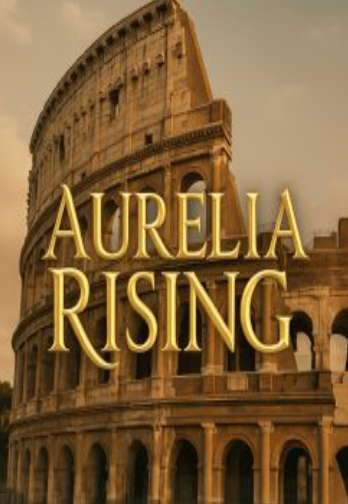
Aurelia fervently dreamed of more. Always being marked as "other" because of her more-than-human nature, she has grown up as an orphan in the fertility obsessed Temple of Ceres. Just days away from her day of majority, her heart longs for adventure. Thankfully, in this ancient world similar to our own, magic flows in every living being! From the deep forests of Gallia, to the highest peaks of the alps, to the underground cavern reals and to the bottomless depths of the Mediterranean, the world is full of both danger and opportunity. Fantastical races accompany humans in this world, Elves, Dwarves, Goblins, and more challenge humanity for dominance. Gods and deities are more than just ways to personify the unknown, they are real forces which affect entire nations! Follow Aurelia as she becomes a Roman adventurer in a time filled with some of history's foundational moments. Will she discover more about her non-human nature? How will she cope with the coming conflicts? Iron sharpens iron, but what's in her pants is as hard as steel, and She's got a lot of "love" to give! Raise your shield and hold on to your loved ones everybody, because tides are rising, and getting wet is only fun sometimes.
Aurelia Rising is a messy but unusually ambitious erotic Roman fantasy LitRPG that reimagines the early Republic as a magic-soaked world of gods, monsters, adventurers, class politics, and one towering non-human heroine trying to turn otherness into appetite, power, and identity.
Who This Book Is For
This is for readers who want historical fantasy with absolutely no interest in staying respectable. If the phrase “ancient Rome, but with real gods, adventurer logic, LitRPG stats, demi-humans, harem romance, and explicit erotic chaos” sounds like a selling point rather than a warning, Aurelia Rising is very much speaking your language.
It is especially suited to readers who enjoy fantasy Rome but are tired of the same sanitized legionary power fantasies. This story is not only interested in soldiers, senators, and conquest. It is interested in temples, social class, fertility culture, citizenship, adventuring, the body, and what happens when a visibly non-human woman tries to claim space in a society obsessed with hierarchy and reproduction.
Readers who like female protagonists with oversized presence, harem-seeking energy, mythological worldbuilding, alternate-history settings, slice-of-life adventuring, and adult content woven directly into the premise will probably find this novel strange, crude, indulgent, and more memorable than expected.
Who This Book Is Not For
This is not for readers who want historically faithful Rome, restrained prose, subtle eroticism, or a clean separation between plot and kink. Aurelia Rising is very open about being an erotic story, and its premise is built around sexuality as both comedy and worldbuilding. The heroine’s body is not a background detail. It is part of the book’s spectacle, social tension, and genre identity.
It is also not for readers who dislike futanari content, harem structures, exaggerated physical description, pregnancy/fertility themes, gore, strong language, or fantasy races filtered through adult web-serial sensibilities. The story is not coy about its tags, and readers should take them seriously.
Finally, this may not work for readers who need polished professional pacing from page one. The author openly frames this as a first serious writing project. That honesty is refreshing, but it also means the novel should be approached as a developing serial with raw ambition rather than a surgically edited historical epic.
Three Reasons to Recommend It
First, the Roman setting gives the smut-fantasy machinery a more interesting skeleton than usual.
Aurelia Rising could have been another generic tavern-and-adventurer fantasy with Roman names sprinkled on top. What makes it more interesting is that the author actually seems invested in the social architecture of the setting. The glossary pays attention to Rome, coinage, patricians, equites, citizens, freemen, family status, public works, and the way magic might allow an ancient city to grow beyond its real technological limits.
That matters. Adult fantasy often uses setting as wallpaper for desire. Aurelia Rising is still absolutely indulgent, but it gives that indulgence a world with institutions. Aurelia is not simply a hot non-human adventurer wandering a theme park. She is emerging from a temple of Ceres, into a society structured by class, citizenship, family expectation, gendered roles, religious authority, and imperial momentum before Rome has even become the Rome of popular imagination.
The result is not academically rigorous history, and it should not be mistaken for that. But as a fantasy remix, it has a hook with bite: Rome’s hunger for expansion meets a world where gods are real, bodies are magical, and the category of “human” is politically unstable.
Second, Aurelia herself is a better concept than the story’s horniest marketing might suggest.
On the surface, Aurelia is pure adult fantasy excess: seven feet tall, winged, golden-haired, impossibly voluptuous, physically overdesigned, and sexually framed from the start. It would be easy to dismiss her as a walking tag cloud.
But the stronger reading is that the exaggeration is doing double duty. Aurelia’s body makes her desirable, but it also makes her impossible to assimilate. She has grown up marked as “other” in a fertility-obsessed temple, visibly non-human in a culture that sorts people obsessively by family, class, citizenship, and function. Her erotic excess is also social alienation. She is not just “special”; she is difficult for the world to categorize.
That gives the novel a more interesting emotional engine than simple wish fulfillment. Aurelia wants adventure, pleasure, knowledge, companionship, and self-definition. She also wants to understand what she is. That question—what am I, and what can I become?—is the real progression line beneath the stats, sex, and Roman fantasy dressing.
Third, the book’s LitRPG elements are wisely presented as loose reference rather than spreadsheet religion.
The author explicitly states that there are stats and skills, but that they should be treated more as a loose reference than an exact science. That is a good choice for this story. A hyper-crunchy system would probably suffocate the atmosphere. Aurelia Rising is more interested in mythic texture, erotic comedy, adventuring, and alternate-history worldbuilding than in turning every chapter into a math problem.
This looser LitRPG approach allows the system to support the fantasy rather than dominate it. It gives readers the pleasure of measurable growth without reducing Aurelia’s journey to accounting. In a story about bodies, gods, Rome, monsters, and desire, that matters. The system should not feel more real than the temple, the road, the city, or the body.
The best version of the book is not “Rome with stat boxes.” It is “Rome as a magical organism where social class, divine power, race, sex, and skill all operate as systems.” That is a much more interesting premise.
One Reason to Hesitate
The novel’s ambition and its indulgence are not always pulling in the same direction.
Aurelia Rising wants to be a historical fantasy, a LitRPG, an erotic harem serial, a slice-of-life adventure, a mythology remix, and a story about a non-human woman discovering herself in a changing ancient world. That is a lot of machinery for one ongoing serial, especially from a first-time serious author.
When the balance works, the book feels exuberant and distinctive. When it does not, the erotic spectacle can overwhelm the historical and emotional material. There is a real risk that Rome, gods, politics, and identity become decorations around the heroine’s body rather than forces pressing meaningfully against her. The sharper question for the serial’s future is whether Aurelia’s sexuality will remain part of her complexity—or flatten into the only thing the story knows how to say about her.
Editor’s Review
Aurelia Rising is not a subtle novel. It is also not a lazy premise. That contradiction is exactly what makes it worth talking about.
At first glance, it looks like pure Scribble Hub adult fantasy maximalism: futanari heroine, harem-seeking protagonist, R-18 content, fantasy races, LitRPG stats, gods, monsters, and enough fertility imagery to make the Temple of Ceres feel less like a religious institution than a metaphysical pressure cooker. A reader could glance at the tags and decide the whole thing is just erotic excess in Roman cosplay.
That reading would not be entirely wrong. It would also be incomplete.
What gives Aurelia Rising its potential is the way its excess collides with Roman order. Rome, even in fantasy form, is a civilization obsessed with categories: citizen and non-citizen, patrician and equestrian, family and outsider, public honor and private appetite, piety and power. Aurelia is a problem for that world because she is too much. Too tall, too strange, too visibly non-human, too sexually charged, too difficult to file neatly into the civic imagination.
That is where the novel’s most interesting theme lives. Otherness here is not quiet metaphor. It is embodied, exaggerated, eroticized, and made socially inconvenient. Aurelia’s body is a spectacle, but it is also a political fact. People will desire it, fear it, categorize it, exploit it, mythologize it, and misunderstand it. The question is whether Aurelia can turn spectacle into agency.
The Roman historical angle gives the book a surprisingly sturdy foundation. Setting the exposition around 280 BC is a clever choice because Rome is not yet the empire of marble clichés. It is still becoming. That gives the story room to mirror Aurelia’s own emergence: city and heroine both rising, both unfinished, both hungry, both moving toward conflicts larger than themselves. The author’s note that world events will loosely follow real history, modified for a magical world, is promising because it suggests the story is not just using Rome as aesthetic garnish. It wants the pressure of history, even if it intends to gleefully corrupt it.
The glossary reinforces that impression. The attention to class strata, coinage, family status, and magical infrastructure shows a writer thinking beyond erotic scenes alone. The world may be horny, but it is not empty.
Still, the book’s weakness is obvious: restraint is not its natural language. Aurelia is described in such maximalist terms that some readers will find her less like a character and more like a monument to appetite. The erotic elements are not incidental; they are welded to the premise. That means the novel’s success depends on whether it can keep giving Aurelia interiority equal to her exterior spectacle. If her desires, fears, curiosity, loneliness, and ambition continue to matter, the story could become a genuinely distinctive adult fantasy epic. If not, she risks becoming a body that walks through lore.
The harem element creates a similar tension. The glossary already frames companions such as Livia, Thessa, and Junia with social and emotional hooks: childhood friendship, trauma, class expectation, adventuring ambition. That is encouraging. A harem story lives or dies by whether its partners feel like people or acquisitions. The raw ingredients are there for something richer than collection fantasy. The execution will determine whether those characters remain companions or become trophies orbiting Aurelia’s gravitational field.
Sharp verdict: Aurelia Rising is chaotic, horny, overbuilt, and clearly still finding its editorial discipline—but it has a stronger conceptual engine than its tags might imply. It is not just “Roman smut LitRPG.” It is a fantasy about a body too strange for the world that raised it, entering a civilization built on hierarchy, appetite, violence, and divine legitimacy.
For readers who want clean historical fiction, run. For readers who want explicit fantasy without ambition, there are simpler options. But for readers willing to tolerate mess in exchange for a wild fusion of ancient Rome, mythic biology, class politics, adventuring, gods, and unapologetic erotic excess, Aurelia Rising is a strange little rising tide worth watching.




 千斤顶
千斤顶









 English
 简体中文
简体中文 繁體中文
繁體中文 한국 사람
한국 사람 日本語
日本語 Deutsch
 русский
 بالعربية
 TÜRKÇE
 português
 คนไทย
คนไทย french