Story Settings: Female Protagonist / Native Protagonist / Talented Protagonist / Conception Start / Quick Start / Start From The Bottom / Low Drama / LitRPG Progression-Focused / LitRPG Reality / LitRPG Society / Complex Universe LitRPG System: Entirely Aspect-Based / Naturally Awakened From Conception / Mathematical / Decision-Making-Heavy / Permanent Decisions / No Kill Experience / No Stats / No Levels Writing Style: First Person / Archnemesis of long and eye-roll-inducing paragraphs / 90% story progression / Clean and readable LitRPG formatting / Extremely light on protracted [Page Down]-inducing descriptions. Pace: More like frantically expeditive than agonizingly slow-burn / No maintaining tension, adding soulless or feels-bad drama, including purposeless long-winded character development, or playing with inane philosophical debates.
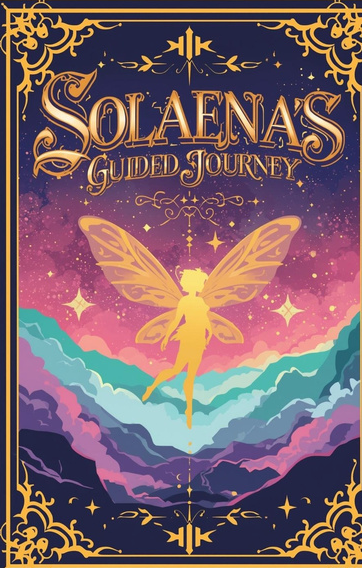
Solaena’s [Guided] Journey is a quietly ferocious fantasy LitRPG about a fairy protagonist born at the bottom of a complex world, where progression is not handed out through levels or kill counts but carved into the body through perception, pain, study, and will.
Who This Book Is For
This is for readers tired of LitRPGs where the system is just a prettier spreadsheet. If you want no levels, no stats, no kill experience, no endless blue boxes, and no protagonist who becomes powerful because the universe keeps awarding them participation trophies, Solaena’s [Guided] Journey feels like a deliberate corrective.
It is especially for readers who enjoy alien or non-human protagonists whose perspective actually matters. Solaena is not a human with wings pasted onto her back. The appeal of the story is watching a very small, very strange being assemble personhood from instinct, deprivation, observation, and guidance. This is not only a power-growth story. It is a consciousness-growth story.
Readers who like progression fantasy with research, experimentation, earned ability acquisition, harsh childhood conditions, survival logic, mentor figures, academic systems, and gradual worldbuilding will likely find this absorbing. The book’s best audience is the kind of reader who does not need a fight every chapter as long as every chapter moves the protagonist’s understanding forward.
Who This Book Is Not For
This is not for readers who want classic popcorn LitRPG: monster grinding, numeric dopamine, easy loot, clean party banter, tournament arcs every few chapters, and a protagonist whose build can be understood at a glance. Solaena’s [Guided] Journey is progression fantasy, but it is not built around instant readability of power. Its Aspect system is more interpretive, more abstract, and more dependent on inference.
It is also not for readers who need warmth immediately. Solaena’s viewpoint can feel cold, odd, and emotionally distant, especially early on. That seems intentional, given her circumstances and non-human nature, but intention does not automatically make the experience comfortable. If you need a highly social protagonist with instant friendships, romance hooks, and conventional emotional reactions, Solaena may feel too isolated, too driven, or too strange to easily love.
And finally, this may not satisfy readers who dislike training, study, research, and internal problem-solving. Some of the most important progression here comes not from battle, but from routines, experiments, libraries, pain tolerance, decisions, and the careful weighing of future paths. For the right reader, that is the selling point. For the wrong one, it will feel like homework with wings.
Three Reasons to Recommend It
First, the progression feels genuinely earned.
The strongest praise for Solaena’s [Guided] Journey is also the most important: its power progression has weight. Solaena does not gain strength because she killed enough low-level wolves or because a hidden class fell into her lap. She grows by paying attention, enduring hardship, making decisions, and physically forcing herself into new states of perception and capability.
That distinction gives the novel a rare seriousness within the LitRPG space. The system does not feel like a slot machine. It feels like a metaphysical language that Solaena must learn by bruising herself against reality. Every Aspect matters because it is connected to experience. The body, the mind, and the system are not separate tracks. They grind against each other.
This is where the book becomes more than another “weak-to-strong” fantasy. A lot of progression fiction claims its protagonist works hard. This one actually dramatizes the process of work: the repetition, the research, the pain, the uncertainty, the planning, and the fact that permanent decisions are terrifying precisely because they cannot be casually respecced later.
The result is a form of growth that feels less like leveling and more like becoming.
Second, the non-human female lead gives the story its real identity.
Solaena’s identity as a fairy is not cosmetic. The story is most compelling when it lets her smallness, isolation, sensory experience, and social unfamiliarity shape the entire reading experience. She begins not as a chosen hero or a reincarnated genre expert, but as a being trying to survive long enough to understand what she is.
That beginning matters. It removes a lot of the usual genre shortcuts. There is no modern human narrator conveniently explaining the world through gamer slang. There is no isekai tourist comparing every new thing to Earth. Solaena is local to the world, but not comfortable in it. She belongs and does not belong at the same time.
That tension gives the novel its freshness. A native protagonist makes the world feel less like a theme park for an imported hero and more like a living structure with its own logic. Solaena is not discovering a fantasy world for our entertainment. She is being formed by it.
The effect can be chilly, even strange, but that is the point. Her alienness is the book’s atmosphere. Her drive is not charming in a conventional way; it is almost frightening. She is not adorable because she is small. She is formidable because the world is large and she refuses to remain merely fragile inside it.
Third, the Aspect system is one of the more interesting anti-stat systems in current web serial LitRPG.
The system described by the author is almost a manifesto against overstuffed LitRPG formatting: no stats, no levels, no kill experience, no standard RPG treadmill. Instead, the novel builds around Aspects, Essence, Origins, Paths, and decisions that appear to have lasting consequences.
That gives the story a more magical and philosophical texture than the average system novel. The mechanics still matter, but they are not reduced to arithmetic. Power is interpretive. Names matter. Concepts matter. Training matters. The reader is asked to think alongside Solaena rather than simply watch numbers inflate.
This is not merely a stylistic preference. It changes the moral shape of the story. If there is no kill experience, violence is no longer the default road to growth. If there are no simple levels, achievement cannot be flattened into a scoreboard. If decisions are permanent, then character-building becomes actual character building, not just build optimization.
That is the book’s most exciting design choice. It treats LitRPG not as a game interface pasted over fantasy, but as a way of organizing reality.
One Reason to Hesitate
The same originality that makes the book stand out may make it feel opaque.
Solaena’s [Guided] Journey trusts the reader to infer a lot: how the world works, what different races are, how certain terms function, what the social structures imply, and why particular Aspects matter. That can be thrilling, because the world feels lived-in rather than dumped into exposition blocks. But it can also create friction. Some readers may want a glossary. Some may want clearer physical descriptions of custom races. Some may want the mechanics spelled out with more traditional LitRPG bluntness.
There is also an occasional stiffness to the prose. The cold, analytical quality of Solaena’s perspective can be compelling, but it sometimes risks feeling robotic rather than merely alien. Add in the page’s AI-assisted-content warning and the scattered reader notes about occasional odd wording or minor errors, and the book may not feel as polished as its best ideas deserve.
Editor’s Review
Solaena’s [Guided] Journey is the kind of Royal Road serial that reminds you how much unexplored territory still exists inside LitRPG when authors stop treating “system” as synonymous with “video game menu.” Its best idea is simple but powerful: remove the usual mechanical shortcuts, then ask what progression looks like when power has to be discovered, interpreted, endured, and chosen.
The answer is stranger and more interesting than the genre norm.
This is a story about a fairy becoming powerful, yes. But more fundamentally, it is a story about a fairy becoming legible to herself. Solaena begins from a place of extreme vulnerability, and the novel understands that vulnerability is not just a starting debuff. It is a whole worldview. A small being in a large, predatory, conceptually complex world cannot afford the luxury of normal childhood, normal socialization, or normal curiosity. She must turn every sensation into data, every pain into instruction, every environment into a possible tool.
That is why the first-person perspective works. It is not there merely to create intimacy. It creates confinement. We are trapped inside Solaena’s narrow, hungry, disciplined field of attention. The world is vast, but we only receive what she can perceive, survive, and understand. The result is a fantasy world that feels glimpsed rather than explained, which is both the book’s sophistication and its barrier to entry.
The Aspect system is the novel’s crown jewel. It has the best quality a magic system can have: it feels like it belongs to the world’s metaphysics rather than to the author’s spreadsheet. It is conceptual but not empty, structured but not mechanical in the dull sense. The fact that progression comes through study, suffering, insight, and permanent decisions gives the story tension without relying on cheap melodrama.
And the book is notably uninterested in the lazier forms of drama. The author’s own framing emphasizes low drama, fast movement, minimal bloated description, and little patience for philosophical wheel-spinning. That is mostly true. The story does not dawdle in the usual ways. It pushes forward through development, training, discovery, and adaptation. But that does not mean it is emotionally shallow. Its emotion simply arrives in a colder register.
Solaena herself is the decisive element. She is not a cuddly fairy heroine. She is not a quippy isekai tourist. She is not a softhearted mascot who happens to gain powers. She is intense, isolated, survival-shaped, and, at times, almost unnervingly instrumental in how she approaches herself. That makes her fascinating. It may not always make her lovable.
The supporting cast, by contrast, still feels secondary in the current material. Mentor figures appear to have more weight than peers, which makes sense for Solaena’s personality and trajectory, but it also means the story risks becoming too vertically structured: Solaena learns from systems, institutions, and elders, while horizontal relationships remain thinner. If the novel wants to deepen from excellent progression study into truly resonant character drama, it will eventually need people around Solaena who are more than tests, tools, guides, or temporary reference points.
The AI-assisted-content warning is also worth addressing plainly. It will be a dealbreaker for some readers on principle. For others, the practical question will be whether the prose feels hollow or generic. Based on the available reception, the answer seems mixed but generally favorable: readers note occasional awkwardness, but the story’s voice, structure, and worldbuilding are strong enough that it does not read like empty machine-polished sludge. Still, a sharper editorial pass would help. A story this conceptually strong deserves cleaner surface execution.
Sharp verdict: Solaena’s [Guided] Journey is not the easiest LitRPG to sell in one sentence, which is exactly why it is interesting. It is not about numbers going up. It is about a strange little being learning how reality recognizes effort. It is about growth as pressure, pain, study, instinct, and irreversible choice.
For readers who want crunchy stat inflation and immediate social comfort, this will feel too odd, too cold, and too research-minded. For readers who want a progression fantasy with an actual metaphysical spine, a non-human protagonist whose perspective matters, and a power system that treats advancement as transformation rather than accounting, Solaena’s [Guided] Journey is one of the more promising new serials to watch.




 千斤顶
千斤顶










 English
 简体中文
简体中文 繁體中文
繁體中文 한국 사람
한국 사람 日本語
日本語 Deutsch
 русский
 بالعربية
 TÜRKÇE
 português
 คนไทย
คนไทย french