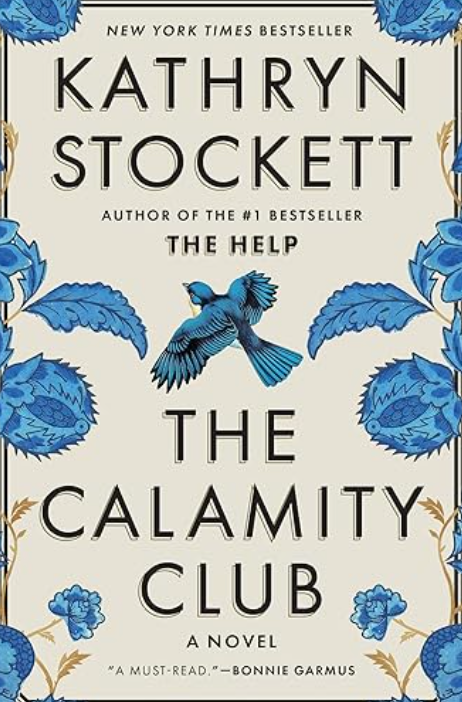
Oxford, Mississippi, 1933. Abandoned by her mother one Christmas Eve, eleven-year-old Meg Lefleur has learned the hard way to rely on no one. Now one of the unadoptable "big girls" at the Lafayette County Orphan Asylum, she fights each day to keep her spirit unbowed. Birdie Calhoun, unmarried and outspoken, has come to Oxford to ask her socialite sister to help the struggling family she’s left behind. But as the Depression tightens its grip, Birdie discovers her sister’s seemingly charmed life is a tapestry of lies. Then, Birdie encounters Charlie, a woman running low on luck with little left to lose. When their fates—and Meg’s—converge, Charlie comes up with an audacious plan for them to take control of their lives. But in a place and time where hypocrisy is rife and women’s freedom is fragile, even the smallest act of defiance can have dangerous consequences. The Calamity Club will make you laugh, cry, and cheer—an epic testament to underestimated women who know that calamity can be the spark of new beginnings. This is Kathryn Stockett at her most confident, heartfelt, and hilarious—the triumphant return of one of the most beloved storytellers of our time.
The Calamity Club is a sprawling, crowd-pleasing Depression-era Southern epic about women pushed to the edge by poverty, hypocrisy, class cruelty, and patriarchal law—and about what happens when they stop asking politely for survival.
Who This Book Is For
This is for readers who want a big, old-fashioned, emotionally generous historical novel with a sharp commercial engine underneath it. If you like multi-character Southern fiction, unlikely female alliances, orphan-girl resilience, class resentment, family secrets, con women, moral reversals, and stories where the downtrodden eventually start plotting back, The Calamity Club will likely give you exactly the kind of immersive reading experience it promises.
It is especially suited to readers who loved the readability of The Help but want Stockett to shift her attention from domestic racial hierarchy toward gender, poverty, reproductive control, and the ways “respectable” society punishes women who cannot or will not fit its script. This is not a quiet chamber novel. It is a page-turning social melodrama with anger in its bloodstream and a strong instinct for entertainment.
It will also work for readers who enjoy historical fiction that feels built for book clubs: accessible, character-forward, emotionally direct, and full of discussion-ready questions about who gets protected by the law, who gets sacrificed by family, and who gets called immoral simply because she refuses to disappear.
Who This Book Is Not For
This is not for readers looking for subtle minimalism, formal experimentation, or a coolly restrained literary portrait of the Great Depression. The Calamity Club is big in almost every sense: big cast, big feelings, big coincidences, big villains, big injustices, big reversals, and a long page count that is not shy about taking the scenic route.
It is also not for readers who are wary of Stockett’s particular brand of Southern uplift. The book is far more focused on women’s economic and bodily vulnerability than The Help was, but it still carries the Stockett signature: hardship filtered through warmth, wit, momentum, and a near-Hollywood faith in narrative satisfaction. For some readers, that will be irresistible. For others, especially those who prefer historical fiction to leave its wounds less neatly dressed, it may feel too eager to turn suffering into applause.
Three Reasons to Recommend It
First, the novel knows that poverty is not just a setting—it is a trap with paperwork.
The best parts of The Calamity Club are not simply about women being poor. They are about how poverty corners them through institutions: orphanages, tax debts, marriage markets, social clubs, employment rules, moral codes, medical authority, and the polite violence of “good people” doing what the system allows them to do.
Birdie’s struggle is not glamorous. She is not poor in a decorative, sepia-toned way. She is competent, underpaid, unmarried, and surrounded by a world that treats female self-sufficiency as both useful and suspicious. Meg, meanwhile, is one of the novel’s most potent figures because her orphanhood is not sentimentalized into instant adorability. She is old enough to be unwanted, young enough to be powerless, and sharp enough to understand that adults often use pity as a mask for control.
That is where Stockett’s storytelling still has force. She is very good at making injustice legible without turning the book into a lecture. She gives you the social machinery, then gives you the human being being crushed inside it.
Second, the female alliance at the center has genuine commercial magic.
Meg, Birdie, and Charlie are not subtle archetypes, but they are effective ones. Meg is the bruised survivor with a hard little flame inside her. Birdie is the practical woman whose decency keeps colliding with her fury. Charlie is the wild card: part fugitive, part strategist, part walking indictment of what men and institutions can do to women when nobody is watching.
Together, they give the novel its engine. The pleasure of the book is not only in watching them suffer, but in watching them become dangerous to the people who underestimated them. The “club” of the title works because it reframes calamity as membership. These women are not united by purity or virtue. They are united by damage, wit, necessity, and the sudden discovery that desperation can become political when shared.
That is the book’s most satisfying fantasy: not that suffering makes women noble, but that suffering might make them organized.
Third, Stockett remains an extremely readable storyteller.
Whatever one thinks of the controversies around The Help, Stockett knows how to build a scene, sharpen a voice, and keep pages turning. The Calamity Club is long, but it rarely feels inert. It has the architecture of popular historical fiction at full volume: cliffhangers, secrets, moral showdowns, comic relief, villainy, reversals, and the kind of emotional release that practically dares a streaming producer not to call.
That readability matters because the book is handling heavy material: abandoned children, forced social roles, economic desperation, abuse, hypocrisy, and the historical policing of women’s bodies. Stockett’s instinct is to keep the story moving rather than let it drown in misery. The result is not always delicate, but it is undeniably effective.
At its best, The Calamity Club feels like a Southern tall tale with a feminist fuse. It is funny until it is not. It is sentimental until it bares its teeth. It wants you to cheer, but it also wants you to notice what exactly you are cheering against.
One Reason to Hesitate
The book’s emotional generosity sometimes softens its own sharpest critique.
The Calamity Club is angry about real things: poverty, misogyny, class performance, reproductive injustice, institutional cruelty. But Stockett is also a deeply commercial storyteller, and commercial storytelling often wants catharsis where history offers contamination. The novel’s final neatness may satisfy many readers, but it also risks making the machinery of oppression feel more narratively conquerable than it ever was in life.
There is also the question of size. At more than six hundred pages, the book gives itself room to sprawl, but not every development needs that much oxygen. Some plotlines carry the voltage of a social novel; others feel closer to prestige-TV plotting, designed to keep the viewer from changing the channel. That does not ruin the experience, but it does make the novel feel more engineered than organic in places.
Editor’s Review
The Calamity Club arrives with a burden few second novels have to carry: it is not merely Kathryn Stockett’s follow-up to The Help, but her return to the public court of Southern historical fiction after a debut that became both a phenomenon and a controversy. That context matters, because this new novel reads like an author trying to keep what made her famous—voice, warmth, moral outrage, ensemble storytelling—while shifting the moral center of gravity.
This time, Stockett is less interested in racial ventriloquism and more interested in what happens to women when class, law, family, and biology become cages. The result is a novel that feels safer in one sense and more openly furious in another. Safer, because its central emotional terrain is female solidarity under patriarchal pressure. More furious, because the book’s anger is not abstract. It is aimed at systems that decide which women are marriageable, employable, adoptable, respectable, fertile, disposable, or mad.
The most compelling figure may be Meg, because she exposes the sentimental lie at the heart of orphan fiction. Children in novels are often treated as moral tests for adults. Meg is that, but she is also a person with strategy. She knows she is being measured, categorized, and prepared for a life of labor before she has even had a real childhood. Stockett does not always resist the pull of pluck, but she gives Meg enough flint to keep her from becoming a greeting-card orphan.
Birdie, meanwhile, is the novel’s moral backbone. Her unmarried status, financial precarity, and inability to conform to the expected feminine path make her a useful lens for the book’s broader argument: a woman does not have to be rebellious by temperament to become radicalized by circumstance. Sometimes all it takes is a tax bill, a selfish relative, and one too many men explaining reality.
Charlie supplies the danger. She is the character who reminds the book that respectability is often just another trap. If Birdie represents endurance and Meg represents survival, Charlie represents retaliation. The novel needs all three. Without Birdie, it would become too reckless. Without Meg, too adult and schematic. Without Charlie, too polite.
The book’s weakness is also its market strength: it wants to be both a social indictment and a deeply satisfying entertainment. It wants to make readers angry, then give them the pleasure of justice, or at least something emotionally close to justice. That is not a crime. Popular fiction has always done this. But it does mean The Calamity Club sometimes rounds off the more brutal implications of its own history. The novel knows the cage is real; it also wants the reader to enjoy the jailbreak.
Sharp verdict: The Calamity Club is not a perfect novel, and it is not a quiet one. It is overstuffed, theatrical, sentimental, funny, furious, and occasionally too eager to wrap its wounds in narrative ribbon. But it has pulse. It has women worth following. It has a strong sense of place, a strong sense of grievance, and the rare commercial-fiction gift of making a long book feel shorter than it is.
Kathryn Stockett has not written a modest return. She has written a big, messy, hell-raising crowd-pleaser about women who have been cornered by history and decide, finally, to corner it back.




 千斤顶
千斤顶










 English
 简体中文
简体中文 繁體中文
繁體中文 한국 사람
한국 사람 日本語
日本語 Deutsch
 русский
 بالعربية
 TÜRKÇE
 português
 คนไทย
คนไทย french