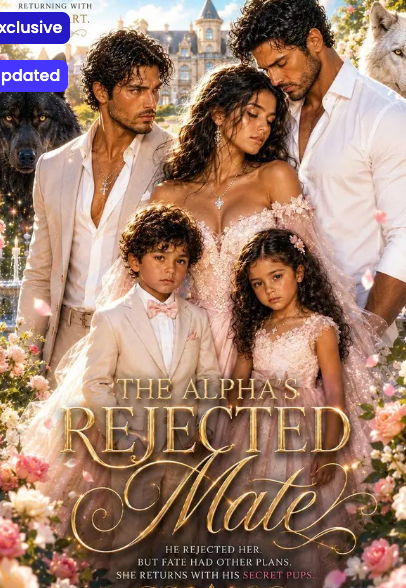
Hi🖐 My name is Monica Hale, and I have a secret to tell you. My mate rejected me. The moment he felt the bond, he cast me aside without a second thought. But that wasn't the worst thing that happened to me. I was already a disappointment long before that day. Wolfless. Weak. A stain on my Alpha father's image. The daughter he wished he never had. Then, on my father's birthday, my life fell apart completely. I woke up in the bed of a stranger with no memory of how I got there and no idea who he was. I never even saw his face. Rejected. Violated. Broken. And as if fate hadn't tortured me enough, I soon discovered I was pregnant. Instead of standing by me, my father threw me out of the pack without hesitation, choosing his reputation over his own daughter. Alone, homeless, and carrying children whose father I couldn't identify, I thought my life was over. I was wrong. Because the secrets surrounding that night were far darker than I imagined. The man I was desperately searching for was far more dangerous than anyone could have guessed. And the mate who rejected me was about to learn that some mistakes come with a price. My name is Monica Hale. The wolfless girl nobody wanted. The rejected mate. The outcast. And this is the story of how they all regretted letting me go.
One-Sentence Verdict:
The Alpha’s Rejected Mate is a high-drama werewolf rejection romance that turns the familiar “weak wolfless girl gets cast out” trope into a revenge-tinged survival story, but its most interesting tension is not who Monica ends up with—it is whether some betrayals deserve redemption at all.
Who This Book Is For:
This is for readers who love rejected-mate werewolf romances with pregnancy drama, pack politics, secret children, alpha regret, humiliation-to-power arcs, emotional suffering, messy love triangles, and heroines who are forced to rebuild their lives after every institution meant to protect them fails.
Who This Book Is Not For:
This is not for readers who need polished prose, airtight worldbuilding, careful handling of sexual trauma, or a romantic lead whose behavior is easily redeemable. If you are uncomfortable with stories involving coercion, violation, pregnancy after a traumatic night, family abandonment, and a heroine being repeatedly punished for existing, this book may be more upsetting than entertaining.
3 Reasons to Recommend It:
1. It knows exactly why rejected-mate romances are addictive.
The book opens with the genre’s most reliable emotional weapon: a girl who believes the mate bond will finally make her wanted, only to be humiliated by the one person fate supposedly chose for her. Monica is not merely rejected by Prince Asher; she is rejected in a way that confirms every cruel thing her father, siblings, and pack have made her believe about herself. She is wolfless, unwanted, socially useless, and treated like a stain on her Alpha father’s image. That emotional stacking is unsubtle, but it works. The reader is not just waiting for romance; the reader is waiting for public reversal, social punishment, and the exquisite satisfaction of watching everyone who dismissed Monica realize they were wrong.
2. Monica’s survival arc gives the familiar trope real emotional pressure.
The best part of the story is not the mate-bond melodrama by itself. It is what happens after Monica loses everything. She is rejected, wakes after a mysterious and violating night with no memory, becomes pregnant, and is then thrown out by the father who should have protected her. That sequence pushes the novel beyond simple “alpha regrets rejecting his mate” territory. Monica’s pain is not symbolic; it has material consequences. She becomes homeless, vulnerable, and responsible for children whose father she cannot identify. The story gains force because her suffering is tied to survival, motherhood, reputation, and power—not just romantic disappointment.
3. The book creates a genuinely combustible romantic debate.
A lot of AlphaNovel-style werewolf romances pretend to offer moral conflict while obviously steering the reader toward one destined couple. The Alpha’s Rejected Mate is more interesting because readers themselves seem divided about Asher. Some are invested in the mystery, regret, and mate-bond pull; others openly question why Monica should ever forgive him, especially given the traumatic circumstances around the night that changes her life. Logan’s presence complicates this further because he represents a very different fantasy: not fated obsession, but chosen care. That contrast gives the book its strongest dramatic engine. Fate may choose one man, but the reader is forced to ask whether fate has any moral authority.
1 Reason Some Readers May Bounce Off:
The book’s biggest weakness is execution. Multiple reader comments point to issues with writing style, missing transitional detail, and inconsistent pack naming or worldbuilding. Those criticisms are fair. The storyline is compelling, but the craft can feel rough: some emotional beats jump too quickly, some aftermath scenes need more breathing room, and the political geography of packs and kingdoms can feel underexplained. The novel has the bones of a very addictive werewolf soap opera, but not always the editorial control needed to make its heaviest moments land with the complexity they deserve.
Editor’s Review:
The Alpha’s Rejected Mate is not subtle, and pretending otherwise would be dishonest. It is built from the rawest ingredients of platform werewolf romance: a rejected mate, a cruel alpha prince, a wolfless heroine, an abusive family, a mysterious pregnancy, exile, secret heirs, royal status, and eventual regret. But the reason these tropes keep working is that, when arranged with enough emotional pressure, they speak directly to a reader’s appetite for vindication. This novel understands that appetite extremely well.
Monica Hale is introduced as someone who has been trained to think of herself as an embarrassment. Her father sees her as a failure, her siblings are favored, her pack gives her no real dignity, and Prince Asher’s rejection simply formalizes what her world has already been telling her: she is disposable. The opening chapters are engineered to make the reader angry on her behalf. In literary terms, that is not especially refined. In serialized romance terms, it is brutally efficient.
Where the book becomes more provocative is in the aftermath of the birthday-night incident. The story does not merely ask, “Will the alpha regret rejecting her?” It asks a darker and more uncomfortable question: what does regret mean after irreversible harm? If a man rejects, humiliates, endangers, or benefits from a woman’s vulnerability, can a mate bond later launder that damage into romance? This is where The Alpha’s Rejected Mate becomes more interesting than its title suggests. The book may lean into familiar fantasy structures, but the reader response shows that its moral center is contested. Some readers want Asher to suffer and earn forgiveness. Others do not want him forgiven at all.
That division is the sign of a story doing something potent, even if not always elegantly. Asher is not a cleanly redeemable alpha from the start. He is cold, status-conscious, cruel, and frighteningly comfortable with rejecting Monica because she does not match his image of power. His later regret, therefore, cannot be treated as a romantic reset button. The novel’s success depends on whether it can make accountability feel as dramatic as attraction. If it reduces Monica’s trauma to a hurdle on Asher’s redemption tour, it weakens itself. If it lets Monica’s pain remain morally real, it becomes far sharper.
Logan’s role matters because he represents the alternative that many rejected-mate stories secretly fear: what if the better love is not the fated one? What if the man who finds Monica broken, pregnant, penniless, and unwanted is more worthy than the man destiny assigned her? That question gives the book a useful tension between supernatural romance and human ethics. Werewolf fiction often treats the mate bond as sacred law. The Alpha’s Rejected Mate is most compelling when it lets the reader doubt that law.
The novel’s flaws are visible. The prose can be awkward. The pacing can skip over moments that deserve fuller emotional processing. The worldbuilding occasionally feels less stable than the drama requires. Readers who care about narrative polish will notice the rough edges quickly. Yet the book has the one quality many smoother romances lack: emotional voltage. It knows how to make humiliation hurt, how to make exile feel personal, and how to make regret feel like a delayed punishment rather than a romantic convenience.
In the end, The Alpha’s Rejected Mate is best read as a dramatic, messy, compulsively readable werewolf soap opera about a woman discarded by blood, bond, and pack—and the ugly pleasure of watching that discarded woman become impossible to ignore. It is not the most refined version of the rejected-mate trope, but it is a highly effective one. Its power lies in the anger it provokes: anger at Asher, at Monica’s father, at a pack system that worships strength while abusing vulnerability, and at a fate that seems to arrive too late to be trusted. For readers who come to werewolf romance for pain, payoff, and moral chaos, this book delivers exactly the kind of storm they are looking for.




 千斤顶
千斤顶










 English
 简体中文
简体中文 繁體中文
繁體中文 한국 사람
한국 사람 日本語
日本語 Deutsch
 русский
 بالعربية
 TÜRKÇE
 português
 คนไทย
คนไทย french