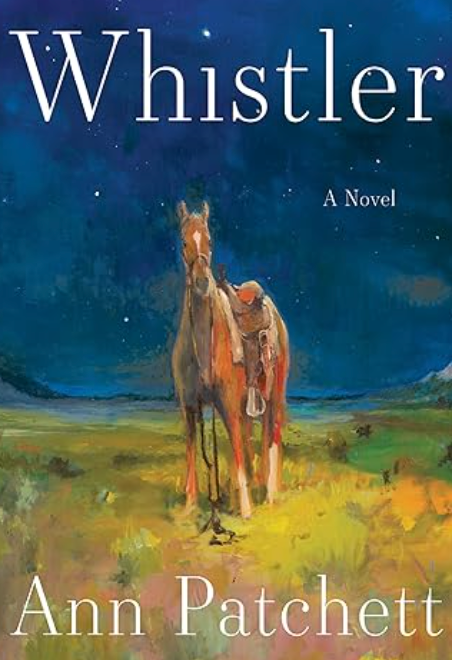
When Daphne Fuller and her husband Jonathan visit the Metropolitan Museum of Art, they notice an older, white-haired gentleman following them. The man turns out to be Eddie Triplett, her former stepfather, who had been married to her mother for a little more than year when Daphne was nine. Now fifty-three, Daphne hasn’t seen Eddie for many years, not since the fateful event that changed the direction of both their lives. Meeting again, time falls away; while their relationship was brief, it had a profound impact on them both, and now that they are reunited, they have no intention of ever being separated again. Whistler is a story about two adults looking back over the choices they made, and the choices that were made for them. It’s a story about bravery, memory, the often small yet consequential moments that define our lives, and the endless stream of loss that in time comes for us all. Beautiful in its simplicity, it is ultimately about how love endures, and how the feeling of being known by one other person, even for a short period of time, can change everything.
One-Sentence Verdict:
Whistler is Ann Patchett at her most intimate and deceptively quiet: a novel that begins with an old man following a woman through the Met and slowly reveals itself as a luminous argument for the emotional afterlife of love.
Who This Book Is For:
This is for readers who love literary fiction about family, memory, grief, chosen kinship, second chances, and the strange permanence of brief relationships. It will especially reward readers who admired the emotional architecture of The Dutch House, Tom Lake, or Commonwealth, but want something smaller in scale and sharper in emotional concentration.
Who This Book Is Not For:
This is not for readers looking for a plot-heavy mystery, dramatic twists, romantic heat, or a novel that announces its profundity with fireworks. If your patience for reflective, conversation-driven fiction is low, Whistler may feel too gentle, too interior, or too polished for its own good.
3 Reasons to Recommend It:
1. Patchett turns a “minor” relationship into the whole moral center of a life.
The novel’s great intelligence lies in its refusal to treat step-family as disposable just because the paperwork ended. Eddie was Daphne’s stepfather for only a short period when she was nine, yet the book insists that duration is not the same thing as importance. Some people parent us briefly and still permanently alter the shape of our inner life. That is the emotional proposition of Whistler, and Patchett makes it feel not sentimental but almost radical. In a culture obsessed with biological legitimacy, romantic destiny, and legally recognized bonds, the novel asks a more dangerous question: what if the person who saw you most clearly was someone the family later edited out?
2. It understands grief without embalming it.
Whistler is clearly written from the far side of loss, but it is not a funeral disguised as a novel. Its grief has wit, appetite, irritation, gossip, museum wandering, old stories, marital comfort, and the odd absurdity of people suddenly reappearing decades too late. Patchett’s gift here is tonal balance. She writes about death and illness without turning the page into a shrine. The dead are not used merely to make the living sad; they remain conversational, inconvenient, funny, and stubbornly present. That is why the book’s emotional force lands so cleanly. It does not beg the reader to cry. It trusts the reader to recognize what has been lost.
3. The novel makes kindness feel artistically serious.
A lazy reader might mistake Whistler for a “nice” book. It is kinder than much contemporary literary fiction, yes, but kindness in Patchett’s hands is not softness without structure. It is a discipline. Eddie’s presence in Daphne’s life is gentle, but the consequences of that gentleness are enormous. He offers attention, memory, and affirmation—the unglamorous materials out of which a self is built. The book’s best insight is that being known by one person, even briefly, can become a kind of private inheritance. Patchett is not arguing that love fixes everything. She is arguing something more adult and more devastating: love may not save us from loss, but it can change what loss is allowed to destroy.
1 Reason Some Readers May Bounce Off:
The book’s restraint is also its risk. Whistler is so controlled, so burnished, and so emotionally composed that readers who prefer messier fiction may find it almost too elegant. Patchett’s late-career style can feel like a beautifully arranged room where even the heartbreak knows where to sit. The novel rarely lets chaos truly rupture the surface; instead, it filters pain through memory, anecdote, conversation, and retrospective wisdom. For many readers, that will be exquisite. For others, it may feel over-managed, as if the book has already forgiven everyone before the reader has had time to be angry.
Editor’s Review:
Whistler is a small book only if you measure fiction by incident. Measured by emotional consequence, it is one of Ann Patchett’s most concentrated works. The premise is almost suspiciously modest: Daphne Fuller, a 53-year-old English teacher, is visiting the Metropolitan Museum of Art with her husband when an older man appears to be following her. He turns out to be Eddie Triplett, her former stepfather, a man she has not seen since childhood. From that encounter, Patchett builds a novel about vanished families, misremembered histories, queer compromise, parental failure, and the stubborn survival of affection.
The title itself is a quiet trick. “Whistler” is not primarily a place, nor simply a symbolic flourish. It is the name of a horse inside a story inside a memory, and that nesting is the point. Patchett has always been interested in how stories become the containers that carry unbearable things across time. Here, storytelling is not decorative; it is rescue technology. What cannot be explained directly can sometimes be smuggled through a remembered tale. What was too frightening for a child can become legible to the adult she becomes.
The novel is also a sly continuation of Patchett’s long fascination with nontraditional families. Like The Dutch House and Commonwealth, it studies the emotional wreckage left by adult decisions that children are forced to live inside. But Whistler feels more distilled than those books. It is less concerned with the sprawl of a family saga than with the aftershock of one severed bond. Daphne’s mother removed Eddie from Daphne’s life, but she could not erase what he had already given her: attention, safety, delight, and the feeling of being chosen.
What keeps the novel from becoming pure nostalgia is Eddie himself. He is not just the saintly lost father figure returned from the past. His life contains compromise, concealment, and the particular historical sadness of a gay man who once tried to live inside the shape of a conventional marriage. Patchett does not treat this as a melodramatic revelation but as one of the book’s central moral facts: people make choices under the pressure of their era, and those choices leave marks on everyone around them. The novel’s compassion is not the same as absolution. It sees the damage and still asks what love survived it.
The criticism to make, and it is a real one, is that Whistler sometimes feels almost too perfectly Patchett-like. Its intelligence is warm, its sadness is civilized, its revelations arrive with elegant timing. Readers who want jaggedness may wish the book allowed more disorder into the room. But that polish is also part of the project. Patchett is writing about the stories adults tell in order to keep living with the past. Of course those stories are shaped. Of course they are edited. Of course they are beautiful and incomplete.
In the end, Whistler is not a novel about recovering the past. It is about discovering that the past was never finished with us. It argues that a relationship does not have to last long to last forever, and that the people who briefly loved us well may become the hidden architecture of our courage. It is tender, wry, emotionally exact, and quietly devastating—the kind of book that does not raise its voice because it knows the reader will lean in.




 千斤顶
千斤顶









 English
 简体中文
简体中文 繁體中文
繁體中文 한국 사람
한국 사람 日本語
日本語 Deutsch
 русский
 بالعربية
 TÜRKÇE
 português
 คนไทย
คนไทย french