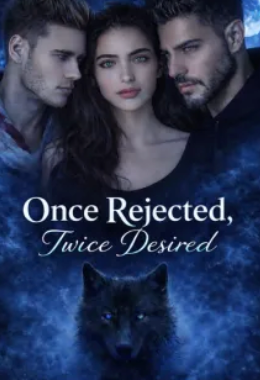
When Alaia turns 18, she knows that she will eventually find her mate. What she doesn't know is what will happen when she finally does. The betrayal of rejection knocks her down, but she's not meant to be down for long. She is meant for greatness. Follow along as she overcomes to get everything she has ever wanted, but was too afraid to ask. She was Once Rejected, but now Twice Desired.
One-Sentence Positioning:
Once Rejected, Twice Desired is a classic rejected-mate werewolf romance that takes the familiar humiliation of being unwanted and turns it into a full-bodied fantasy of self-recovery, second desire, and finally becoming too powerful to be treated like someone else’s mistake.
Who This Book Is For:
This book is for readers who love emotionally dramatic werewolf romance with fated mates, rejection trauma, possessive attraction, pack politics, soulmate confusion, protective Alphas, steamy tension, and a heroine whose pain becomes the starting point of her power arc. It will especially appeal to fans of rejected Luna stories, “he lost her and now someone else wants her” dynamics, second-chance-adjacent mate drama, and webnovel pacing where every chapter ends with a new emotional complication.
Who This Book Is Not For:
This is not for readers who want understated paranormal romance, slow literary realism, morally tidy relationships, or a heroine whose growth happens without melodrama. If you are tired of mate-bond anguish, jealousy, possessive male leads, surprise destiny reveals, heated pack hierarchy, or serialized romance that leans into big emotional swings rather than subtle psychological shading, this may feel too familiar or too heightened.
3 Reasons to Recommend It:
1. It understands why rejection is the most addictive wound in werewolf romance.
The title does almost all the marketing work by itself. Once rejected, twice desired: that is the entire emotional contract. The story’s power comes from a fantasy that is both painful and deeply satisfying — the person who was dismissed does not simply survive; she becomes wanted, seen, and impossible to reduce to that first rejection. In werewolf romance, rejection is never just romantic disappointment. It is biological, social, spiritual, and public. When a mate rejects you, it is not only the heart that is wounded; the whole mythology of belonging collapses. This book uses that collapse as the ignition point.
2. Alaia’s arc is built around recovery, not just romantic replacement.
The strongest version of this story is not “one man rejects her, another man wants her.” That would be too easy. The better emotional engine is that Alaia’s rejection forces her to confront how much of herself has been shaped by fear, longing, and underestimation. The synopsis makes a clear promise: she was knocked down, but she was not meant to stay down. That promise matters. The appeal is not only watching her become desired by someone else; it is watching her become less available to the old version of herself who was afraid to ask for what she wanted.
3. The story delivers the genre pleasures cleanly.
This is a book that knows its readers. The chapter titles alone signal the rhythm: birthday awakening, mate discovery, rejection, new claim, confusion, challenge, destiny. It is not pretending to be a quiet paranormal character study. It is built for the pleasures of recognition: the moment the mate bond hits, the sting of being discarded, the shock of being wanted again, the pack hierarchy, the possessive “mine” energy, and the slow reveal that the heroine’s importance has been underestimated. For readers who come to werewolf web fiction for emotional payoff, the story appears to understand the assignment.
1 Major Drawback:
The main weakness is that the book leans heavily on very familiar rejected-mate architecture. The rejected heroine, the painful eighteenth-birthday awakening, the fated bond, the second desire, the special destiny, the possessive Alpha energy — these are potent tropes, but they are also among the most recognizable building blocks in the genre. Readers who already love this lane will likely find the familiarity comforting and addictive. Readers looking for a radical reinvention of werewolf romance may feel the story is remixing known pleasures rather than breaking new ground.
Editor’s Review:
Once Rejected, Twice Desired is not a subtle title, and that is a good thing. It announces the story’s central bargain with almost brutal efficiency: first humiliation, then hunger. First abandonment, then recognition. First the heroine is told she is not enough; then the narrative sets about proving that the original rejection was not just cruel, but catastrophically wrong.
That is the lifeblood of rejected-mate fiction. The genre works because it translates ordinary emotional pain into supernatural consequence. In a contemporary romance, being rejected by the person you love is devastating. In a werewolf mate-bond romance, rejection becomes existential. The body knows. The wolf knows. The pack may know. Desire is not merely personal; it is woven into fate, hierarchy, and identity. So when Alaia is rejected, the wound is larger than romance. It is a rupture in the story she thought the universe had written for her.
The smartest thing about the premise is that it does not leave her there. Alaia’s story is pitched as an overcoming narrative, and that is crucial. Rejected-mate books can sometimes become repetitive misery machines, keeping the heroine in pain long after the reader has understood the injury. This one’s title suggests a different emotional trajectory: the rejection is the first act, not the final definition. Alaia’s movement from discarded to desired is less interesting as romantic revenge than as identity correction. She is not becoming valuable because someone new wants her. She is becoming visible because the rejection failed to destroy what was already there.
The “twice desired” element is also doing important genre work. It complicates the clean certainty of the mate bond. In theory, fated mates are supposed to simplify romance: one soul, one match, one destiny. But the rejected-mate subgenre thrives by making destiny misfire. What if the bond is real but the person attached to it is not worthy? What if rejection frees the heroine rather than ruins her? What if a second claim reveals that fate was less absolute than everyone believed? These questions are not new, but they remain powerful because they let the reader enjoy both cosmic romance and personal agency.
Alaia herself appears designed for that transformation. She begins in the ordinary threshold moment of the genre — turning eighteen, expecting the mate bond, waiting for life to arrange itself around destiny. The betrayal that follows forces the book into its true subject: not love at first recognition, but selfhood after recognition fails. That is why the best rejected-mate stories are rarely just about romance. They are about humiliation, dignity, and the moment a heroine stops treating someone else’s failure to choose her as a verdict.
The book’s likely appeal, reflected in its cross-platform presence and reader ratings, is its fluency in these emotional beats. It offers the pleasures that paranormal web-romance readers often want: fast emotional stakes, readable conflict, possessive tension, a heroine with latent importance, and enough pack-world escalation to keep the romance from existing in a vacuum. The fact that the story appears under the Blue Moon label on Goodreads and across multiple reading platforms also suggests it has traveled beyond a single app ecosystem, which matters in a genre where discoverability often depends on reader word-of-mouth and trope clarity.
The critique is equally clear. Once Rejected, Twice Desired is not, at least from the available public material, trying to dismantle the rejected-mate formula. It is trying to satisfy it. That means its strengths and weaknesses are inseparable. The same tropes that make it immediately clickable can make it predictable. The same possessive intensity that creates heat can limit nuance. The same destiny-driven structure that gives the romance mythic force can make character choices feel preloaded. Whether that bothers you depends almost entirely on what you want from the genre.
But there is a reason this formula keeps working. Rejection stories speak to a private fantasy many readers understand: not merely being loved, but being re-seen after someone misjudged your worth. The cruel pleasure is watching the person who dismissed the heroine become irrelevant, regretful, or simply surpassed. The deeper pleasure is watching the heroine realize she does not have to remain the person who was hurt in chapter six.
That is where Once Rejected, Twice Desired has its strongest emotional promise. It is not only a werewolf romance about mates. It is a story about the afterlife of humiliation — about what happens when the girl who was not chosen becomes the woman no one can ignore.
Final Verdict:
Once Rejected, Twice Desired is a trope-forward, emotionally charged werewolf romance built for readers who love rejected-mate pain followed by power, desire, and vindication. It is familiar, sometimes proudly so, but its appeal is obvious: the book takes the ache of being discarded and turns it into the addictive fantasy of becoming wanted on your own terms.




 千斤顶
千斤顶










 English
 简体中文
简体中文 繁體中文
繁體中文 한국 사람
한국 사람 日本語
日本語 Deutsch
 русский
 بالعربية
 TÜRKÇE
 português
 คนไทย
คนไทย french