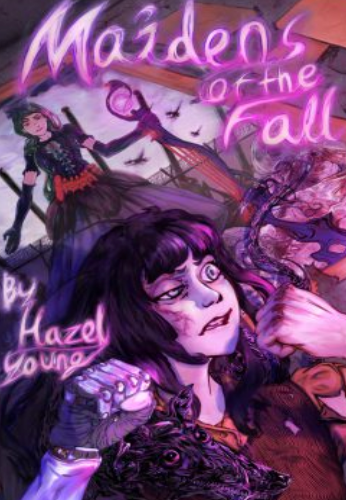
Octavia blames magical girls for the collateral damage that killed her parents and left her disabled. She resents their power as figureheads of the state, beyond reproach, beyond revenge. She hates their necessity; magical girls, young women chosen by the Dream-Gods of Earth, are the only ones who can turn back the Nightmares that creep through the open wound in reality, cut through England’s heart. In the decades since the wall between the waking world and the Dreamlands came crashing down, no amount of fire-power can match divine favour. Octavia’s greatest wish is to go unnoticed, to avoid the government censors and the emotional hygiene officers, England’s front line in the war on dreams. She must swallow her rage and her desire. She must ignore a hopeless love for her best friend, though going to university is about to part them forever. But then a magical girl attacks another one in broad daylight, in a terrorist bombing. Octavia finds herself arrested, both witness and suspect. The only way out is a contract with a Dream-God, but this divine trickster isn’t from Earth.
One-Sentence Positioning:
Maidens of the Fall is a ferocious magical-girl cosmic-horror serial that strips the sparkle off the genre and asks what happens when the chosen girl is not a symbol of hope, but a disabled, furious, grieving young woman weaponized by gods, governments, and her own need for revenge.
Who This Book Is For:
This is for readers who want magical girls treated not as pastel wish-fulfillment, but as political instruments, trauma survivors, divine weapons, public idols, and possible monsters. It will especially work for fans of cosmic horror, dystopian England, sapphic yearning, body horror, state surveillance, anti-authoritarian fantasy, psychologically intense narration, and stories where transformation is less “glittering destiny” than “catastrophic consent under pressure.”
Who This Book Is Not For:
This is not for readers looking for cozy magical-girl nostalgia, simple heroism, fast comfort, or a clean power fantasy. If you want lighthearted team battles, neat moral categories, gentle pacing, or a protagonist who processes pain in an easily digestible way, this serial may feel too jagged, too internal, and too emotionally punishing. It is not difficult because it is obscure; it is difficult because it keeps dragging the reader back into the wound and asking them to look properly.
3 Reasons to Recommend It:
1. It understands that magical girls are political before they are cute.
The smartest thing Maidens of the Fall does is refuse to treat the magical-girl system as innocent. In this world, magical girls are not merely heroines; they are state-adjacent icons, divine contractors, public necessities, and untouchable symbols. Octavia’s hatred of them is not petty envy. It is political grief. Her parents are dead because of collateral damage, her body has been permanently altered by violence, and the same society that praises magical girls also asks ordinary people to swallow their rage for the sake of survival. That makes the premise immediately sharper than a standard genre inversion. The story is not saying “what if magical girls were dark?” It is asking: what institutions would form around girls chosen by gods, and who would be crushed beneath the myth of their necessity?
2. Octavia is a protagonist with teeth, not polish.
Octavia’s narration is angry, wounded, desirous, frightened, resentful, and often ugly in ways that feel intentional rather than accidental. She is not written to be universally likable. She is written as someone whose life has made likability feel like another form of obedience. Her disability, grief, queer longing, and rage are not accessories; they shape how she reads every room and every promise of safety. That gives the serial its psychological charge. The reader is not simply watching a girl gain power. We are watching someone who wanted to disappear become impossible to ignore. That transition is thrilling because it is not clean. Her empowerment does not erase her damage; it gives the damage a shape dangerous enough to move through the world.
3. The prose builds atmosphere like an infection.
The writing is one of the serial’s major strengths. It has a dense, sensory, almost feverish quality: urban decay, dream-logic, bureaucratic menace, body horror, rain, blood, concrete, hunger, shame, and divine wrongness all pressing against the same membrane. The cosmic horror does not feel imported from another genre; it seeps naturally into the magical-girl framework. Dream-Gods, Nightmares, reality wounds, emotional hygiene officers, government censors — these are not just cool nouns. They create a world where inner life itself has become a battleground. The result is a serial that feels less like a sequence of battles and more like a psychological weather system: oppressive, unstable, beautiful, and hard to breathe inside.
1 Major Drawback:
The serial’s intensity can become exhausting. Its introspection is often powerful, but it is relentless; the narrative spends a great deal of time inside pain, fear, dissociation, resentment, and bodily vulnerability. For some readers, that depth will be the point. For others, it may slow the plot’s momentum or make the reading experience feel claustrophobic. Maidens of the Fall is not a casual binge unless your idea of casual reading includes trauma, cosmic dread, institutional violence, queer repression, and girls becoming divine weapons in a collapsing world.
Editor’s Review:
Maidens of the Fall arrives at the magical-girl genre with a scalpel in one hand and a Molotov in the other. It is not content to parody the genre’s tropes, nor does it simply invert them for shock value. Instead, it performs a more interesting operation: it takes the familiar architecture of chosen girls, transformations, monsters, divine power, public adoration, and emotional purity, then asks who benefits from that architecture and who gets buried under it.
Octavia is the perfect pressure point for that question. She is not outside the magical-girl myth because she is indifferent to it. She is outside because it has already ruined her. Her hatred comes from experience, not ideology. She knows the cost of collateral damage because she has paid it in family, body, and future. That makes her eventual entanglement with a Dream-God feel less like destiny and more like a trap with teeth. The classic magical-girl contract is usually framed as awakening; here, it looks closer to coercion, infection, and opportunity arriving in the same breath.
The worldbuilding is unusually strong because it fuses metaphysical horror with civic infrastructure. The Dreamlands are not merely a mystical elsewhere; their breach has reorganized society. England is not just haunted — it is administratively haunted. Censors and emotional hygiene officers are among the most chilling details because they imply a state that does not only police bodies, but also dreams, expressions, and emotional deviation. In that sense, Maidens of the Fall is a horror story about both cosmic invasion and domestic governance. The gods are terrifying, but so is the paperwork.
What makes the serial more than a grimdark magical-girl remix is its emotional specificity. Octavia’s sapphic yearning, her fear of being seen, her resentment toward power, and her longing for escape all collide in the same body. The result is not empowerment fantasy in the easy sense. It is closer to apotheosis as survival strategy. To become powerful here is not to become healed. It is to become capable of damaging the systems that damaged you. That is a much darker, more interesting proposition.
The reader response available outside Scribble Hub supports this impression: the most enthusiastic readers seem drawn to the technical polish, the oppressive atmosphere, the psychological intensity, and the sense that the story is actively dissecting the magical-girl formula rather than merely wearing its costume. The criticism, where it appears, is also predictable and fair: this is heavy reading. The introspection can feel almost punishing. The narrative is not always in a hurry to provide relief. It prefers pressure over release, dread over comfort, and transformation over catharsis.
But that severity is also the book’s identity. Maidens of the Fall is not asking whether magical girls can be edgy. It is asking whether a world that needs girls to become symbols has already failed them. It is asking whether hope, when administered by the state and sanctioned by gods, is still hope or just another technology of control. It is asking whether revenge can be morally ugly and still politically comprehensible. And, most importantly, it is asking what kind of girl survives when the genre that was supposed to save her becomes another machine for consuming her.
The sharpest critique is that the serial’s brilliance may limit its audience. It is atmospheric, intelligent, and emotionally raw, but it is not especially forgiving. Readers who need warmth between wounds may find themselves starved. Readers who prefer plot-first progression may occasionally feel trapped inside Octavia’s interiority. Yet for the right audience, that same interiority is the point: the horror is not just what happens to the world, but what it feels like to be a person whose private anguish has become cosmically relevant.
Final Verdict:
Maidens of the Fall is a bleak, ambitious, beautifully abrasive magical-girl horror serial with real literary bite. It is dense, queer, angry, grotesque, and politically charged — less a deconstruction of magical girls than a hostile takeover of the genre’s moral machinery. Not an easy read, but a memorable one, especially for readers who like their heroines wounded, furious, and dangerous enough to make gods nervous.




 千斤顶
千斤顶










 English
 简体中文
简体中文 繁體中文
繁體中文 한국 사람
한국 사람 日本語
日本語 Deutsch
 русский
 بالعربية
 TÜRKÇE
 português
 คนไทย
คนไทย french