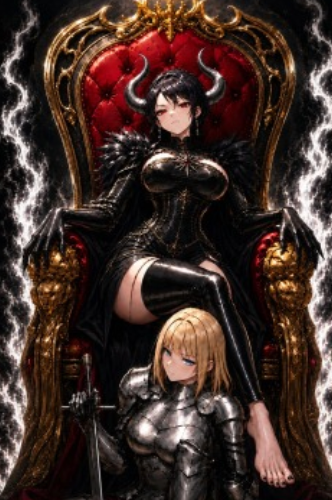
Lysanthia, the strongest Demon Queen, spent centuries trying to die. Not because she wanted death. It was the only way to break her chains. Her reincarnation spell worked -mostly. She woke in a forest nearly a thousand years in the future, in a body that wasn't quite hers, stripped of her overwhelming power. A world without a System. Without Classes. Without the Gods watching her every step. With the Hero who killed her now reborn at her side, she's thrust into a world almost completely alien, and yet recognizable. A world where power is etched in Ink, where she must start from nothing. A world where people show her kindness for no reason at all. That might be harder than starting over. The strongest Demon Queen is free. Not even she knows what happens next.
One-Sentence Positioning:
The Demon Queen Wants To Live is a yuri progression fantasy that takes the most overused villain-reincarnation setup imaginable and gives it a surprisingly tender, psychologically sharp spine: what if the Demon Queen did not want conquest, revenge, or redemption, but simply the right to exist without being used?
Who This Book Is For:
This is for readers who enjoy female-led progression fantasy with emotional damage under the armor. If you like overpowered heroines who have to rebuild from almost nothing, enemies-to-something-slower-and-stranger dynamics, demon queen mythology, reincarnation, cultivation-adjacent power systems, sapphic tension, and character growth that matters as much as combat growth, this is an easy recommendation. It will especially work for readers who like arrogant, socially maladjusted leads whose confidence is partly performance and partly wound.
Who This Book Is Not For:
This is not for readers who want immediate power fantasy gratification, nonstop fights, or a clean “evil queen becomes good girl” redemption arc. It is also not ideal for anyone who dislikes yuri romance, slow-burn relationship development, emotionally awkward protagonists, or fantasy stories where the internal arc is just as important as the external plot. If you need the Demon Queen to immediately start conquering kingdoms again, you may find the book almost provocatively domestic in places. It is less “bow before me, mortals” and more “why are these mortals being kind to me, and why does that feel worse than war?”
Three Reasons to Recommend It:
1. Lysanthia is not interesting because she is powerful; she is interesting because power failed her.
The best twist in The Demon Queen Wants To Live is that the Demon Queen’s overwhelming strength is not treated as the solution to her life. It is part of the prison she escaped. The premise could easily have been a smug OP fantasy about a legendary tyrant waking up weaker and climbing back to the top. Instead, the book frames Lysanthia’s old power as something inseparable from role, expectation, divine interference, and emotional isolation. She was the Demon Queen because history, gods, enemies, and her own survival instincts demanded she be the Demon Queen. In the new world, weakness is not only humiliation. It is possibility. That gives the progression arc real thematic weight. She is not just regaining numbers; she is trying to discover what strength looks like when it is no longer a cage.
2. The Hero/Demon Queen pairing has a better emotional engine than the trope usually gets.
A reincarnated Demon Queen traveling with the Hero who killed her sounds like a gimmick. Here, it becomes the story’s most effective human machine. Ash and Lysanthia are not merely “opposites attract.” They are two people who were once trapped inside symbolic roles so large they barely had room to be people. The Hero was the Hero. The Demon Queen was the Demon Queen. The old world knew exactly what they were supposed to mean. The new world gives them the terrifying freedom of not knowing. That is why their dynamic works: it is not just banter, tension, or eventual romance. It is mutual disorientation. Ash adapts to kindness more easily; Lysanthia treats kindness like a trap because, for most of her existence, it probably was. Their slow movement toward trust feels earned because both characters are learning a language they were never taught.
3. The book understands that “learning to live” is not a soft premise.
The title sounds almost simple: the Demon Queen wants to live. But the story treats that sentence with the seriousness it deserves. Living, for Lysanthia, is not the same as not dying. It means inhabiting a body that is not quite hers, accepting a future without the System and gods that once defined her, handling ordinary care without flinching, and rebuilding identity without the old architecture of war. That is why the slower sections matter. Campfires, awkward conversations, social misreads, small acts of protection, and moments of accidental vulnerability are not filler; they are the battlefield where the actual story is happening. The progression system may be about power, but the emotional progression is about selfhood.
One Reason Some Readers May Drop It:
The pacing is deliberately steady, and the story’s emotional priorities may frustrate readers expecting a pure action-progression rocket. The book does have power growth, action, and an OP-female-lead promise, but it spends real time on trauma, confusion, relationship texture, and Lysanthia’s painful inability to process basic kindness. That patience is part of the charm, but it is also the filter. If your main question is “when does she start crushing everyone again?” the answer may arrive slower than you want. The story is more interested in who she becomes between battles than in making every chapter a flex.
Editor’s Verdict:
The Demon Queen Wants To Live is the kind of web serial that looks familiar from ten paces away and stranger the closer you get. Demon Queen. Reincarnation. Lost powers. Hero companion. Progression fantasy. Yuri tension. On paper, it sounds like a stack of recognizable tags. In practice, its appeal comes from how carefully it bends those tags away from cheap wish-fulfillment and toward character excavation.
Lysanthia is a particularly strong central figure because the story does not confuse arrogance with confidence. She is grand, sharp, dramatic, and often funny, but much of that presence reads like armor welded over old terror. She has the reflexes of someone who survived by being untouchable and the emotional literacy of someone who was never safely touched at all. That makes her social awkwardness more than a joke. It is funny when she misreads kindness; it is sad because we understand why she has no category for it. The book’s comedy and ache often come from the same place.
That balance is what separates the novel from a standard “villainess gets a second chance” or “demon lord becomes cute” setup. Lysanthia is not simply being softened for reader comfort. She is being confronted with a world that refuses to obey the old rules, and the shock of that is almost more violent than combat. A world without the old System, without the gods watching every step, without Classes carving destiny into shape, should feel liberating. Instead, it feels terrifying because freedom asks a question tyranny never did: what do you want when nobody is forcing you to be useful, monstrous, legendary, or doomed?
The romance angle, or at least the emotional groundwork for it, is also smarter than the average enemies-to-lovers pipeline. Ash is not just “the good girl who will melt the Demon Queen.” That would be too easy and frankly less interesting. Ash matters because she represents a different relationship to the old story. She killed Lysanthia, but she is also tied to her by the same mythic machinery. Their connection is not clean. It carries guilt, curiosity, irritation, tenderness, and the strange intimacy of having once been each other’s narrative purpose. Watching them figure out how to exist after the roles have collapsed is more compelling than watching them simply trade romantic tension.
The prose appears to be one of the main reasons early readers are responding well. It has a readable flow, a sharp internal voice, and enough humor to keep the trauma from becoming self-serious sludge. The Demon Queen’s ego is funny because it is excessive; it is touching because it is defensive. The story can be light-hearted without being shallow, which is harder than it looks. Many fantasy web serials either drown in lore or sprint through feeling to reach the next power-up. This one seems willing to let the character work breathe.
That said, the book’s strengths will not be universal. Its pacing is not built for readers who want constant escalation. Its sapphic trajectory will not appeal to readers uninterested in yuri romance. Its character voice may feel too stylized for some. And because it is still early in its run, part of the recommendation rests on promise: the promise that the progression system will keep deepening, that the relationship will keep earning its turns, and that the world beyond the initial premise will become as textured as Lysanthia’s interior life.
But as an opening proposition, The Demon Queen Wants To Live has real bite. It takes the Demon Queen fantasy and asks a better question than “how strong can she become?” It asks what strength is worth after survival has stripped a person down to reflex, pride, and loneliness. The answer, so far, is not conquest. It is not revenge. It is the far more dangerous work of accepting kindness without immediately looking for the knife.
For a story about an overpowered Demon Queen, that may be its most radical choice.




 千斤顶
千斤顶











 English
 简体中文
简体中文 繁體中文
繁體中文 한국 사람
한국 사람 日本語
日本語 Deutsch
 русский
 بالعربية
 TÜRKÇE
 português
 คนไทย
คนไทย french