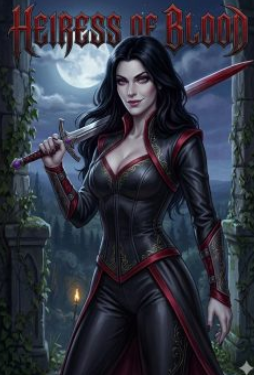
When the young vampire, Verena Tavanor, discovers her class, she learns that the difficulties of her childhood were far from coincidence, and her unprecedented potential turns her life upside-down. In a whirlwind of life, death, and a lot of pleasure, she suddenly finds herself responsible for the lives of the people who once protected her, and to add to the pressure, she begins to realize that some of those people might mean a bit more to her than she once thought. As tensions build, and threats mount, her determination to get stronger becomes greater than ever, and it's strength she's going to need, for what's coming for her.
The Heiress of Blood is a messy, ambitious, character-driven vampire LitRPG that sells itself as a spicy girls-love harem fantasy, but is at its best when it stops chasing heat and lets Verena’s competence, trauma, classlessness, and moral burden do the real seducing.
Who This Book Is For
This is for readers who want their LitRPG with blood, status sheets, aristocratic politics, sapphic tension, monster-girl energy, and a protagonist who feels like she has lived before the plot arrived. If you are tired of level-one heroes who behave like newly hatched teenagers, Verena is the main attraction: she has pride, scars, skill, sensual confidence, and a history that actually shapes how she moves through the world. The book will also work for readers who enjoy slow-building poly or harem dynamics where the love interests are not merely decorative rewards, but people with their own loyalty, friction, and emotional weight.
It is especially suited to readers who like web-serial fantasy in its raw, expansive form: imperfect, energetic, overstuffed, sometimes clumsy, but alive with possibility. The appeal here is not a surgically polished novel. It is the feeling of watching a first major work grow in public and occasionally hit something much sharper than its packaging suggests.
Who This Book Is Not For
This is not for readers who need clean traditional-novel pacing, subtle exposition, or sensitive topics handled with mature precision from the beginning. The book has mature content, harem/futanari tags, power imbalance elements, slavery-related plot material, and dark worldbuilding that some readers find interesting and others find mishandled. If those subjects are immediate deal-breakers, this is not the story to test your tolerance on.
It is also not for readers who dislike LitRPG mechanics, shifting points of view, explicit romance, or web-serial looseness. The book can explain too much, hurry emotional beats, and stall its own plot with lore. If you want elegant restraint, The Heiress of Blood may feel like a banquet where the chef keeps interrupting the meal to describe the kitchen.
3 Reasons to Recommend
Verena is the rare overpowered protagonist who feels earned before she becomes overpowered.
The smartest thing The Heiress of Blood does is build its power fantasy on delayed access rather than instant gratification. Verena does not begin as a lucky blank slate who suddenly receives a broken class and becomes interesting because the system says so. Her lack of a class has already wounded her pride, limited her growth, and made her an anomaly inside a world that treats system access as destiny. That changes the entire flavor of the progression arc.
When Verena finally begins to move, it does not feel like raw numbers replacing personality. It feels like an old reservoir finally finding an outlet. Her competence matters because it predates the system. Her swordsmanship, discipline, social instincts, and stubbornness are not loot drops; they are survival habits. This is why the story has a sturdier foundation than many harem LitRPGs with similar tags. Verena’s future strength may become excessive, but the emotional logic behind it is clear: she had to become formidable long before the world agreed to measure her properly.
The romance and harem elements have more emotional architecture than the tags imply.
On paper, this could easily look like another “hot monster-girl protagonist collects women” serial. In practice, the better moments come from the fact that Verena’s relationships are not just erotic checkpoints. Readers have specifically responded to the way her love interests feel like characters rather than storage space for desire, and that praise is justified. The story understands that harem romance only works when charisma is not a cheat code but a responsibility.
Verena’s sensuality has a sharp edge. She can be commanding, indulgent, affectionate, and cruel in ways that make the story’s consent dynamics important rather than optional. When the book handles that well, it becomes genuinely compelling: attraction is tied to trust, power is tied to care, and intimacy becomes another arena where Verena’s morality is tested. That is much more interesting than simple wish fulfillment. The book is sex-positive, but not purely sex-driven, and the author’s own note is accurate: readers coming only for smut may be surprised by how much of the engine is actually plot, loyalty, and identity.
The worldbuilding has real hooks, even when the delivery is rough.
The class-unlocking system is one of the book’s best ideas because it turns LitRPG mechanics into social pressure. A hidden class is not just a stat feature; it becomes a measure of legitimacy, adulthood, family pride, and political value. Verena’s failure to unlock hers is not a minor inconvenience. It is a public humiliation, a private wound, and a structural disadvantage. That gives the system thematic weight.
The aristocracy, race politics, supernatural hierarchy, and darker institutions of the setting all create a world that feels broader than Verena’s bedroom or character sheet. The book’s ambition is obvious. It wants romance, action, family drama, moral conflict, and progression fantasy to coexist. Does it always balance them cleanly? No. But the attempt is part of the appeal. A safer version of this novel would be smoother and probably less memorable. The current version overreaches, but at least it reaches for something.
One Deal-Breaker
The major warning is not the sexual content; it is the handling of exposition and sensitive subject matter. The book can be very earnest and very clumsy at the same time. It sometimes explains emotions that the scene has already made clear, stops momentum to deliver lore, or approaches dark topics in a way that feels more conceptually interesting than emotionally responsible.
That matters because the story is not dealing only with harmless fantasy stakes. Slavery, coercion, trauma, and sexual violence-adjacent worldbuilding require a sharper hand than “the world is dark and complicated.” Some readers praise the book for raising difficult moral questions; others feel it grants too much nuance to people or systems that do not deserve that framing. That disagreement is not a small footnote. It is the central risk of the novel. If you are sensitive to clumsy treatment of exploitation, The Heiress of Blood may lose your trust even when its character work is strong.
Editor’s Take
The Heiress of Blood is one of those web serials that is more interesting than it is tidy. It has the obvious surface appeal: vampire heiress, girls-love harem, LitRPG progression, aristocratic fantasy, mature content, strong protagonist. But the reason it has gathered attention is not merely because it checks popular tags. It is because Verena gives the fantasy a spine.
She is not an empty reader-insert wearing fangs. She is proud, wounded, capable, vain, affectionate, and dangerous. She has the kind of confidence that only works because it is mixed with old insecurity. The early classlessness premise is particularly effective: it makes her strength feel like defiance before it becomes destiny. In lesser progression fantasy, the system is the source of identity. Here, the system arrives late to a woman who has already spent decades becoming someone. That single choice gives the book a maturity many louder LitRPGs lack.
The romance is also better than the cynical reader might expect. Yes, the story belongs to a niche full of indulgent fantasy, and yes, it knows exactly what kind of audience those tags attract. But its better scenes are not built on conquest. They are built on Verena’s ability to pull emotional responses out of people: devotion, irritation, fear, tenderness, desire. The love interests are not always equally developed, and the pace of romantic escalation can feel too quick, but the story has enough relational texture to avoid feeling like a simple checklist.
Where the novel stumbles is craft control. It is not short on ideas; it is short on filtration. The author often seems afraid the reader will miss the point, so the prose explains, repeats, clarifies, underlines. That kind of writing is common in early web serials, but here it creates a frustrating contrast: the character concept is confident, while the narration sometimes behaves like it does not trust itself. The book’s emotional beats often work, but they would work harder if the author allowed silence, implication, and contradiction to carry more of the scene.
The darker material is the sharper problem. The story wants a morally complicated world, and that ambition is admirable. But complexity is not the same thing as blur. When a fantasy novel engages slavery, coercion, and sexual exploitation, it has to know exactly where its moral camera is pointed. The Heiress of Blood sometimes does; sometimes it wobbles. That wobble is why the reader response is so fascinatingly divided. Fans see nuance, pragmatism, and difficult ethical terrain. Critics see clumsiness and misplaced sympathy. Both readings are understandable, which is why this is not a blandly “safe” recommendation.
Still, there is something undeniably compelling here. The book has the urgency of a writer learning in motion, and that can be more engaging than sterile competence. The flaws are visible, but so is the growth. The story’s ambition, Verena’s presence, and the unusually strong foundation for a harem LitRPG make it stand out from the pack. It is not the best-written serial in its lane, but it may be one of the more promising ones because it has a reason to exist beyond its tags.
Final Verdict
The Heiress of Blood is uneven, over-explanatory, morally messy, and occasionally too clumsy for the weight of its own themes. It is also charismatic, addictive, and built around a protagonist who can carry far more than the premise initially promises. For readers who like sapphic fantasy LitRPG with erotic charge, political darkness, slow-burn power growth, and a heroine who feels seasoned rather than freshly manufactured, this is absolutely worth trying. For readers who need clean pacing and delicate handling of dark subjects, approach with caution.
Its best quality is not the blood, the sex, the harem, or the system. It is Verena herself: a woman the system failed to define, finally becoming dangerous on her own terms.




 千斤顶
千斤顶








 English
 简体中文
简体中文 繁體中文
繁體中文 한국 사람
한국 사람 日本語
日本語 Deutsch
 русский
 بالعربية
 TÜRKÇE
 português
 คนไทย
คนไทย french