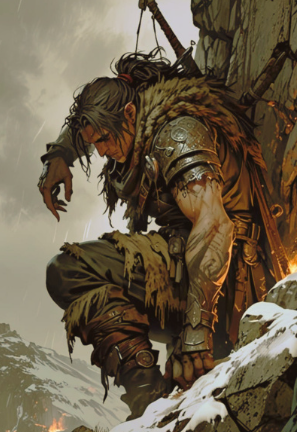
Among his people, strength is everything. Weakness means death. When Hakon finally completes the Rite, he expects at least a modest Ancient Power. Instead, he awakens something his tribe scorns: A Power of the Mind known as Enhanced Comprehension. Those of his tribe value brute force and herculean strength. To them, Hakon is nothing. But he sees what they cannot – patterns, weaknesses, possibilities. They may possess strength, but Hakon knows how to use it. As tribes stir, ancient grudges reignite and whispers spread, prophesying the rise of a Warlord. A warrior born from the blood of his enemies. A man whose very existence heralds chaos and bloodshed. And Hakon decides to become that very man. He will grow to rise to power and claim his father’s seat as the tribe’s chieftain, and unite the tribes to rise as the next Warlord. But first, he has to survive long enough to understand his Power…and to teach those who refuse to accept the strength of the Mind.
Savant Barbarian is a sharp-edged LitRPG progression fantasy that takes the oldest barbarian fantasy in the book — strength is everything — and asks what happens when the most dangerous weapon in the tribe is not muscle, bloodline, or rage, but comprehension.
WHO THIS BOOK IS FOR
This is for readers who like progression fantasy with a tactical brain inside a violent body. If you enjoy Royal Road LitRPGs where advancement feels earned, systems reward observation rather than button-mashing, and the protagonist wins by reading the battlefield before the battlefield reads him, Savant Barbarian is very much in your lane.
It is especially suited to readers who want tribe-building, early kingdom-building DNA, brutal rites of passage, bloodline culture, warrior hierarchy, a non-modern fantasy society, and a main character who is ambitious without being a smug chessmaster. Hakon is not “the weak kid who secretly hates violence.” He is very much a barbarian. He wants status, strength, glory, and his father’s recognition. The twist is that he is willing to think his way toward those things in a culture that treats thinking as suspiciously close to weakness.
WHO THIS BOOK IS NOT FOR
This is not for readers looking for a polished, finished epic with a massive backlog. It is still early, still proving itself, and still carrying the rough edges of an ongoing Royal Road launch. If you need a fully mature cast, airtight early-world logic, elegant dialogue, or a system that has already revealed its full shape, you may want to wait before committing.
It is also not for readers who dislike violent coming-of-age stories, hierarchy-heavy societies, tribal masculinity, or progression systems that make you pay attention to mechanics. This is not cozy fantasy wearing furs. It is a story about surviving a culture that respects power, fears weakness, and has no interest in making room for a boy whose gift looks useless until it starts producing corpses and consequences.
3 REASONS TO RECOMMEND IT
It makes “smart barbarian” feel like a real character premise, not a gimmick.
The obvious failure mode for this book would have been easy: make Hakon a modern genius in a barbarian skin, sneer at everyone around him, and solve violence with spreadsheet logic. Savant Barbarian mostly avoids that trap. Hakon is not interesting because he is too civilized for his tribe. He is interesting because he belongs to that tribe more than he wants to admit.
That is the key. He does not reject the barbarian worldview. He wants to master it. He wants to be strong, feared, respected, and eventually impossible to dismiss. His Enhanced Comprehension does not turn him into a pacifist philosopher; it gives him a new route to the same brutal social currency everyone else is chasing. That makes the conflict sharper than a simple “brains versus brawn” setup. Hakon is not trying to replace strength with intellect. He is trying to prove that intellect is strength when used without apology.
This is why the positive reader response makes sense. Reviewers repeatedly point to Hakon as nuanced, ambitious, and not simply a mindless brute or an unrealistic super-genius. That balance is the book’s main selling point. He is clever, but not omniscient. Driven, but not frictionless. Capable, but not yet mythic. In a genre crowded with protagonists who receive a cheat skill and immediately start sleepwalking through enemies, that restraint matters.
The progression system has thematic teeth.
A lot of LitRPG systems are just vending machines for dopamine: kill thing, numbers go up, new skill appears, repeat until godhood. Savant Barbarian is more compelling because Hakon’s power is humiliating before it is useful. Enhanced Comprehension is not the kind of gift his people know how to worship. It does not announce itself as a giant fist, a sacred bloodline, or a glorious ancestral weapon. It looks like thought. And in Hakon’s world, thought has a branding problem.
That gives the system an actual dramatic function. Hakon’s advancement is not just about acquiring stronger abilities; it is about forcing a culture to recognize a category of strength it has misnamed as weakness. Observation, adaptation, weakness detection, combat awareness — these are not merely mechanics. They are the language of a mind trying to survive inside a society that respects only visible dominance.
The best progression fantasy gives the reader two pleasures at once: the mechanical pleasure of seeing a build develop, and the emotional pleasure of seeing a worldview proven wrong. Savant Barbarian understands that. Every clever use of Hakon’s power is not just a tactical win. It is an insult to the tribe’s assumptions.
The worldbuilding has enough brutality to make the ambition believable.
The tribal setting works because it is not treated as decorative barbarian cosplay. The story is built around status, rites, blood, shame, inheritance, rivalry, and the terrifying simplicity of a society where weakness can become a death sentence. That gives Hakon’s ambition a credible edge. He is not chasing power because the genre requires it. He is chasing power because his world has made power the only language with legal tender.
The father-son tension is especially important here. Hakon’s disappointment is not abstract. He wants recognition from a system embodied by his family, his tribe, and the ancestral expectations pressing down on him. That makes the rise-to-chieftain arc more personal than a generic “conquer the tribes” premise. He does not only want to rule. He wants to make the people who misread him admit that they were using the wrong definition of strength.
This is also where the kingdom-building promise has potential. The book is not yet a full political machine, but the seeds are visible: competing tribes, ancient grudges, prophetic Warlord imagery, and a protagonist whose gift naturally bends toward organization, exploitation of weakness, and strategic unification. If the story follows through, Hakon’s mind may become more dangerous at the scale of armies than it is in single combat.
1 TURN-OFF
The biggest turn-off is that the early chapters may feel more promising than fully settled. Some readers have already flagged the dialogue as too sparse or functional, and that criticism is not baseless. The setting has force, the premise has bite, and Hakon has a strong conceptual hook, but not every supporting character immediately feels as textured as the central idea around him. There are moments where mystery can feel a little too mechanically withheld, and moments where side characters risk becoming social functions rather than people.
In other words, the book’s engine is strong, but the chassis is still being tightened. Readers who are highly sensitive to early internal-logic bumps or thin dialogue may bounce off before the premise has time to flex.
EDITOR’S NOTE
Savant Barbarian is exactly the kind of Royal Road story that can look simple from the outside and become more interesting the longer you sit with its central contradiction. “Barbarian with a brain” sounds like a pitch you could write on a napkin. The reason it works is that the book does not treat intelligence as an imported virtue from a superior culture. Hakon is not above barbarism. He is inside it. He bleeds for its approval, absorbs its values, and wants the throne it says he is unfit to claim.
That makes the story more honest than many “misfit genius” fantasies. Hakon is not trying to enlighten his tribe into modern morality. He is trying to beat them at their own game using a weapon they do not respect. That is more interesting, and frankly more ruthless. He does not need the tribe to become kinder. He needs it to become wrong.
The best thing about the novel so far is that its power fantasy is not clean. Hakon’s Enhanced Comprehension is empowering, but it is also socially alienating. It gives him perspective in a world that punishes perspective unless it can be converted into dominance. That creates a strong thematic loop: the more he understands, the more dangerous he becomes; the more dangerous he becomes, the harder it is for his tribe to keep pretending that understanding is not power.
There is also a refreshing resistance to instant overpowered nonsense. The story’s early appeal comes from earned application rather than raw escalation. Hakon does not simply receive a god-tier ability and start steamrolling tradition. He has to interpret it, test it, weaponize it, and survive the contempt of people who see no value in what they cannot immediately measure in broken bones. That is a better progression rhythm than pure number inflation.
Still, the novel is not immune to the usual early-serial weaknesses. Some dialogue can feel clipped to the point of undernourished. Some characters arrive more as pressure points in Hakon’s development than as fully alive social beings. The culture is compelling, but because it is so strongly organized around strength, shame, and rivalry, the story will need to keep deepening its people if it wants the tribe to feel like a civilization rather than a training arena with customs.
But the raw material is strong. Very strong. Savant Barbarian has the rare LitRPG advantage of a system that actually belongs to the theme. Enhanced Comprehension is not just a cool ability; it is the argument of the book. It says that intelligence is not soft, not civilized, not separate from violence. In the right hands, intelligence is violence refined.
That is the promise here: not a barbarian who stops being a barbarian because he learns to think, but a barbarian who becomes terrifying because he finally understands what everyone else has been doing badly.




 千斤顶
千斤顶









 English
 简体中文
简体中文 繁體中文
繁體中文 한국 사람
한국 사람 日本語
日本語 Deutsch
 русский
 بالعربية
 TÜRKÇE
 português
 คนไทย
คนไทย french