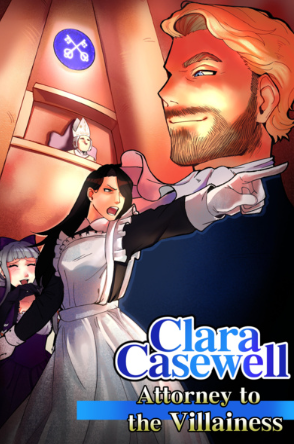
Clara Casewell is an ambitious up-and-coming associate at an international corporate law firm. Yet underneath her serious lawyerly persona lies a woman with a passion for all sorts of villainess stories. It doesn’t matter how trashy or badly written they are: as long as it’s got a haughty girl and a brooding duke, Clara will devour it like popcorn! After a heated year at the firm, Clara ekes out a promotion to Senior Counsel over her rival, the cocky Warren Righton. But on her way to celebrate, a bout of turbulence sends her plane spiraling down. When Clara wakes up, she’s wearing a… maid’s uniform? She finds herself in a world of nobles and magic, not social media and corporate grind. And there’s one more problem: Clara’s master is the notorious villainess Iris von Rhenia, and Iris and Clara are about to be put on trial for poisoning the heroine. A trial based on truth magic, where the accused get no defense. Join Clara as she learns the ins-and-outs of the unfair, convoluted, and often fantastical courts of the Holy Kingdom of Arcadia, meeting a colorful cast of characters including the heir to the Duke of the North™—but why does he look eerily like her annoying rival Warren?!
Clara Casewell, Attorney to the Villainess is what happens when Ace Attorney crashes into otome isekai and somehow lands on its feet: a witty, legally-minded fantasy courtroom serial where the real magic is not truth spells, but cross-examination.
Who This Book Is For
This is for readers who love otome isekai but wish the genre would occasionally replace tea-party scheming with actual procedure, evidence, loopholes, and tactical argument. If you enjoy villainess stories, fantasy courts, noble politics, rivals-to-lovers tension, sharp female protagonists, and the specific pleasure of watching a modern professional weaponize her boring real-world expertise in a ridiculous fantasy setting, this novel is almost dangerously tailored to you.
It is also for readers who like parody that does not hate the thing it is parodying. Clara Casewell knows villainess tropes are absurd. It also knows they are delicious. The book laughs at brooding dukes, unfair trials, magic institutions, noble arrogance, and genre clichés, but it does not sneer from outside the club. It is written by someone who clearly understands the appeal of the room before rearranging the furniture.
Who This Book Is Not For
This is not for readers looking for gritty legal realism. The courtroom system here is intentionally theatrical, unfair, magical, and frequently absurd. If you need fantasy law to behave like an actual modern judiciary, you may spend half the book objecting to the objections.
It is also not ideal for readers who want a conventional power fantasy where the protagonist quickly becomes the strongest mage, sword saint, queen, or secret divine heir. Clara’s “progression” is more intellectual than numerical. She becomes more dangerous because she understands systems, not because she gets a bigger fireball. Readers who came only for classic LitRPG-style leveling may find this more legal drama than progression fantasy.
3 Reasons to Recommend It
The central mashup is genuinely fresh, not just a gimmick.
“Lawyer gets isekai’d into an otome villainess story” sounds like a joke title. The impressive thing is that the novel actually builds a functioning engine out of that joke. Clara is not simply a modern woman who knows the plot. She is a corporate lawyer dropped into a world where truth magic is treated as absolute, defendants get no meaningful defense, and aristocratic institutions confuse divine authority with due process.
That gives the story a sharper hook than the usual “I know the future, so I will avoid my doom” setup. Clara’s advantage is not just genre knowledge. It is professional instinct. She sees rules, pressure points, contradictions, bad assumptions, procedural gaps. The fun is watching her look at a fantasy legal system that everyone else treats as sacred and immediately start asking the most dangerous question a lawyer can ask: “But what exactly does that mean?”
That is why the court scenes work. They are not only about proving innocence. They are about exposing the architecture of power. A world that worships truth magic still needs interpretation. A spell can reveal words, but not context. A blessing can compel speech, but not justice. Clara’s presence turns fantasy law into a battlefield where language itself becomes a weapon.
Clara is competent without becoming smugly invincible.
A lot of isekai protagonists suffer from the same disease: they are “smart” because everyone around them has been made stupid. Clara avoids that trap more often than not. She is capable, funny, genre-savvy, and ambitious, but she is not written as an omniscient goddess in a blazer. She has to learn the world. She has to improvise. She has to survive institutions built to crush people who do not already belong.
That matters because courtroom fiction collapses when the protagonist is always five steps ahead with no cost. The best parts of Clara Casewell come from the sense that Clara is thinking fast, not merely delivering pre-written victory speeches. She wins through pressure, reading people, noticing inconsistencies, and understanding how authority performs itself.
Her dynamic with Warren is a major part of the appeal. The “rival who looks suspiciously like someone from her old life” setup could have been cheap, but it works because their conflict has texture. Warren is not simply there to be handsome and irritated. He gives Clara friction. He forces her to sharpen herself. The slow-burn energy is less about instant chemistry and more about professional irritation gradually mutating into something dangerously fun.
The villainess is allowed to be complicated instead of conveniently innocent.
One of the smartest choices here is that Iris von Rhenia is not immediately flattened into the usual “misunderstood angel in villainess clothing.” Reader comments have picked up on this, and for good reason: the story is more interesting because Iris is not simply a victim of bad publicity. She has edges. She has pride. She has a history. She has enough moral ambiguity to justify the title without turning her into a cartoon monster.
That gives the Clara-Iris relationship more bite. Clara is not merely defending a perfect waif wrongly accused by the narrative. She is defending someone whose position, personality, and reputation are all politically charged. The question is not just “is Iris innocent of this specific crime?” It is “what does guilt even mean in a society that has already decided what kind of woman she is?”
This is where the book’s otome-isekai literacy pays off. It understands that the villainess archetype is powerful because she is usually the one woman allowed to be angry, vain, proud, theatrical, and politically visible. By placing a lawyer beside her instead of reincarnating directly into her, the story changes the angle. Clara becomes not the villainess, but the person arguing that even a villainess deserves a defense.
That is a much stronger premise than simple wish fulfillment.
1 Reason You Might Drop It
The legal system is entertaining, but it is not always convincing if you read it too literally.
This is the book’s main tension. The trials are fun, dramatic, and full of Ace Attorney-style rhythm, but the world’s law is deliberately exaggerated. Truth magic, theatrical proceedings, noble pressure, and procedural absurdity make for excellent serial entertainment; they do not always make for a legal culture that feels fully stable under scrutiny.
For most readers, that will be part of the charm. For some, it will be the wall. The story asks you to accept a court system that is ridiculous enough to be funny but serious enough to endanger lives. When that balance works, it is electric. When it wobbles, you may feel the machinery behind the curtain.
There is also a smaller expectation issue: despite the title, Iris may not be villainous enough for readers hoping for a deliciously cruel, morally black heroine. The book is more interested in complexity than pure wickedness. That is better writing, but not necessarily the fantasy some readers clicked for.
Editor’s Review
Clara Casewell, Attorney to the Villainess is one of those rare web serials whose title tells you the joke, but not the reason the joke works.
The obvious hook is “Ace Attorney but otome isekai.” That alone is enough to get clicks. The deeper hook is that Clara’s legal mind turns a genre usually driven by fate, romance, and social reputation into a story about systems. Most villainess fiction revolves around knowing the script: avoid the prince, befriend the heroine, stop the condemnation event, survive the academy. Clara Casewell asks a better question: what if the script itself is admissible evidence?
Clara’s power is not that she knows everything. In fact, the premise becomes stronger because she does not have perfect information. Her advantage is procedural. She understands that systems are made of assumptions, and assumptions can be challenged. She understands that truth is not the same as proof. She understands that a courtroom is not a holy place where justice naturally appears; it is a stage where whoever controls the rules controls the story.
That is a surprisingly sharp idea for a comedy-fantasy serial. The novel’s best scenes are not merely fun because someone shouts “objection.” They are fun because Clara is doing something more subversive than winning cases. She is teaching a fantasy world that certainty is not the same as fairness.
This is where the book quietly becomes more than a genre mashup. Truth magic sounds like the dream of every legal system: no lies, no evasions, no false testimony. But the novel understands the nightmare hidden inside that dream. Who asks the questions? Who interprets the answers? Who decides what counts as relevance? Who benefits when a society believes its institutions are too divinely sanctioned to need defense counsel?
Clara walks into that world and immediately becomes a problem. Not because she is overpowered, but because she has the wrong kind of literacy. She knows bureaucracy. She knows adversarial thinking. She knows that rules are never neutral just because they are written down. In a kingdom where magic gives authority a halo, a lawyer is practically a heretic.
The character work gives the premise staying power. Clara could easily have become a one-note snark machine, but the story gives her ambition, insecurity, professional pride, and an actual personality beyond “modern woman reacts to fantasy nonsense.” Her old life matters because it shaped how she thinks. She is not a random reader dropped into a novel. She is a worker from a high-pressure corporate environment who has been trained to read incentives, hierarchies, and risk. That background makes her oddly perfect for aristocratic fantasy. Nobles and law firms have more in common than either would like to admit.
Warren is equally important because he prevents Clara from becoming too frictionless. Their rivalry brings heat to the page without requiring immediate romantic surrender. The best rivals-to-lovers dynamics are built on recognition: two people annoyed not because they are opposites, but because they see too clearly how the other person thinks. Clara and Warren have that potential. Their banter works because it is not only flirtation; it is professional combat with better lighting.
Iris, meanwhile, is the book’s most delicate balancing act. The story would be weaker if she were secretly perfect. It would also be weaker if she were simply evil. Instead, she occupies the more interesting middle ground: a girl shaped by rank, pride, fear, and narrative expectation. She is not the cardboard villainess the original story likely needed her to be, but she is not absolved of all sharpness either. Clara’s defense of Iris therefore becomes morally richer. She is not defending innocence as an aesthetic. She is defending personhood against a genre that likes to turn inconvenient women into plot devices.
The novel’s comedy deserves credit too. It understands that parody lands best when the world remains emotionally sincere. The court rules are ridiculous, the otome tropes are lovingly obvious, the “Duke of the North” energy is entirely deliberate, and yet the characters are not treated as disposable punchlines. That is a difficult balance. Too much mockery would hollow the story out. Too much sincerity would make the premise feel less agile. Clara Casewell usually finds the sweet spot: playful, but not weightless.
Its weakness is the same as its strength: theatricality. The more the story leans into Ace Attorney logic, the more it asks the reader to accept a world where law bends around dramatic timing. That is not necessarily a flaw. Ace Attorney itself has always cared more about emotional truth and puzzle rhythm than legal realism. But readers should know what they are getting. This is fantasy courtroom drama, not a bar exam with elves.
The book also risks lowering its villainess tension too quickly. One reviewer’s complaint that the “villainess” is not as villainous as expected points to a real challenge. Once the archetype is humanized, the title’s promise shifts. That can be good. But the story has to keep finding new pressure so the premise does not soften into ordinary academy intrigue with occasional trials. The hints of conspiracy, political rot, and a wider mystery are therefore crucial. The court cases are the hook; the larger structure will decide whether the serial has long-term force.
Still, the early success makes sense. Clara Casewell, Attorney to the Villainess is clever without being smug, referential without being lazy, and funny without abandoning stakes. It gives otome-isekai readers a heroine who does not merely know the plot; she knows how to litigate it. In a genre crowded with reincarnated duchesses trying to dodge death flags, Clara stands out because she does something more interesting than avoid the condemnation event.




 千斤顶
千斤顶










 English
 简体中文
简体中文 繁體中文
繁體中文 한국 사람
한국 사람 日本語
日本語 Deutsch
 русский
 بالعربية
 TÜRKÇE
 português
 คนไทย
คนไทย french