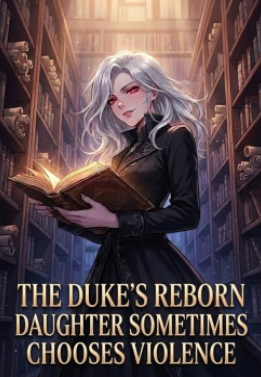
Esra Veyne. Most only know of her as the 'White Ghost', a Duke's Daughter who never even leaves her room. A girl fated to die in obscurity, if only someone didn't reincarnate into her body. The 'new' Esra has no interest in being a ghost. She wants to enjoy her new life. There's just one problem: Everywhere she looks, she finds something that needs fixing, and she can't just let someone else do it. Even if it means breaking fingers to get answers. Even if it means using a traumatized girl as an assassin. Even if it means never getting to enjoy being a Duke's daughter in the first place. Hopefully, she doesn't have to solve every problem with violence. This Esra Veyne was never very good at staying in her room.
The Duke’s Reborn Daughter Sometimes Chooses Violence is an isekai otome-fantasy with a knife behind its lace glove: a reborn noble girl story that starts like another abused-duke’s-daughter setup, then becomes a sharper, bloodier meditation on power, trauma, responsibility, and the dangerous thrill of being the only competent person in a broken room.
Who This Book Is For
This is for readers who love villainess-adjacent noble fantasy but are tired of heroines whose greatest weapon is being politely misunderstood. Esra Veyne is not simply reborn into privilege; she is reborn into a body treated as decorative, disposable, and already half-erased. The fun comes from watching her reject that role with cold intelligence, social audacity, and, when necessary, very practical violence.
If you like female-led isekai, otome-game politics, antihero protagonists, found family, hidden abilities, weak-to-strong progression, morally complicated rescue missions, and heroines who try to be kind but are absolutely willing to break fingers for answers, this story has a strong hook. It is especially suited to readers who enjoy court intrigue and action sharing the same table: one chapter may deal with etiquette, reputation, and noble hypocrisy; another may remind you that the title was not joking.
Who This Book Is Not For
This is not for readers who want a soft reincarnated-noble slice of life where the heroine drinks tea, collects loyal maids, and wins society through charm alone. It is also not ideal for anyone who needs early-world logic to be airtight from page one. Several readers have pointed out that the beginning can feel rough, that the first major conflict strains credibility, and that the social rules of the setting are not always explained with enough discipline.
It is also not for readers who dislike dark material. The story openly deals in trauma, violence, coercive systems, gore, strong language, class cruelty, racism, manipulation, and children being forced into adult-scale brutality. The title sounds almost playful. The actual story often is not.
3 Reasons to Recommend It
Esra is interesting because she is both caring and dangerous.
The best thing about Esra Veyne is that she is not written as a clean empowerment fantasy. She does not wake up in a duke’s daughter’s body and become instantly graceful, adored, and morally luminous. She wakes up, looks around, and sees rot. Servants are compromised. Nobles are useless or predatory. Children are being shaped into weapons. Institutions are held together by manners and cowardice. Esra’s tragedy is not that she lacks power; it is that she sees too much too quickly.
That makes her violence more complicated than simple wish fulfillment. She is not violent because the author needs cheap edge. She is violent because the world keeps presenting her with problems that polite systems refuse to solve. The tension is that she knows violence works. That is also why it is dangerous.
The story’s smartest move is making Esra clever but not omniscient. The synopsis promises a protagonist with blind spots, and that matters. A flawless mastermind becomes boring fast. Esra is compelling because she is capable, wounded, and often right, but not always wise. She wants to fix things. She also has the temperament of someone who may confuse saving people with controlling the board. That is a much richer heroine than the usual “secretly genius noble girl” template.
The found family angle gives the story emotional weight beyond revenge.
A lot of otome-isekai stories treat supporting characters as loyalty trophies. The maid is loyal. The knight is loyal. The misunderstood child is loyal. Everyone orbits the heroine because the plot says she deserves it. This novel has the potential to do something stronger: it makes loyalty feel like something built under pressure.
The found family here is not cozy in the easy sense. It grows out of damage, necessity, protection, and terrible choices. Esra’s relationships matter because they are tied to rescue, obligation, guilt, and survival. When she protects someone, the act is rarely clean. When she uses someone, the story does not let that decision feel entirely innocent. That friction is where the novel has its best emotional texture.
This is also why the “Duke’s daughter” fantasy feels less shallow than expected. Esra’s noble status is not just decoration. It is a tool, a cage, a shield, and a stage. She has rank, but rank alone does not make her safe. She has authority, but authority does not automatically make her understood. The story is most alive when it explores how a girl with inherited status still has to claw her way into actual agency.
Once it finds its rhythm, the intrigue and action have real bite.
The book seems to be one of those serials that asks for patience. The early chapters divide readers, and that criticism should not be ignored. But the positive comments are also revealing: several readers suggest the story improves once the initial setup gives way to larger intrigue, sharper schemes, and broader political conflict.
That tracks with the premise. Esra is not built to stay locked in her room. The more she moves through the world, the more the story gains oxygen. The action works because it is not separated from politics. Violence is not only physical; it is social. A duel, an insult, a rescue, a public appearance, a hidden ability, a noble’s silence — all of these become part of the same battlefield.
The result is a story with a stronger engine than its title suggests. It is not merely “reborn girl gets revenge.” It is about a person with adult consciousness and ugly memories trying to navigate a world where childhood, nobility, gender, power, and violence are all theatrical performances. Esra sometimes chooses violence because the world around her has already chosen it first. She is just impolite enough to stop pretending otherwise.
1 Reason You Might Drop It
The opening has a credibility problem, and for some readers that will be fatal.
The prose is widely praised even by several critical readers, but the early plot logic is more divisive. The first serious conflict appears to be a breaking point for many: some readers feel the social consequences, adult reactions, and rules around honor or punishment do not cohere enough to support the drama. That kind of issue matters because political fantasy lives or dies by believable systems. If the rules feel arbitrary, then cleverness stops feeling clever.
This is the novel’s main weakness: it sometimes wants the emotional impact of a harsh aristocratic world before it has fully earned the machinery behind that harshness. A brutal society can absolutely force children into grotesque situations, but the reader needs to understand why everyone in the room accepts the rules. Without that, trauma risks feeling engineered rather than inevitable.
Editor’s Review
The Duke’s Reborn Daughter Sometimes Chooses Violence is a far better title than it first appears, because the most important word is not “violence.” It is “sometimes.”
That single word is the hinge of the whole project. Esra is not a berserker in a ball gown. She is not a pacifist pushed once too far. She is a reborn girl with a practical mind, a damaged past, a noble body, and a very low tolerance for systems that ask victims to remain decorative. Violence is one option in her toolkit. The real question is when she reaches for it, why she reaches for it, and what part of herself gets reinforced each time it works.
That is what separates the story from generic villainess power fantasy. The pleasure is not just watching Esra punish bad people. The pleasure is watching her decide what kind of person she can afford to be. Her new life gives her a title, a family name, and access to power, but it does not give her peace. Everywhere she looks, there is another problem demanding intervention. The cruel joke is that she wanted to enjoy being alive. Instead, she becomes the only person in the room willing to act.
The novel is strongest when it treats that impulse as both heroic and alarming. Esra’s desire to save people is real. So is her willingness to use people. That contradiction gives her teeth. She can be tender, but her tenderness is not harmless. She can be righteous, but righteousness can become a blade that never goes back into its sheath. The story seems aware that “competent savior” is only a few steps away from “benevolent tyrant,” and that awareness makes Esra worth following.
The found family material deepens this. The best found families in fantasy are not collections of cute side characters; they are emotional economies. Who owes whom? Who trusts whom? Who was saved, and what did that salvation cost? This book understands that rescue can create intimacy, but it can also create debt. Esra’s bonds are compelling because they are not purely sweet. They are built in a world where kindness often arrives with blood on its hands.
The setting has similar strengths and weaknesses. On the positive side, it avoids feeling like a blank otome-game backdrop. There are signs of broader politics, magical systems, class structures, prejudice, and noble rot. The world becomes more interesting as Esra pushes outward and the story widens past household mistreatment. The action also benefits from the author’s willingness to make consequences ugly. This is not a pastel academy fantasy with occasional swordplay. It has a darker pulse.
But the criticisms about the beginning are legitimate. A story this dependent on intrigue needs early consistency. If the rules of nobility, honor, punishment, and adult authority feel unstable, the reader starts questioning the scaffolding instead of the characters. The novel’s defenders argue that it finds its groove after the first twenty or so chapters, and that may be true. But “wait until it gets good” is always a risky bargain. The early chapters are not just a doorway; they are a contract. If they ask too much too soon, some readers will leave before the stronger material arrives.
Even so, there is a reason the story has gathered passionate support. It has what many technically cleaner web novels lack: conviction. Esra is not a bland reader-insert with a noble title. She has pressure behind her. The prose has enough polish to carry emotion. The politics have enough bite to promise future headaches. The action has enough consequence to avoid feeling ornamental. And the heroine’s moral ambiguity gives the whole thing a sharper flavor than the average reincarnated-duke’s-daughter serial.
The Duke’s Reborn Daughter Sometimes Chooses Violence is uneven, but not empty. It is rough in places, but rarely lazy. Its early logic may test your suspension of disbelief, yet its central character is strong enough to make that test worth considering. At its best, the novel is not asking whether violence is cool. It is asking what happens when a traumatized, intelligent girl enters a world where violence has already been hidden under etiquette, inheritance, and noble smiles.
Esra does not introduce violence into that world.
She simply stops letting everyone else pretend it was not already there.




 千斤顶
千斤顶









 English
 简体中文
简体中文 繁體中文
繁體中文 한국 사람
한국 사람 日本語
日本語 Deutsch
 русский
 بالعربية
 TÜRKÇE
 português
 คนไทย
คนไทย french