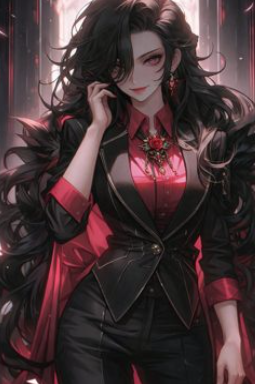
After her death, Lilith awakens in a world where fourteen billion players struggle for survival, power, and the right to continue existing. Over Ten million of them have become Demon Lords, each building their own race, their own territory, and their own army. Demonic Dragon Knights command vast legions, Vampires rise to build empires, and Lords of Catastrophe leave nothing but ruin in their wake. Yet Lilith enters this world as the Primordial Succubus Monarch - and quickly realizes she cannot walk the same path as the others. Instead of endless armies, she is given only three succubi, each unique in their own way, and the system permanently seals her ability to summon more. In a world where power is measured in numbers, such a gift feels more like a death sentence than a blessing. If she wants to conquer this world, she will have to take armies from other Demon Lords, grow stronger despite her limitations, and prove that a demon of desire is not meant only to seduce - but to fight. And above them all stand the Heroes… beings created for one purpose alone.
I Became a Demon Lord With Only Three Succubi is a shamelessly horny, surprisingly strategic sapphic LitRPG power fantasy where the joke of “only three succubi” slowly turns into a brutal argument about quality over quantity in a world obsessed with armies, ranks, and domination.
Who This Book Is For
This is for readers who like their fantasy systems loud, their heroines overpowered but still cornered, and their kingdom-building wrapped in danger, desire, monster evolution, and battlefield improvisation. If you enjoy demon-lord stories, female-led progression fantasy, sapphic harem dynamics, survival-game premises, and the pleasure of watching a supposedly doomed build become terrifyingly efficient, this novel is very much playing in your arena.
It is also for readers who understand that web fiction does not always win by being elegant. Sometimes it wins by being hungry. This book moves like it knows its audience has five other tabs open and no patience for a slow ceremonial entrance. It throws Lilith into a monstrous world, gives her a hilariously unfair limitation, surrounds her with three specialized succubi, and asks a very simple question: what happens when the weakest-looking starting hand belongs to someone who refuses to play by the intended rules?
Who This Book Is Not For
This is not for readers looking for subtle literary fantasy, restrained romance, or a morally polished heroine who conquers through diplomacy and clean speeches. It is not ideal for anyone uncomfortable with sexual content, gore, profanity, harem mechanics, domination-coded power dynamics, or jokes that sometimes push too close to uncomfortable territory. It is also probably not for readers who need every battle to feel tactically balanced from the start. Lilith can feel very strong very quickly, and the story’s tension often comes less from “can she survive this fight?” and more from “what kind of ruler is she becoming while she survives it?”
3 Reasons to Recommend It
The premise is stronger than the title makes it sound.
At first glance, I Became a Demon Lord With Only Three Succubi sounds like disposable ecchi clickbait: demon lord, succubi, harem, system, repeat. But the central limitation is genuinely good genre engineering. In a world where millions of Demon Lords are building races, territories, and armies, Lilith’s inability to summon more than three succubi should be a death sentence. The fun comes from watching the story weaponize that handicap.
The book understands one of the oldest pleasures in progression fantasy: constraints are more interesting than abundance. Lilith cannot simply drown the map in disposable troops, so she has to steal, adapt, exploit, cultivate resources, and turn a narrow build into a terrifying one. The “only three succubi” hook works because it creates an immediate asymmetry. Other Demon Lords have scale. Lilith has precision. Other rulers are playing civilization management. Lilith is playing asymmetric warfare with sex demons, resource hacks, and a growing sense that the system may not be as fair as advertised.
That is where the novel is most entertaining. It is not just “sexy demon girl gets stronger.” It is “sexy demon girl discovers that being underestimated is an economic advantage.”
Lilith is an effective power-fantasy protagonist because she is not pretending to be normal.
A weaker version of this story would spend too much time apologizing for Lilith’s nature. This one is more honest about what kind of fantasy it is selling. Lilith is a Demon Lord, not a reluctant village mayor with horns. Her power is desire, command, appetite, and survival. The story is at its best when it lets her embrace that without sanding everything down into generic heroism.
That does not mean she is deeply complex yet. Some readers are right to point out that her inner motivation and the supporting cast’s emotional foundations could use more depth. But as a web-serial lead, she has momentum. She is readable because she makes decisions. She adapts. She claims. She looks at a system designed to kill her and starts treating it like a marketplace, battlefield, and chessboard at once.
The result is a protagonist who may be overpowered, but not passive. And in this subgenre, that matters. A power fantasy becomes boring when power removes personality. Lilith’s appeal is that power amplifies hers.
The kingdom-building and resource-game elements give the spice something to stand on.
The book’s adult and harem elements are obvious selling points, but the better surprise is that the story is not only leaning on heat. There is also a steady interest in logistics: territory, food, subordinates, monsters, resources, trade, skills, evolution, and political positioning. The later “Potato King” material is a good example of the novel’s oddball charm. It is funny, a little absurd, and yet also exactly the kind of detail that makes a Demon Lord story feel like more than a chain of fights.
That blend of erotic power fantasy and base-building is what gives the novel its binge value. One chapter may lean into succubus spectacle; another may pivot toward army growth, dungeon-like encounters, or the economics of survival. The tonal mix is not always smooth, but it is rarely dull. There is a pulpy confidence here, a willingness to throw monster evolution, sapphic romance, system screens, army-building, and dark comedy into the same pot and stir until something addictive bubbles up.
The best thing about the book is that it understands power is not only a stat. Power is food supply. Power is loyalty. Power is information. Power is having three subordinates who matter more than a hundred faceless soldiers.
1 Reason You Might Drop It
The execution can be messy, and not always in a charming way.
The story has a strong engine, but it sometimes drives like the brakes were optional. Tonal control is the biggest issue. A series can absolutely combine sex comedy, violence, survival stakes, and sapphic power fantasy, but the sharper the content gets, the more carefully the author has to handle the line between dark humor and reader alienation. Some reader criticism about a later chapter getting too close to a rape-joke register should not be waved away as prudishness. In a novel built around succubi, desire, domination, and power imbalance, consent is not a side issue. It is part of the architecture.
There is also the problem of early power scaling. Lilith’s strength makes sense within the premise, but if she walks through too many threats too easily, the story risks turning strategy into decoration. The novel is most exciting when she has to think around a problem. It is less exciting when the answer feels like “she is simply that powerful.” The premise promises an underdog build; the story should be careful not to outgrow that tension too quickly.
Editor’s Review
I Became a Demon Lord With Only Three Succubi is the kind of web novel that looks trashy from across the room, then reveals that its trashiness has a working skeleton.
That is not an insult. In fact, it may be the book’s greatest advantage. It knows the appeal of its title. It knows readers are clicking for succubi, Demon Lord mechanics, sapphic harem energy, and a female protagonist who is not waiting for permission to become dangerous. But beneath that obvious bait is a sharper genre question: what does power look like when the system gives everyone else armies and gives you intimacy?
That is the novel’s most interesting tension. Lilith’s “weakness” is numerical. She only has three succubi. But numbers are not the same as value. Three distinct, loyal, evolving subordinates can matter more than a swarm of forgettable soldiers. A power that looks erotic may also be political. A race associated with seduction may be underestimated in war precisely because other players mistake desire for softness.
The book’s better instincts live in that contradiction. It is a demon-lord fantasy about scarcity. It is a harem fantasy where the smallness of the harem actually matters. It is a LitRPG where the system’s rules create both comedy and existential threat. Fourteen billion players and millions of Demon Lords is an almost absurd scale, but the absurdity works because it makes Lilith’s little starting camp feel like a spark in a hurricane.
The supporting cast is fun, though still somewhat underdeveloped. The succubi have enough differentiation to avoid feeling like interchangeable accessories, but the story would benefit from giving them deeper histories, sharper ideological conflict, and more interiority beyond loyalty and function. A harem story becomes stronger when each romantic or bonded character feels like a worldview, not just a role. The foundation is there. The book now has to build upward.
The same applies to Lilith. She is entertaining, decisive, and easy to follow, but she needs more moments where victory costs her something internally. Power fantasies are not weakened by vulnerability; they are strengthened by consequence. If Lilith is going to become a ruler rather than simply a stronger player, the narrative needs to test what kind of authority she believes in. Does she liberate, possess, exploit, protect, or merely replace one hierarchy with another more aesthetically pleasing one? The novel flirts with these questions. It should lean into them harder.
Still, there is a reason the story is attracting attention across platforms. It has velocity. It has a clean hook. It has a protagonist with immediate genre appeal. It has enough resource-game thinking to keep the fantasy from collapsing into pure erotic spectacle. And perhaps most importantly, it has the confidence to be a sapphic power fantasy without acting embarrassed about it.
The rough edges are real. The prose and pacing can be blunt. The comedy can overreach. The challenge curve needs careful handling. The sexual politics need more discipline than the story always shows. But the core appeal is undeniable: Lilith is not building an empire because destiny crowned her. She is building one because the world gave her a bad hand, called it a blessing, and expected her to die politely.
She does not.
That is the hook. That is the pleasure. And that is why I Became a Demon Lord With Only Three Succubi works better than its title suggests. It is not refined, but it is alive. It is not always tasteful, but it is rarely timid. In a crowded field of Demon Lord LitRPGs, that hunger counts for a lot.




 千斤顶
千斤顶








 English
 简体中文
简体中文 繁體中文
繁體中文 한국 사람
한국 사람 日本語
日本語 Deutsch
 русский
 بالعربية
 TÜRKÇE
 português
 คนไทย
คนไทย french