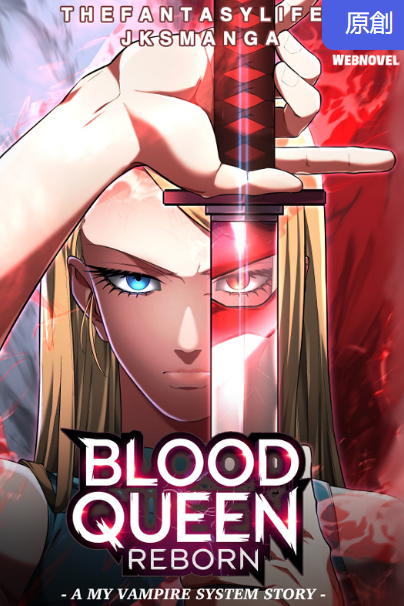
The world is at war… and power is everything. When hidden humans with abilities finally step forward, the balance begins to shift. Then, peace came...but Erin, she didn't want peace. To everyone else, she’s perfect. Beautiful. Untouchable. Living a life others envy, with powers that placed her at the top. But the truth? She’s already lost everything and was too weak to get what she truly wanted. Until she got her hands on something that wasn’t meant for her, that changed everything. [System Activated] “It is time to feed!” “You must drink human blood within 24 hours” “Your HP will continue to decrease…”
Blood Queen Reborn is not just a vampire-system spin-off with a female lead; it is a provocative alternate-universe rewrite that asks what happens when the mythology of My Vampire System is handed to the character many fans never expected, or never wanted, to see at the center.
Who This Book Is For
This book is for readers who already understand the strange addictive machinery of system fiction: the countdowns, the quests, the stat pressure, the brutal little thrill of watching a character become something monstrous because survival leaves them no cleaner option. If you like vampire progression stories where power arrives as both gift and infection, Blood Queen Reborn knows how to push that button.
It is especially for My Vampire System readers who are open to alternate-universe storytelling, role reversals, shared mythology, and the unsettling pleasure of seeing familiar events tilted just enough to become unfamiliar again. The book is not selling itself as a clean replacement for Quinn Talen’s story. Its real hook is disruption. It takes a universe many readers already have emotional ownership over and moves the spotlight toward Erin, a character whose very presence as protagonist has become part of the controversy.
That controversy is not a weakness by itself. In fact, it may be the most interesting thing about the novel. Blood Queen Reborn is for readers who are not afraid of friction inside fandom. It is for people who can enjoy a story that walks directly into the argument: Who deserves to be the main character? Can a disliked side character become compelling if the narrative gives her hunger, pain, and consequence? Is a system story still sacred if the system chooses differently?
It is also for readers who prefer their heroines imperfect. Erin is not positioned as a soft, universally lovable chosen girl. She is beautiful, powerful, damaged, ambitious, and already carrying the emotional residue of loss before the system truly remakes her. The book’s best angle is not “girl becomes vampire and gets strong.” It is “girl who already lives behind an image of perfection is forced into a body and system that make her appetite impossible to hide.”
Who This Book Is Not For
This is not for readers who want My Vampire System left untouched, unbent, and centered permanently around Quinn. If your attachment to the original depends on Quinn remaining the unquestioned emotional and structural core, Blood Queen Reborn may feel less like an expansion and more like an intrusion. The comment section makes that divide obvious: some readers are excited by the female-lead pivot; others cannot accept anyone else occupying the narrative gravity that once belonged to Quinn.
It is also not for readers who dislike alternate-universe fiction that reuses familiar scaffolding. This is a story built on deliberate echo, remix, and redirection. For some readers, that will feel like creative reanimation. For others, it will feel too close to fanfiction, especially if they are looking for a fully independent fantasy world rather than a Talenverse variation.
And if you need fast, elegant plotting with every scene transition polished smooth, this may test you. The premise has teeth, but the execution may not satisfy readers who want the reinvention to feel completely autonomous from the original series. Blood Queen Reborn is more fascinating when treated as a bold “what if” experiment than as a totally separate novel trying to stand without inherited emotional debt.
Three Reasons to Recommend It
Reason 1: The female-lead pivot gives the vampire-system formula a sharper psychological flavor.
The smartest thing Blood Queen Reborn does is not simply swapping a male protagonist for a female one. A lazy version of this book would have made Erin “Quinn, but a girl.” The more compelling version is messier: Erin is not entering the system from the same emotional place, and that changes the atmosphere around the power fantasy.
Quinn’s original appeal was rooted in weakness, alienation, and the brutal climb from nothing. Erin’s appeal is different. She begins from contradiction. To the outside world, she appears polished, elevated, untouchable. Inside, she is already hollowed out by loss and inadequacy. That means the vampire system does not merely empower her; it exposes her. It gives physical form to a hunger that was already there.
This makes her transformation more morally interesting than a standard weak-to-strong arc. Erin is not just learning to survive. She is learning what kind of person she becomes when the mask slips and the system rewards instincts she may not want to admit. The blood-drinking requirement is not just a horror mechanic. It is a thematic insult: the perfect girl must now feed, decline, hide, and choose. Her body becomes an argument against the image everyone else has of her.
That is where Blood Queen Reborn earns its title. “Queen” is not merely a power fantasy label. It suggests authority, danger, loneliness, and the burden of being watched. “Reborn” implies not healing, but replacement. Erin is not being restored to herself. She is becoming someone new enough to frighten the old version.
Reason 2: The book weaponizes fandom discomfort in a way that is more interesting than safe nostalgia.
A safer spin-off would flatter the existing fanbase by giving them exactly what they already loved, only with a new cover and slightly rearranged stakes. Blood Queen Reborn does something riskier. It puts pressure on the audience’s loyalty. It asks readers to tolerate a universe where Quinn is no longer the sole gravitational center and where Erin’s role is not a side note but a structural challenge.
That choice is messy. It is also alive.
The most interesting spin-offs are rarely the ones that behave politely. They create anxiety. They make readers defensive. They force the question of whether a franchise is a museum or a living organism. Blood Queen Reborn understands, intentionally or not, that alternate-universe fiction is at its best when it feels slightly illegal to the original emotional order. It should bother people. It should make fans argue. It should create the sense that the author has moved a load-bearing wall just to see what collapses.
That does not mean every choice works. But it does mean the book has a pulse. The polarized reception is not just noise; it is part of the reading experience. Fans who love Erin feel vindicated. Fans who resent her feel provoked. Readers who want Quinn protected read the book with suspicion. Readers who want a female lead in JKSManga’s system universe read it like overdue correction.
That tension gives the novel a meta-layer many web serials never achieve. Blood Queen Reborn is not only about a girl gaining a vampire system. It is about a fandom watching the system choose someone else.
Reason 3: The system mechanics still deliver the immediate, addictive pressure readers come for.
For all the controversy around protagonist choice and AU structure, the basic engine still works because system fiction is brutally efficient when handled with confidence. A ticking health penalty, a feeding requirement, experience gain, abilities, combat pressure, military-school structure, and altered character arcs all create the same compulsive loop that made this universe readable in the first place.
The appeal is simple but powerful: every rule has consequences. Every condition creates urgency. Every upgrade promises freedom while deepening dependency. Erin’s system does not just give her tools; it gives her deadlines. That is the secret weapon of this kind of fiction. It turns internal conflict into interface design.
The vampire-system setup is especially effective because it fuses genre pleasures that should not work together but do: school hierarchy, military training, alien-war backdrop, supernatural hunger, RPG progression, and moral corrosion. Blood Queen Reborn inherits that cocktail and makes it stranger by placing Erin inside it. Her strength is never purely glamorous, because the system’s demands are invasive. The book keeps reminding us that becoming powerful is not the same thing as becoming free.
That is why the story remains compelling even when it feels derivative. The mechanics create rhythm. The altered roles create curiosity. The familiar world creates emotional shorthand. And Erin’s contested position gives the whole thing a sharper edge than a simple continuation might have had.
One Reason Some Readers May Bounce Off
The biggest problem is that Blood Queen Reborn sometimes lives dangerously close to the line between bold alternate-universe reinvention and glorified role-swap fanfic. That is not an insult by default; fanfic energy can be fertile, passionate, and emotionally direct. But when a story is attached to a beloved universe, it has to do more than rearrange the pieces. It has to prove why the rearrangement matters.
The book’s harshest skeptics are not completely wrong to ask whether Erin’s centrality has been fully earned. A protagonist swap is not automatically depth. A shared system is not automatically innovation. A familiar plot viewed from a different angle still needs its own internal necessity. Blood Queen Reborn is most persuasive when Erin’s psychology changes the meaning of the system. It is least persuasive when it feels like the original architecture is simply being replayed with a controversial new user.
That is the novel’s central challenge: it must justify its own existence not by reminding readers of My Vampire System, but by becoming the version of the universe that could only happen because Erin is at the center.
Editor’s Review
Blood Queen Reborn is a fascinatingly risky entry in JKSManga’s system universe because it does not merely expand the mythology; it disturbs the hierarchy of affection around it. This is not the kind of spin-off that arrives quietly, offers a new side quest, and asks the fandom for polite applause. It grabs one of the most emotionally loaded engines in the author’s universe, the vampire system itself, and reroutes it through Erin.
That choice is the book’s strength, its controversy, and its marketing problem all at once.
On paper, the premise is irresistible: a world shaped by war, hidden abilities, fragile peace, and a system that turns survival into a set of cruel instructions. Erin is already powerful in the eyes of others, already admired, already untouchable. But the story immediately undercuts that surface. She has lost too much, wants too much, and is too weak in the ways that matter to get what she truly wants. Then the system activates, and the novel gives her the worst kind of miracle: power with a blood price.
That is a strong hook because it reframes vampirism as both escalation and exposure. Erin does not simply become dangerous. She becomes dependent on danger. The system externalizes everything polished society wants her to suppress: appetite, violence, need, ambition. The more she levels, the less she can pretend to be merely perfect. The vampire system does not make her monstrous from nothing; it gives form to the monstrous pressures already inside her life.
The real literary interest here is not whether Blood Queen Reborn is “better” than My Vampire System. That is the wrong question, though many readers will inevitably ask it. The better question is whether the book can transform inheritance into argument. A spin-off should not exist simply because the audience recognizes the furniture. It should move the furniture until the room reveals a different crime scene.
At its best, Blood Queen Reborn does that. It uses Erin to test the assumptions of the original formula. What if the system’s host is not the boy readers instinctively root for, but a girl whose reputation is complicated, whose likability is debated, and whose hunger is not easily romanticized? What if the power fantasy is not clean ascent from weakness, but a more uncomfortable rebirth from public perfection into private monstrosity? What if the protagonist does not begin as the obvious underdog, but as someone whose pain has been hidden by status, beauty, and expectation?
Those are genuinely interesting questions. They give the book a reason to exist beyond brand extension.
But Blood Queen Reborn also carries the risks of its own premise. Because it is so visibly tied to an existing universe, every familiar beat invites comparison. Every role change risks looking like remix instead of reinvention. Every scene that leans too heavily on known mythology reminds readers that the story is borrowing emotional capital from a beloved predecessor. That does not make it invalid, but it does raise the standard. Alternate-universe fiction can be thrilling, but it must be ruthless about purpose.
The reader response already tells the story of the book’s reception: excitement from fans who trust JKSManga and welcome a female lead, resistance from readers who cannot detach the vampire-system identity from Quinn, and sharper criticism from those who feel the work should have been framed more openly as fan-made or AU-adjacent rather than absorbed into the main authorial brand. That split is not incidental. It is the book’s cultural weather.
And honestly, that weather makes the novel more interesting.
Blood Queen Reborn is not a universally safe recommendation. It is too entangled with legacy, too dependent on a reader’s willingness to accept Erin, and too exposed to accusations of repetition. But it is also more alive than many cleaner, safer spin-offs precisely because it takes a swing that can miss. It makes a choice some fans dislike, then dares to build a story around that discomfort.
The best version of this book is not “My Vampire System, but Erin.” The best version is a bloodier, more psychologically abrasive question: can a character many readers resist become powerful enough, complicated enough, and narratively necessary enough to make the resistance part of the point?
That is why Blood Queen Reborn is worth reading with a critical eye rather than dismissing on premise alone. It may not convert every Quinn loyalist. It may not fully escape the gravitational pull of the story that birthed it. But as a female-led vampire-system AU about hunger, control, identity, and the violence of being rewritten, it has a sharper hook than its skeptics want to admit.




 千斤顶
千斤顶











 English
 简体中文
简体中文 繁體中文
繁體中文 한국 사람
한국 사람 日本語
日本語 Deutsch
 русский
 بالعربية
 TÜRKÇE
 português
 คนไทย
คนไทย french