"𝐈 𝐥𝐨𝐯𝐞 𝐮𝐬𝐢𝐧𝐠 𝐲𝐨𝐮 𝐥𝐢𝐤𝐞 𝐦𝐲 𝐨𝐰𝐧 𝐩𝐞𝐫𝐬𝐨𝐧𝐚𝐥 𝐭𝐨𝐲." ~ Marriage was never for love-it was for legacy. A strategy. A performance. And for the Lombardis and the Morettis, it was the most calculated, showstopping alliance of the century. Roman Moretti, Don of the La Cosa Nostra, and Angeline Lombardi, only daughter of the French-Italian Mafia Capo, had been betrothed since her birth --matched to unite two empires under one crown. Hidden from the world, Angeline was raised to be the perfect wife. Groomed. Silenced. Controlled. She learned early that one misstep would strip her of everything-including her name. Everyone's first mistake? They underestimated her. Though no one had ever seen her, the world assumed the Lombardi Princess was a polished doll. Quiet. Disposable. Roman saw the marriage as a formality-another calculated step toward total dominance. He had no plans to love her. No plans to live with her. Just a wife on paper, tucked away from him elsewhere, summoned when needed for appearances.
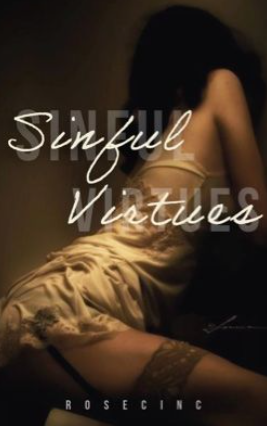
Sinful Virtues is a velvet-gloved mafia romance about power, inheritance, obsession, and the dangerous moment when a woman raised to be ornamental reveals she has been studying the architecture of the cage all along.
Who This Book Is For
This book is for readers who want their romance dark, theatrical, morally compromised, and dripping with old-family menace. If you like arranged marriage plots where the wedding is less a love story than a hostile corporate merger with guns, bloodlines, secrets, and sexual tension in every locked room, Sinful Virtues knows exactly what table it is sitting at. It is for readers who enjoy heroines who are underestimated before they weaponize silence, and heroes who believe they are in control right up until desire turns into a strategic liability.
It will especially work for readers who love the “mafia princess is not a doll” trope, the cold husband slowly unraveling trope, and the kind of romance where attraction is not presented as soft salvation but as another form of danger. The pleasure here is not innocence. It is spectacle, leverage, and the slow burn of two people realizing that marriage may be the least intimate contract between them.
Who This Book Is Not For
This is not for readers who need morally clean leads, gentle pacing, or a romance that separates love from violence with neat little borders. It is also not for anyone exhausted by alpha-male dominance, bloodline politics, possessive language, or a heroine whose agency has to fight through a world designed to erase her. If you prefer realism over operatic intensity, Sinful Virtues may feel less like a novel and more like a candlelit fever dream in a bulletproof ballroom.
Three Reasons to Recommend It
It understands that dark romance works best when desire is also a power negotiation.
The strongest thing about Sinful Virtues is that it does not treat marriage as a romantic finish line. It treats marriage as a battlefield. Roman and Angeline are not simply “forced together”; they are placed inside a system where the wedding itself is a political machine. The story’s real charge comes from watching intimacy become indistinguishable from strategy. Every look, every room, every public appearance feels like a move on a board neither character fully controls.
That gives the romance a sharper edge than the usual “he hates her until he wants her” formula. Roman’s obsession is compelling because it threatens his self-image. Angeline’s appeal is not just beauty or mystery; it is the possibility that she has been underestimated by men who mistake silence for emptiness. The book’s best tension comes from that reversal. He thinks he is receiving a wife. What he gets is a rival, a mirror, and possibly the only person dangerous enough to understand him.
Angeline is the reason the premise does not collapse into cliché.
The hidden mafia daughter could easily have been written as a decorative trauma object: beautiful, sheltered, damaged, waiting for the male lead to discover her worth. Sinful Virtues is more interesting when it resists that. Angeline’s power lies in performance. She knows what people expect her to be, and she uses that expectation like a locked blade.
That is where the book finds its most satisfying bite. The world has groomed her to be a symbol, but she has learned to read the symbolic language better than the men who invented it. She is not powerful because she becomes “one of the boys.” She is powerful because she understands that femininity, secrecy, vulnerability, and silence can all be misread by arrogant people. In a genre crowded with “strong female characters” who are mostly strong because they talk like men with better hair, Angeline’s stillness feels more dangerous. She does not need to dominate the room immediately. She lets the room underestimate her first.
The atmosphere is unapologetically excessive, and that is part of its charm.
Sinful Virtues is not subtle, but it is rarely bland. It belongs to the lush, high-drama wing of dark romance: old estates, family empires, arranged alliances, hidden scars, expensive rooms that feel like tombs, and dialogue that wants to be remembered. The book’s emotional palette is black silk, gunmetal, candlelight, bruised pride, and inheritance law written in blood.
That excess will not work for everyone, but it gives the story a strong identity. The novel knows that mafia romance is fantasy architecture: the genre is less interested in procedural realism than in turning power into mood. At its best, Sinful Virtues uses that mood to dramatize a serious question: what happens to a woman raised as currency when she starts setting her own exchange rate?
One Reason Some Readers May Bounce Off
The book can lean so hard into genre heat and dramatic intensity that the emotional realism occasionally has to sprint to keep up. Some scenes may feel designed for maximum impact before they are fully earned, and the prose sometimes favors grandeur over restraint. That is not automatically a flaw in dark romance, where heightened emotion is part of the contract, but it does mean readers looking for quiet psychological precision may find the temperature permanently set to inferno.
The sharpest critique is this: Sinful Virtues is strongest when it trusts its power games and weakest when it overexplains the heat. The chemistry is already there in the premise. The danger is already there in the marriage. The book does not always need to underline every obsession in red ink. When it lets silence do the work, it becomes far more seductive.
Editor’s Review
Sinful Virtues is the kind of dark romance that understands why readers keep returning to morally impossible love stories: not because they are healthy, but because they turn desire into a test of power. Its central hook is not merely “mafia man meets mysterious bride.” It is the collision between a man trained to inherit command and a woman trained to survive being possessed.
What makes the story click is the tension between image and agency. Angeline has been constructed as an object in other people’s narratives: daughter, alliance, bride, asset, myth. Roman enters the marriage thinking he can file her away as one more obligation of empire. The pleasure of the book lies in watching that assumption rot from the inside. Angeline does not simply disrupt his plans; she exposes how unimaginative they were.
The novel’s title is doing real work. “Sinful” and “virtues” are not just pretty opposing words. They capture the book’s moral theater. In this world, loyalty can be monstrous, marriage can be transactional, protection can look like possession, and love can become indistinguishable from weakness. The story is most interesting when it refuses to pretend that virtue is clean. Angeline’s survival requires calculation. Roman’s devotion, when it emerges, is not automatically redemption. These characters are not being washed pure by love; they are being made more honest by it.
That is why the book has strong “highly addictive serial romance” energy. It is built around escalation: secrets, power shifts, charged confrontations, and the delicious humiliation of powerful men realizing they have misread the woman in front of them. It is not literary minimalism; it is a chandelier crashing in slow motion. But within its melodrama, there is a genuine emotional engine: the fantasy of being seen not as fragile, not as useful, not as owned, but as dangerous enough to be chosen on equal terms.
The caveat is that Sinful Virtues sometimes mistakes intensity for depth. The darker the genre, the more discipline matters, because shock without structure can become noise. When the book slows down and lets Roman and Angeline occupy the same emotional chessboard, it is magnetic. When it rushes toward the next grand declaration or dangerous set piece, it risks flattening its own complexity. Still, even its excesses feel consistent with its world. This is not a restrained novel pretending to be dangerous. It is a dangerous fantasy fully aware of its own perfume.
For readers who enjoy dark mafia romance with arranged marriage stakes, a heroine sharpened by confinement, and a love story that feels less like healing than mutually assured destruction with benefits, Sinful Virtues delivers exactly the kind of obsessive, quote-ready drama that keeps comment sections alive.




 千斤顶
千斤顶









 English
 简体中文
简体中文 繁體中文
繁體中文 한국 사람
한국 사람 日本語
日本語 Deutsch
 русский
 بالعربية
 TÜRKÇE
 português
 คนไทย
คนไทย french