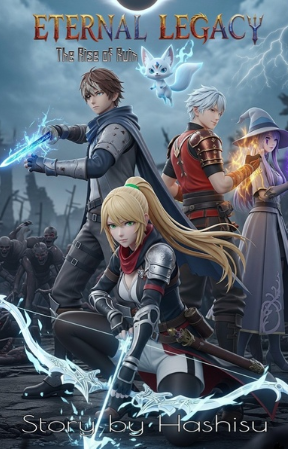
In a world on the edge of war… where chaos spreads and darkness begins to rise, one heir carries a truth powerful enough to change everything. Nathan was born with a hidden legendary bloodline, one forged in sacrifice before he was born. Unaware of his past, he lived until the day rival nations and dark forces across Tenaria, along with hidden enemies, uncovered his secret. Hunted. Forced to flee. Thrown into a destiny he never chose. As tensions rise and war threatens the world of Tenaria, Nathan must uncover the truth behind his origins before it consumes him. Alongside loyal friends who refuse to abandon him, he steps into a path filled with danger, loss, and a darkness that threatens to devour everything. But some legacies are not meant to be hidden… They are meant to rise. And when the time comes, Nathan must decide… run from his fate, or become the very force that stands against ruin. Because in the end, the fate of Tenaria… rests on his life… on the edge of oblivion.
One-Sentence Positioning:
Eternal Legacy: The Rise of Ruin is a classic destiny-driven epic fantasy built around hidden bloodlines, rising darkness, and a reluctant heir who must decide whether legacy is a blessing, a burden, or a curse wearing a crown.
Who This Is For:
This is for readers who still believe in the emotional power of old-school high fantasy: secret origins, hunted heirs, loyal companions, ancient forces, political tension, prophecy-flavored dread, and a world inching toward war. If you like stories where the protagonist is not born ready for greatness but is dragged toward it by blood, history, and necessity, this novel speaks directly to that appetite.
It is also for readers who enjoy earnest web serials with visible ambition. This is not a cynical fantasy trying to deconstruct every trope it touches. It wants grandeur. It wants pain. It wants friendship, sacrifice, mystery, and the slow ignition of a larger myth. That sincerity is one of its most important qualities.
Who This Is Not For:
This is not for readers who are tired of hidden-bloodline chosen-one fantasy, or who demand instantly polished prose, razor-tight pacing, and subversive genre reinvention from page one. The novel leans into familiar fantasy architecture rather than pretending it has never seen a prophecy before. If you need fantasy that is ironic, brutally efficient, or stylistically immaculate, this may feel too traditional and too rough-edged.
It is also not ideal for readers who dislike slow-building emotional pressure. The story appears more invested in destiny, atmosphere, bonds, and gradual escalation than in delivering a clean dopamine loop of constant victories.
3 Reasons to Recommend:
It understands the emotional appeal of the reluctant heir.
Nathan’s premise works because it does not begin with triumph. It begins with exposure. A hidden bloodline is not presented as a simple upgrade button; it is a target painted on his back. That makes the story’s central fantasy more interesting than “boy discovers he is special.” The sharper version is: what if being special is the thing that ruins your life?
That distinction matters. A legendary inheritance should not feel like a lottery win. It should feel like a debt collected by history. Eternal Legacy: The Rise of Ruin is at its strongest when it treats Nathan’s legacy as something dangerous, not decorative. He is not merely gaining power; he is being forced into a narrative other people already fear, worship, or want to control.
The world has a pleasingly classic epic-fantasy pressure cooker.
Tenaria is framed as a world already near fracture: rival nations, hidden enemies, dark forces, and a larger conflict waiting to ignite. That gives the novel a broad-canvas energy. The story is not only about one young man’s personal awakening; it is about how private identity becomes public crisis.
This is the kind of fantasy setup that works when the reader wants scale. A secret bloodline matters because kingdoms care. A single fugitive matters because war is coming. A personal mystery matters because it may reshape the balance of the world. The novel’s appeal lies in that widening circle: Nathan’s life begins as a survival problem, but slowly becomes a geopolitical and mythic problem.
Its sincerity gives the story more heart than polish.
There is something refreshingly unguarded about this kind of fantasy. It is not embarrassed by friendship. It is not embarrassed by destiny. It is not embarrassed by big emotions or dramatic stakes. In a market crowded with self-aware antiheroes and ironic genre remixes, Eternal Legacy: The Rise of Ruin feels like it is reaching for the old heroic register without apology.
That does not mean it is flawless. In fact, part of the reading experience is feeling the gap between ambition and execution. But that gap can be compelling in its own way. You can sense a story trying to grow into the size of its own mythology. For readers who value potential, emotional intent, and classic fantasy atmosphere, that roughness may feel less like failure and more like early-stage fire.
1 Turn-Off Point:
The biggest obstacle is craft unevenness. The premise is emotionally strong, but it is also familiar: hidden bloodline, hunted heir, rising darkness, loyal allies, fate of the world. To make that formula truly soar, the prose and pacing need to be sharp enough to make old ingredients feel newly dangerous.
At times, the story risks leaning too heavily on the language of destiny instead of letting scenes generate their own force. “Legacy,” “darkness,” “truth,” “fate,” and “ruin” are powerful words, but fantasy readers have seen them before. The novel’s challenge is to make those words bleed again. When it does, the story has weight. When it does not, the grandeur can feel more announced than earned.
Editor’s Comment:
Eternal Legacy: The Rise of Ruin is not a cold, polished machine of a web novel. It is something messier and more vulnerable: a young epic fantasy with a big heart, a familiar skeleton, and the kind of ambition that can either mature into something genuinely gripping or collapse under its own dramatic vocabulary.
The best way to read it is not as a finished monument, but as a forge. The metal is there: a hunted protagonist, a dangerous inheritance, a world on the verge of war, companions who matter, and an atmosphere of secrets pressing in from every side. What the story still needs is harder shaping. The emotional beats are promising, but they would hit harder with tighter pacing, more textured politics, and a willingness to let silence and consequence do some of the work that exposition currently wants to do.
That said, there is a reason this kind of fantasy remains durable. Hidden-bloodline stories work because they externalize a universal fear: that there is something inside you that will change how the world treats you once it is revealed. Nathan’s journey taps into that fear. He is not simply discovering who he is; he is discovering that identity can be weaponized by everyone around him. Enemies want to destroy him, allies want to protect him, history wants to claim him, and destiny wants to rename him before he has even decided what he wants.
That is the novel’s real hook. Not the bloodline itself, but the loss of ordinary life that comes with it.
The sharper version of this story will not be about whether Nathan is powerful. Power is the least interesting part of chosen-one fantasy. The real question is whether he can remain human while being converted into a symbol. If Eternal Legacy: The Rise of Ruin keeps pushing in that direction, it could become more than a standard rise-of-the-heir narrative. It could become a story about the violence of legacy itself.
For now, this is an earnest, emotionally charged, imperfect but promising epic fantasy. It will frustrate readers looking for sophistication from the first page, but it may win over those who still have room for sincere high fantasy told with conviction rather than irony. It has rough edges, yes. But rough edges are not always a death sentence. Sometimes they are proof that the blade is still being made.




 千斤顶
千斤顶








 English
 简体中文
简体中文 繁體中文
繁體中文 한국 사람
한국 사람 日本語
日本語 Deutsch
 русский
 بالعربية
 TÜRKÇE
 português
 คนไทย
คนไทย french