Worse than a god in rage... is a god in love. I punish lies and deceit, An eternal damnation of agony and pain. Yet, when it is my wife whose deception plagues me, I know what I must do. Shackle her soul to the lying, cold corpse that she is, Ensuring that she never escapes me. My wrath, My torture, My pain, And my pleasure. I am the King of Flesh and Bone, Every part of her I possess and own. She is mine, Death shall never do us part. Welcome home, my queen.
One-Sentence Positioning:
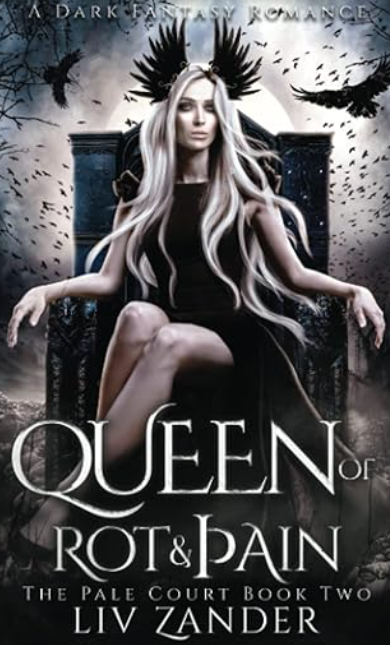
Queen of Rot and Pain is a savage, gothic, body-horror fantasy romance that turns obsession, grief, punishment, and devotion into a love story so dark it feels less like a fairytale and more like a curse that learned how to kiss.
Who This Book Is For:
This book is for readers who already know that “dark romance” means more than a brooding hero and a few sharp lines of dialogue. Queen of Rot and Pain is for the romantasy reader who wants the monster to stay monstrous, the love story to feel dangerous, and the fantasy world to smell of bone, rot, blood, old gods, and impossible grief.
It is especially suited to fans of villain romance, gothic fantasy, morally black love interests, obsessive devotion, death-marked heroines, and relationships that are built not on safety but on possession, suffering, and the terrifying idea that love can survive even when it should not. If you want a soft redemption arc, this may not be your throne. But if you want a god-king whose love feels like a prison, a battlefield, and a funeral vow all at once, this book knows exactly what it is doing.
This is also a strong pick for readers who prefer their happily ever afters to be earned through ruin. Queen of Rot and Pain is not romantic because it is gentle. It is romantic because it commits completely to its own darkness, then dares to find beauty in the aftermath.
Who This Book Is Not For:
This book is not for readers who need a traditionally heroic male lead, clean consent dynamics, cozy romantasy pacing, or a romance that behaves like emotional comfort food. The official description itself makes clear that this world contains dark themes, violence, loss, and horror elements, and the book’s entire appeal depends on the fact that its central love story is extreme, disturbing, and morally hostile.
It is also not the best entry point for readers who have not read King of Flesh and Bone. Queen of Rot and Pain is the second half of a duet, and its emotional force depends on the damage, obsession, betrayal, and worldbuilding that came before it. Starting here would be like walking into a cathedral after the altar has already burned.
3 Reasons to Recommend It:
It fully understands the appeal of villain romance.
Queen of Rot and Pain does not dress its villain in hero’s clothing. That is its greatest strength. Enosh is not softened into a misunderstood prince or quietly domesticated into a safe romantic lead. He is wrathful, possessive, terrifying, and built from the exact material that makes dark fantasy romance addictive: power, grief, hunger, and a love so absolute it becomes indistinguishable from violence.
The book’s power lies in its refusal to apologize for that fantasy. It knows the reader is not here for a clean knight. The reader is here for the god of flesh and bone, the man who would rather damn the woman he loves than release her, the figure whose devotion is as horrifying as it is magnetic. That confidence gives the novel its pulse.
The atmosphere is grotesque in the best possible way.
This is not a pretty fantasy world with a few shadows painted in the corners. Queen of Rot and Pain is drenched in decay. Its imagery leans into corpses, bone, flesh, rot, punishment, grief, and the physical horror of love surviving beyond death. That gives the romance a texture many romantasy novels lack. Desire here is not perfumed. It is cold, visceral, and half-buried.
The result is a book that feels genuinely gothic rather than merely darkly aesthetic. The Pale Court is not just a setting; it is an emotional condition. Everything about the world seems to mirror the central relationship: beautiful, ruined, inescapable, and alive in ways it absolutely should not be.
Ada’s transformation gives the darkness emotional weight.
A villain romance only works if the heroine is more than a captive audience for the villain’s intensity. Ada matters because she resists being swallowed by the myth around him. She is not simply the woman loved by a monster; she is a woman forced to become something harder, stranger, and more sovereign because of what loving and surviving him costs.
That is where Queen of Rot and Pain becomes more than shock-value romantasy. Beneath the horror and obsession is a story about a woman remade by pain. Ada’s strength is not clean empowerment. It is scar tissue. It is refusal. It is the slow, brutal evolution from victim of a god’s obsession to a queen who can stand inside that obsession and still have a will of her own.
1 Turn-Off:
The biggest turn-off is also the book’s strongest selling point: this romance is deeply, deliberately uncomfortable. Readers who want clear moral boundaries, tender emotional repair, or a love interest who becomes safe before he becomes desirable may find Queen of Rot and Pain too brutal. Its darkness is not decorative. It is structural. The book does not merely contain disturbing material; it builds its romance out of it.
Editorial Review:
Queen of Rot and Pain is the kind of dark fantasy romance that seems written for readers who are tired of monsters being tamed too quickly. Liv Zander’s sequel does not simply continue The Pale Court Duet; it deepens the rot, tightens the chain, and pushes the central relationship into territory that feels operatic, horrifying, and strangely beautiful.
What makes the book work is its commitment to excess. The emotions are not mild. The metaphors are not subtle. Love is not a healing balm; it is a wound that refuses to close. Enosh’s devotion is grand in the oldest, ugliest sense of the word: mythic, selfish, punishing, and absolute. He loves like a god who has never learned the difference between worship and ownership. That is precisely why the story is so compelling for the right audience.
The novel’s gothic force comes from the fact that death does not end the romance. If anything, death makes the bond more grotesque, more intimate, and more impossible to escape. This is a love story where the body matters, the soul matters, and neither provides freedom. That premise gives the book a uniquely claustrophobic intensity. It is not about whether love can conquer death. It is about whether love becomes more monstrous when death fails to stop it.
Ada is the necessary counterweight to all of this ruin. Without her defiance, the book would risk becoming only a portrait of obsession. With her, it becomes a battle of wills inside a marriage shaped by divinity, violence, grief, and power. Her arc gives the novel its emotional legitimacy. She is not merely acted upon; she endures, judges, resists, and changes. The title Queen of Rot and Pain is not just ornamental. It signals a transformation. Ada does not simply survive the Pale Court. She is altered by it until the crown no longer looks misplaced on her head.
The book also succeeds because it treats horror as part of the romance rather than a separate genre garnish. The grotesque imagery is not there simply to shock. It externalizes the emotional truth of the relationship. Enosh and Ada’s bond is not clean, so the world is not clean. Their love is tangled with punishment, so the magic feels punitive. Their longing is inseparable from grief, so the atmosphere feels funereal. Everything is working toward the same dark emotional thesis: some love stories are not flowers blooming in sunlight; they are bones knitting back together in the grave.
For readers who want morally comfortable fantasy romance, Queen of Rot and Pain will likely feel too much. Too cruel. Too possessive. Too macabre. Too unwilling to behave. But for readers who love villain-centered romantasy, this is exactly the appeal. The book does not offer a hero. It offers a god of rot, a queen forged through suffering, and a relationship so wrong it becomes impossible to look away from.
Queen of Rot and Pain is not a gentle romance. It is a fevered cathedral of obsession, grief, horror, and devotion. It is disturbing, dramatic, and intensely readable, with the kind of atmosphere that clings to the reader long after the final page. As the second half of The Pale Court Duet, it delivers what dark romantasy readers most want from a sequel: higher stakes, deeper wounds, uglier love, and a happily ever after that feels less like sunlight and more like two monsters choosing the same throne.




 千斤顶
千斤顶









 English
 简体中文
简体中文 繁體中文
繁體中文 한국 사람
한국 사람 日本語
日本語 Deutsch
 русский
 بالعربية
 TÜRKÇE
 português
 คนไทย
คนไทย french