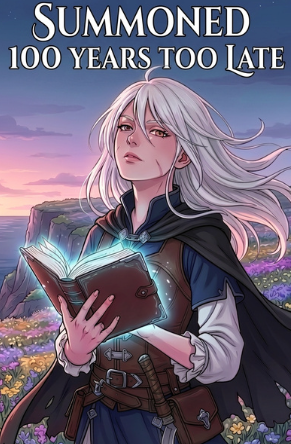
After 3,841 days of logins, Alexandra was the only player left. For ten years, she ground through daily quests on empty servers, long past the point of reason. Long past the point of quitting. Until that group quest. All alone, she was about to fail. She opened a support ticket and begged the devs to please, please save her streak. That's when the gods took her instead, and reset her streak to zero. When Alexandra arrives in a world of real magic, her guildmates are already there and have been for a century. And her old friends don’t want another player in their game. One day. One quest. One reward. They have empires and a hundred years head start. Alexandra has her streak.
One-Sentence Positioning:
Summoned A Hundred Years Too Late: A Daily Quest LitRPG is a sharply addictive progression fantasy about the last obsessive grinder in a dead game being dragged into a real magical world where everyone else already had a century-long head start.
Who This Book Is For:
This book is for LitRPG readers who understand the spiritual sickness of “just one more daily.” If you have ever logged in because of a streak, completed chores in a game long after the fun had technically expired, or felt that tiny irrational panic at the thought of missing a reward cycle, Alexandra’s story will hit with embarrassing precision.
It is especially suited to fans of portal fantasy, weak-to-strong progression, system rewards, stubborn female leads, and stories where the protagonist’s greatest flaw is also her greatest weapon. Alexandra is not summoned because she is the chosen one in the traditional sense. She is summoned because she is the one person too pathologically committed to quit. That makes the premise funny, bleak, and weirdly heroic all at once.
Readers who enjoy Azarinth Healer-style grind, incremental skill growth, survival fantasy, and “numbers go up” satisfaction will find a lot to like here. But the real hook is not just the system. It is the timing. Alexandra is not arriving at the beginning of the grand adventure. She is arriving after the other players have had a hundred years to build power, influence, empires, grudges, and whatever ugly myths form when former gamers become world-shaping figures.
Who This Book Is Not For:
This book is probably not for readers who dislike repetition as a deliberate character engine. The daily-quest structure is the point, and Alexandra’s fixation on maintaining her streak appears to shape both the plot and her personality. If you need a protagonist who always makes calm, healthy, socially graceful decisions, she may frustrate you.
It may also not be ideal for readers who want immediate empire-scale battles, instant overpowered wish fulfillment, or a clean heroic fantasy arc where the protagonist arrives, gets a legendary class, and starts effortlessly winning. The appeal here seems more grounded in compulsion, survival, mistakes, awkward social navigation, and the slow compounding of small rewards. This is progression fantasy for readers who enjoy the grind, not just the victory screen.
3 Reasons to Recommend It:
The daily-quest system is a genuinely strong LitRPG hook.
A lot of LitRPG stories rely on familiar levels, stats, classes, and skill windows. Summoned A Hundred Years Too Late stands out because it builds its emotional and mechanical identity around the daily quest. That may sound small, but it is brilliant as a narrative engine. A daily quest creates pressure every single day. It forces movement. It gives the protagonist short-term goals while quietly building long-term growth. It also turns Alexandra’s obsession into plot structure. Her flaw does not sit beside the system; it locks directly into it.
That is what makes the premise feel so satisfying. Alexandra’s addiction to routine, achievement, and completionism would be pathetic in one context. In this new world, it becomes a survival tool. The story understands that progression fantasy is not only about power. It is about ritual. Showing up. Doing the thing. Getting the reward. Doing it again tomorrow.
Alexandra is compelling because she is not effortlessly admirable.
The best thing about Alexandra, at least from the available premise and reader response, is that she sounds messy in a way that feels intentional. She is obsessive, stubborn, fallible, and capable of making bad choices. That gives the story more bite than a standard competence fantasy. She is not simply “strong” because the narrative says she is. She is strong because she cannot let go, even when letting go would be reasonable.
That kind of protagonist will not work for everyone, but it gives the book personality. Alexandra’s streak is funny until it becomes dangerous. Her discipline is admirable until it starts looking like self-destruction. Her refusal to miss a daily quest is satisfying until readers begin to wonder what she might sacrifice to keep the chain unbroken. That tension makes her much more interesting than a blank-slate isekai hero.
The “hundred years too late” twist adds real narrative weight.
The title is not just a gimmick. It changes the entire emotional architecture of the story. Alexandra is not entering a fresh game world with everyone else at level one. Her old guildmates have already been there for a century. That means the usual portal fantasy power curve is inverted. The people who should have been her peers are now legends, rulers, threats, or something worse.
This gives the story a deliciously uncomfortable social dynamic. Alexandra is not merely underleveled. She is historically displaced. She arrives with gamer habits in a world where the game has had generations to become politics, religion, empire, and trauma. Her former friends may no longer be friends. Her old assumptions may be useless. Her biggest advantage may be the one thing they no longer have: the raw, compulsive, almost ridiculous purity of someone who still believes a daily quest must be done today.
1 Turn-Off:
The biggest potential drawback is that Alexandra’s obsession may read as too narrow for some readers. A protagonist who structures her entire identity around a streak can be fascinating, but also irritating if the reader wants broader emotional range right away. The premise deliberately leans into compulsion. For the right audience, that is the magic. For the wrong one, it may feel like the heroine has one defining trait repeated too often.
Editorial Review:
Summoned A Hundred Years Too Late: A Daily Quest LitRPG has one of those premises that feels obvious only after someone else has written it. LitRPG has always been about systems, rewards, loops, and the dopamine architecture of games. This story simply takes one of the most quietly powerful loops in modern gaming—the daily quest streak—and treats it as both a magic system and a psychological condition.
That is the cleverness at the center of the book. Alexandra is not a legendary warrior, a reincarnated demigod, or a tactical genius walking into a world designed to adore her. She is the last person still logging into an abandoned game after thousands of days. There is something funny and tragic in that image: one player, empty servers, dead community, routine maintained long after meaning has collapsed. Then the gods answer her support ticket in the worst possible way. They do not save the streak. They reset it.
As an inciting incident, that is excellent. It is petty, cosmic, and emotionally precise. A normal protagonist would be horrified by being dragged into another world. Alexandra is horrified, in part, because the streak is gone. That tells the reader exactly who she is before the fantasy machinery even begins. Her priorities are warped, but they are coherent. And in progression fantasy, coherent obsession is often more compelling than generic bravery.
The late-arrival isekai angle gives the story its second major strength. A hundred-year delay is not just a power gap; it is a moral gap. What happens to players when they stop being players and become institutions? What happens to guildmates when time turns them into rulers, monsters, myths, or cowards? Alexandra’s former companions have had a century to adapt, corrupt, rationalize, and entrench themselves. She arrives as a glitch in their settled order, a reminder of what they used to be before the world became theirs.
That gives the story a stronger hook than a simple survival LitRPG. Alexandra is not only trying to level. She is entering a world already shaped by people like her, but older, stronger, and less likely to welcome competition. Her daily quests may be small, but the consequences around her are not. The gap between her modest immediate goals and the enormous political-history shadow around them gives the book room to grow.
The tone also seems well-calibrated for Royal Road readers. It promises grind, rewards, skill growth, danger, awkwardness, and the blunt pleasure of watching numbers climb. But it also hints at something more character-driven: the cost of obsession. A streak looks admirable from the outside because it suggests discipline. Inside Alexandra’s head, it may be closer to compulsion. The story’s most interesting question is not whether she can keep doing her dailies. It is whether she can learn what deserves to matter more than the streak.
That emotional question is what could elevate the novel beyond a fun system gimmick. The best progression fantasy understands that power growth is only satisfying when it changes the person carrying it. Alexandra’s daily quests may make her stronger, but they also expose her limitations. She can survive hardship. She can endure routine. She can grind. But can she trust? Can she change? Can she recognize when the quest marker is leading her somewhere morally ugly? Can she choose people over progress?
For readers who love LitRPG because of systems, Summoned A Hundred Years Too Late offers a clean and addictive mechanical promise: one day, one quest, one reward. For readers who love progression fantasy because of character transformation, it offers something sharper: a protagonist whose greatest strength may also be the thing that breaks her.
This is the kind of webnovel that understands its audience’s habits a little too well. It knows the strange pride of a streak. It knows the comfort of routine. It knows the thrill of incremental growth. And then it asks what would happen if that gaming compulsion became the only thing standing between a woman and a world where everyone else has already had a century to win.
Summoned A Hundred Years Too Late is funny, grim, game-literate, and immediately bingeable. It is not just another isekai about being transported into a fantasy world. It is a story about arriving after the party is over, after the winners have rewritten the rules, and after your only remaining advantage is the one habit nobody else was stubborn enough to keep.




 千斤顶
千斤顶










 English
 简体中文
简体中文 繁體中文
繁體中文 한국 사람
한국 사람 日本語
日本語 Deutsch
 русский
 بالعربية
 TÜRKÇE
 português
 คนไทย
คนไทย french