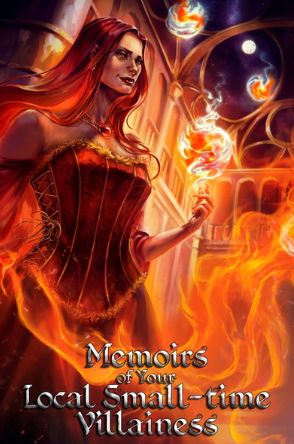
An editor at the prime of her life—and with maybe just a little too much free time—finds herself waking up in one of her favorite RPGs with no clue as to what's going on or how to get back home. This might be the part where others rejoice over getting whisked away to a world of wizards and magic, but she certainly doesn't think it's anything to celebrate about. After all, she woke up in the body of a small-time villain with some severe personality issues.
Memoirs of Your Local Small-time Villainess is a smart, slow-burn villainess isekai that turns “waking up inside an RPG” into a tense, character-driven study of reputation, restraint, power, and the exhausting art of surviving as someone everyone already thinks they know.
Who This Book Is For
This book is for readers who enjoy portal fantasy, villainess transmigration, progression fantasy, political maneuvering, magical worldbuilding, and female leads who solve problems with knowledge, planning, social control, and terrifying composure rather than raw impulsive heroics.
If you like the premise of an ordinary modern person dropped into a game world, but you want the consequences to matter, Memoirs of Your Local Small-time Villainess is an excellent fit. Scarlett does not simply wake up in a fantasy RPG and start collecting convenient wins. She wakes up as a minor villainess with a damaged reputation, complicated social ties, a dangerous future, and a personality that is not entirely under her own control. The fantasy here is not freedom. It is containment. She has power, knowledge, status, and leverage, but every advantage comes with strings.
It will especially appeal to readers who like isekai that respects its game-world premise. Scarlett’s prior knowledge is useful, but not omnipotent. She knows locations, future threats, quest logic, and hidden opportunities, but the world is alive enough to resist simple optimization. Once she starts changing events, the plot stops being a checklist and becomes a web of consequences. That is where the novel becomes more interesting than a standard “I know the game, therefore I win” story.
This is also for readers who enjoy a cold, controlled, socially intimidating heroine. Scarlett is not warm in the traditional protagonist sense. She is aloof, proud, sharp, and often misunderstood. But that is precisely what makes her fascinating. Watching her try to do the right thing while trapped behind the mask and instincts of a villainess gives the story its best tension.
Who This Book Is Not For
This is not the ideal pick for readers who want fast gratification, constant combat, immediate emotional openness, or a heroine who behaves like a modern person in a fantasy costume. Memoirs of Your Local Small-time Villainess takes its time. It spends a great deal of energy on social positioning, noble etiquette, hidden agendas, party management, magical research, reputation control, and the slow accumulation of trust.
It may also not work for readers who dislike emotionally restrained protagonists. Scarlett can be difficult to read because the story intentionally places distance between her inner motives, her outward behavior, and other characters’ interpretations of her. That distance is the point, but it can make the emotional experience colder than some readers expect from a villainess story.
Readers looking for a fluffy otome-style redemption comedy may also be surprised. There is humor, and there are plenty of misunderstandings, but the world has genuine darkness: crime, exploitation, violence, dangerous magic, political pressure, and personal guilt. This is not merely a “villainess becomes beloved by being secretly nice” comfort read. It is sharper, slower, and more morally textured than that.
Three Reasons to Recommend It
Reason 1: Scarlett is one of the more compelling villainess protagonists in web fantasy.
The central triumph of Memoirs of Your Local Small-time Villainess is Scarlett herself. The novel understands that a good villainess protagonist should not simply be a misunderstood saint wearing a black dress. Scarlett’s appeal comes from contradiction. She is intelligent, disciplined, proud, socially dangerous, and often genuinely intimidating. She is also a person trying to redirect a life built on cruelty, suspicion, and old damage.
What makes her so engaging is that redemption is not easy for her. She cannot simply smile, apologize, and become a beloved heroine. Her reputation precedes her. Her mannerisms betray her. Her inherited identity pushes her toward arrogance, distance, and a kind of brittle superiority. Even when she acts with good intentions, she often looks calculating, cold, or threatening. The gap between what she means and how others perceive her becomes one of the story’s strongest engines.
That creates a deliciously unusual character dynamic. Scarlett may be trying to prevent disasters, rescue people, gather power, and prepare for future threats, but she must do so while maintaining the image of a noblewoman who cannot afford softness. The result is a heroine who often does kind things in the most suspicious possible way. She helps people while sounding like she is issuing a warning. She saves lives while preserving deniability. She earns loyalty almost by accident because her version of care looks like ruthless competence.
This makes her more memorable than the average transmigrated protagonist. She is not merely using game knowledge to win. She is fighting a war on three fronts: against the game’s future, against the world’s expectations, and against the shape of the person whose life she has inherited.
Reason 2: The game knowledge remains relevant without flattening the story.
Many isekai and LitRPG stories make one of two mistakes. Either the protagonist’s game knowledge solves everything too easily, or the story discards that knowledge so quickly that the premise becomes meaningless. Memoirs of Your Local Small-time Villainess finds a much more satisfying middle ground.
Scarlett’s knowledge matters. It gives her access to hidden opportunities, secret dangers, future events, and systems other people do not fully understand. That is part of the fun. Readers get the pleasure of watching her maneuver through the world with the quiet confidence of someone who knows where the traps are buried.
But the novel does not allow that knowledge to become a magic wand. The world is not static. People react. Relationships shift. Politics complicate simple solutions. Events do not always fit the script. The more Scarlett intervenes, the more she creates ripples that even she cannot perfectly predict. This is exactly what a game-world transmigration story needs: enough foreknowledge to reward the premise, enough unpredictability to preserve tension.
The progression elements also avoid becoming overbearing. The story has magic, advancement, combat, artifacts, dungeons, and system-like structures, but it is not drowned in stat screens. The mechanics support the narrative rather than replacing it. Scarlett’s growth is not just numerical; it is social, political, magical, and psychological. Her power increases, but so does the complexity of the life she is trying to manage.
That balance gives the novel an unusually sturdy foundation. It scratches the progression itch while still feeling like a character-driven fantasy rather than a spreadsheet with dialogue.
Reason 3: The supporting cast and social world make the story feel alive.
One of the reasons Memoirs of Your Local Small-time Villainess works over such a long span is that the world does not exist only to validate Scarlett. The supporting characters have their own histories, ambitions, loyalties, fears, and misreadings. They do not instantly trust her just because the reader knows she is trying. That resistance is crucial.
A lesser version of this story would have everyone around Scarlett quickly realize that she is secretly wonderful. This novel is more patient. Trust has to be earned. Damage has to be addressed. People who were hurt, frightened, or alienated by the old Scarlett do not simply forget. That gives the interpersonal drama real weight.
The noble setting is also handled with unusual care for a web serial. Scarlett’s status is not just decorative. It shapes how she speaks, what she can do, what others expect from her, and what mistakes she cannot afford. The story understands that aristocratic power is performance as much as privilege. A noblewoman’s posture, language, silence, generosity, cruelty, and public decisions all become part of the political game.
This is why the misunderstandings work so well. They are not random sitcom confusion. They grow from the difference between Scarlett’s internal motives and the social language available to her. She may be trying to be protective, but she sounds imperious. She may be trying to be careful, but she looks secretive. She may be trying to change, but the world has every reason to doubt her. That tension creates both humor and pathos.
The result is a cast that feels less like a collection of followers and more like a network of relationships slowly being renegotiated. Scarlett is not just leveling up. She is rebuilding the meaning of her own name.
One Caveat
The biggest caveat is pacing. Memoirs of Your Local Small-time Villainess is a slow-burn serial, and the opening stretch asks readers to invest in setup, reputation management, character positioning, and the mechanics of Scarlett’s new life before the larger machinery fully reveals itself.
For some readers, that patience will be rewarded richly. For others, the story may feel too measured, especially if they come in expecting immediate revenge, constant combat, or quick emotional payoffs. Scarlett’s restrained personality can also make the story feel cool at times. The novel is very good at showing her control, but that same control may frustrate readers who want direct vulnerability or explosive catharsis.
In other words, the book’s strongest artistic choice is also its main barrier: it commits fully to the difficulty of living as Scarlett. That difficulty is fascinating, but it is not always fast.
Editorial Review
Memoirs of Your Local Small-time Villainess is one of the more confident executions of the villainess-isekai premise on Royal Road because it understands the true horror of the setup. The horror is not simply waking up in another world. The horror is waking up inside a role.
Scarlett does not enter the story as a blank-slate heroine with a convenient title and a pretty mansion. She enters as a known quantity, and that is far worse. People have already judged her. Servants have already learned how to fear her. Allies and enemies have already formed expectations around her behavior. Her body, voice, reputation, and social position all speak before she does. Even when a modern consciousness attempts to redirect the course of events, the world keeps answering the person it believes Scarlett to be.
That is the novel’s most interesting insight. A villainess is not merely someone who has done bad things. A villainess is a social construct. She is a story other people tell about danger, pride, selfishness, power, and cruelty. Scarlett’s challenge is not only to survive the game’s plot. It is to revise that story without making it obvious that she is trying.
Flameruner builds the novel around that tension with impressive patience. Scarlett’s game knowledge gives the story its progression structure, but her reputation gives it emotional and social stakes. She knows things she should not know. She can locate opportunities others would miss. She can prepare for threats long before they arrive. Yet all of that knowledge has to pass through the narrow channel of her persona. She must act, but not too openly. Help, but not too warmly. Change, but not so abruptly that suspicion becomes more dangerous than hostility.
That is what makes the book more than a familiar power fantasy. The reader is not simply watching someone become stronger. The reader is watching someone learn the cost of appearing strong all the time. Scarlett’s coldness is useful. Her authority is useful. Her ability to intimidate is useful. But these tools also isolate her. They protect her while preventing others from seeing her clearly. The character drama lies in whether she can use the villainess mask without being consumed by it.
The RPG-world framework remains satisfyingly functional throughout. This is a story where prior knowledge matters, and that is refreshing. Scarlett’s understanding of quests, hidden resources, future dangers, and world mechanics gives the narrative a strategic pleasure. Watching her exploit information is fun because the book does not pretend she is just lucky. She plans. She prioritizes. She prepares.
But the game has become a world, and that distinction matters. People are not NPCs simply waiting for the correct dialogue option. They have pride, resentment, fear, loyalty, and private motives. When Scarlett changes the timeline, the world changes back at her. That push and pull keeps the story from collapsing into a simple optimization exercise.
The supporting cast is one of the book’s major strengths. Characters such as those around Scarlett do not merely exist to admire her competence. They react to her presence from their own emotional positions. Some distrust her. Some are baffled by her. Some begin to respect her before they understand her. Some are pulled into her orbit because she gives them something they need, even if she does so with the warmth of a drawn blade. That gradual evolution of relationships is more satisfying than instant found family because the story makes trust feel like labor.
The prose also suits the premise. It carries a formal edge that fits Scarlett’s noble identity and the high-fantasy setting. The dialogue often reinforces class, distance, and status, which helps the world feel less like modern people wearing medieval costumes. This matters in villainess fiction. The fantasy of nobility only works if social performance has consequences, and here it does. A gesture can be a threat. A favor can be leverage. A silence can become strategy.
The novel is not without flaws. Its deliberate pacing can test readers who want a faster plot. The sheer scale of the serial means some arcs naturally breathe longer than others. Scarlett’s controlled affect, while thematically appropriate, can create emotional distance. And readers who dislike slow political and interpersonal maneuvering may feel that the story takes too long to reach its larger confrontations.
Still, those caveats are inseparable from what makes the book distinctive. Memoirs of Your Local Small-time Villainess is not trying to be a quick-hit wish-fulfillment isekai. It is interested in the friction between knowledge and identity, intention and perception, power and isolation. It asks what happens when a person with modern memories must live inside a character whose entire social existence resists sincerity.
The answer is a story that is frequently clever, often funny, occasionally grim, and surprisingly moving in its quieter moments. Scarlett’s journey is not about becoming good in the simplistic sense. It is about learning how to act with purpose inside a role designed for harm. It is about using a villainess’s tools against the future that made her necessary. It is about discovering whether a reputation built on fear can be redirected into something like protection.
For readers who love villainess stories, game-world transmigration, progression fantasy, noble politics, and heroines who are more formidable than cuddly, Memoirs of Your Local Small-time Villainess is an easy recommendation. It is not the loudest isekai on the shelf, but it is one of the more thoughtful ones. Its pleasures are cumulative: a sharper plan, a changed relationship, a hidden threat avoided, a misunderstanding weaponized, a cold word that somehow becomes an act of care.
In a genre full of protagonists who escape into fantasy to become free, Scarlett’s story is more interesting because she escapes into fantasy and becomes trapped in a reputation. Watching her turn that trap into a throne is the reason to keep reading.




 千斤顶
千斤顶











 English
 简体中文
简体中文 繁體中文
繁體中文 한국 사람
한국 사람 日本語
日本語 Deutsch
 русский
 بالعربية
 TÜRKÇE
 português
 คนไทย
คนไทย french