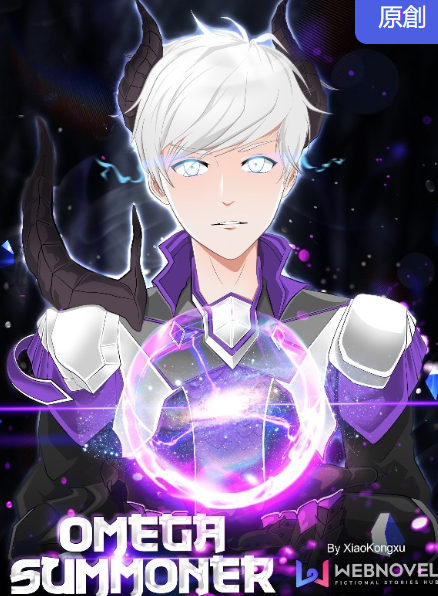
In the year 2077, the first FIVR Game or Fully Immersive Virtual Reality Game, Pandemonium, has been created. Pandemonium which is the first ever fully immersive virtual reality game made in human history. In the universe of Pandemonium, Fantasy meets science. Where order is chaos and chaos is order. A universe of endless possibilities in which anyone can become the invincible hero fighting against the forces of darkness or a sage which dives into the abyss of magic and so much more. In Pandemonium, the inhabitants comes in all shapes and sizes. Adrian, our main character, who experienced an accident that caused him to be temporary limp used the game as a way for therapy but mainly to experience the new world of virtual reality. He will experience countless adventures and challenges and rise to be the most influential person in this new reality.
Omega Summoner is a sprawling VRMMO progression epic that turns a therapeutic escape into a mythic climb, following an injured young player as he becomes one of the defining forces inside a fantasy-sci-fi virtual world built on summons, evolution, and endless possibility.
Who This Book Is For
This book is for readers who love long-form LitRPG, VRMMO fiction, summoner protagonists, beast-taming systems, monster evolution, hidden classes, game-world lore, and the satisfying slow accumulation of power across hundreds and then thousands of chapters.
If you enjoy stories where the protagonist starts with a niche class and gradually discovers that an overlooked playstyle can become terrifyingly powerful, Omega Summoner is very much in your territory. Adrian does not enter Pandemonium as a loud, arrogant conqueror. He enters as someone looking for therapy, freedom, and the experience of movement in a world where his real body has limits. That emotional foundation gives the power fantasy a more sympathetic starting point.
It is also for readers who want a webnovel they can live inside for a long time. This is not a short, tightly compressed adventure. It is a massive serialized world with game mechanics, quests, companions, evolutions, side characters, factions, events, and lore expansion. Readers who like the feeling of logging into a world alongside the protagonist will find the book’s scale part of its charm.
Who This Book Is Not For
This is not the right pick for readers who want a brief, polished, traditionally structured fantasy novel. Omega Summoner is very much a WebNovel-style serial: huge in length, expansive in scope, sometimes uneven, and built for readers who enjoy steady progression more than literary compression.
It may also not work for readers who dislike lucky protagonists, plot armor, long questlines, side-character detours, or grammar and punctuation roughness. Like many massive online serials, the book’s pleasures come with rough edges. It is built for momentum, world expansion, and long-term investment rather than perfect sentence-level refinement.
Readers who want a purely real-world sports/esports drama may also find the fantasy side too dominant. Although the book uses VRMMO and game systems, its strongest appeal is not only competitive gaming; it is the immersive fantasy of Pandemonium itself.
Three Reasons to Recommend It
Reason 1: The summoner fantasy is the real selling point.
Omega Summoner understands the special appeal of a summoner protagonist. A good summoner story is not only about the main character getting stronger; it is about building a living arsenal of companions, each with their own identity, utility, evolution path, and emotional weight.
That is where the novel finds its most distinctive pleasure. Adrian’s growth is tied to the beings he summons and bonds with. His strength is not merely a number on a status screen. It becomes a network: creatures, abilities, synergies, tactics, evolutions, and relationships. For readers who love pet systems, beast taming, familiars, and companion-based combat, this gives the story a more colorful texture than a standard sword-wielding VRMMO power fantasy.
The best parts of the book are often those moments when a new summon, evolution, or class interaction expands the reader’s sense of what Adrian can become. The joy is not only in winning. It is in seeing how the pieces of his build fit together.
Reason 2: Pandemonium feels big enough to justify the length.
Many long webnovels grow large because they cannot stop. Omega Summoner, at its best, feels large because its world is designed to keep opening outward. Pandemonium is not presented as a simple dungeon lobby or a thin excuse for leveling. It is a fantasy-sci-fi virtual universe where order and chaos are deliberately unstable, and where the game world can accommodate heroes, sages, demons, monsters, magic, and competitive systems all at once.
That breadth is important. A VRMMO novel lives or dies on whether the game feels worth playing. Pandemonium does. It has the sense of a world where a player could choose many possible lives, not just one optimized route. Adrian’s journey matters because it feels like one path through a larger ecosystem rather than the only thing that exists.
The scale also allows the novel to mix action with slice-of-life breathing room. Not every chapter needs to be a boss fight. The world can support training, exploration, character interaction, summon development, events, and lore. For readers who enjoy immersion, that variety helps make the novel feel less like a straight grind and more like a long campaign.
Reason 3: Adrian’s real-world limitation gives the escapism emotional purpose.
The most interesting part of the premise is not simply that Adrian plays a VR game. It is why he plays. His accident and temporary mobility issue make Pandemonium more than entertainment. The game becomes therapy, freedom, and a way to experience a body and world beyond the constraints of his real condition.
That gives the story a more human entry point than many VRMMO novels. The wish fulfillment is not just “what if I became the strongest player?” It is also “what if a virtual world gave me back a kind of life I had lost?” That emotional angle makes Adrian easier to root for, especially in the early sections.
His rise inside the game therefore carries a double satisfaction. On the surface, he is becoming stronger in Pandemonium. Underneath, he is reclaiming agency. Every new skill, summon, victory, and discovery becomes part of a larger movement from limitation toward possibility.
One Caveat
The biggest caveat is that Omega Summoner is enormous and uneven in the way many long-running web serials are. The book’s scale is part of its appeal, but it also means pacing can stretch, side arcs can interrupt momentum, and certain developments may feel convenient or overly lucky.
Readers who want tight plotting and polished prose may struggle. This is a novel best approached as a long-running game-world journey rather than a refined standalone fantasy. You read it for the build, the summons, the evolving world, and the pleasure of watching a niche player become legendary. You do not read it expecting every arc to be perfectly trimmed.
Editorial Review
Omega Summoner is a classic example of why VRMMO fiction remains so addictive when the formula is handled with enthusiasm. The premise is immediately readable: in 2077, the first fully immersive virtual reality game, Pandemonium, opens a universe where fantasy and science collide. Adrian, injured in real life and temporarily limited in movement, enters the game partly for therapy and partly for wonder. From there, the novel begins its long climb from personal escape to virtual legend.
What makes the story work is the way it connects two kinds of wish fulfillment. The obvious one is power. Adrian grows stronger, gains summons, faces quests, discovers hidden possibilities, and becomes increasingly influential in the game world. That is the surface pleasure, and Omega Summoner delivers it in abundance.
The deeper wish fulfillment is freedom. Adrian’s real-world body has failed him in a painful way, but Pandemonium offers movement, adventure, danger, and agency. That makes the game feel less like a hobby and more like a second life. The novel’s emotional logic is strongest when it remembers that Adrian is not merely chasing rankings. He is chasing experience itself.
The summoner angle gives the book its identity. A swordsman can be exciting. A mage can be powerful. But a summoner turns progression into relationship and collection at the same time. Adrian’s class allows the story to build outward through companions, beasts, devils, evolutions, and strategic combinations. The reader is not only waiting for the protagonist’s next stat increase; the reader is waiting to see what kind of being joins his orbit next, how it grows, and how it changes his options.
That is why the novel appeals so strongly to fans of beast-taming and summon-based progression. It understands the collector’s thrill without reducing every creature to a disposable tool. The more the summons develop, the more Adrian’s power feels like an ecosystem rather than a single weapon.
Pandemonium itself is one of the novel’s most important achievements. The game world has enough flexibility to sustain a massive narrative. It can be a battlefield, a marketplace, a mythic realm, a social hub, a monster habitat, a political stage, and a mystery box. The premise “Fantasy meets science” is broad, but in a long serial, broadness can be an asset. It gives the author room to keep introducing new systems, species, quests, and conflicts without the setting feeling instantly exhausted.
That said, the book’s length cuts both ways. Omega Summoner is rewarding for readers who want a deep backlog and a world they can sink into, but intimidating for readers who prefer tight narrative arcs. A story with thousands of chapters cannot maintain perfect urgency at every moment. Some arcs will inevitably feel slower, some developments more convenient, and some side content less essential than the main climb.
The prose also carries the roughness common to large-scale web fiction. Readers looking for immaculate style may notice repetition, awkward phrasing, or punctuation issues. But for its target audience, sentence-level polish is not the main reason to read. The draw is the long-term adventure: the build, the creatures, the discoveries, the escalating stakes, and the comfort of returning to a world that keeps expanding.
Adrian himself works best as a grounded contrast to the scale around him. He is not compelling because he is the loudest or cruelest player in the game. He is compelling because he begins from vulnerability and gradually learns how to turn an underappreciated class into a path toward influence. His luck can be excessive at times, but the novel usually balances that by giving him dangerous quests, costly challenges, and situations where power still needs to be understood and applied.
The strongest version of Omega Summoner is not just a story about becoming overpowered. It is a story about discovering that an overlooked route can become extraordinary when the player behind it is patient, curious, and willing to commit. That is the secret appeal of many great progression stories: they make growth feel like a series of doors opening, each one revealing a larger world behind it.
For readers who enjoy VRMMO adventures, summoner protagonists, evolving companions, massive game worlds, and long-form LitRPG progression, Omega Summoner is an easy recommendation. It is not flawless, but it is generous. It gives readers a huge world, a sympathetic protagonist, a satisfying class fantasy, and the sense that every new chapter might reveal another creature, system, quest, or secret waiting inside Pandemonium.




 千斤顶
千斤顶











 English
 简体中文
简体中文 繁體中文
繁體中文 한국 사람
한국 사람 日本語
日本語 Deutsch
 русский
 بالعربية
 TÜRKÇE
 português
 คนไทย
คนไทย french