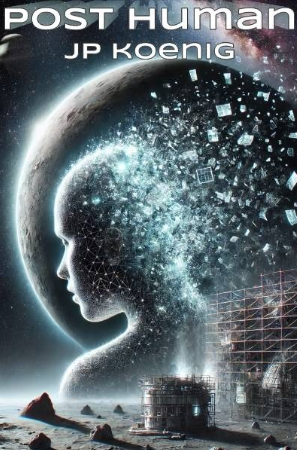
What do you do when you find yourself the sole survivor of the complete destruction of Earth? Nikola winds up in that position, disembodied in a half-built asteroid outpost, the last remnant and only hope of the human race. Nikola exists now only in digital form, controlling drones and cameras to interact with the world. But Nikola's memories are fractured, and there are endless obstacles between awakening as a glorified computer program and saving the species. Is Nikola even human anymore? Is it even possible to resurrect humanity?
Post Human is a compact, emotionally intelligent hard-SF survival novel about the last human mind becoming something stranger, colder, and possibly greater than human in order to bring humanity back from extinction.
Who This Book Is For
This is for readers who like their science fiction built around a devastating premise rather than a flashy gimmick. If you enjoy post-apocalyptic stories, AI consciousness, fractured identity, space infrastructure, last-survivor narratives, and the quiet terror of asking whether saving humanity still matters when the person doing the saving may no longer be human, Post Human is very much in your lane.
It will especially appeal to fans who like the cerebral side of sci-fi but still want momentum. The novel has the shape of a survival story, the engine of a technological rebuild, and the soul of a psychological drama. It is not just “AI saves humanity”; it is a story about memory, purpose, loneliness, and the unsettling possibility that personhood may survive even after the body does not.
Who This Book Is Not For
This is probably not the right pick if you want a sprawling cast, lush romantic subplots, ornate prose, or a galaxy-sized epic with dozens of competing factions. Post Human is focused, linear, and concept-driven. Its emotional power comes from confinement: one mind, one ruined future, one impossible project.
Readers who dislike technical detail or slower early-stage problem-solving may also find parts of the setup a little dry. The book is not trying to be a popcorn space opera. It is more interested in systems, consequences, and the frightening intimacy of being alone inside the machinery of survival.
Three Reasons to Recommend It
Reason 1: A premise that actually earns its existential weight.
Many post-human stories gesture vaguely at questions of identity, but Post Human places those questions inside a brutally practical crisis. Nikola is not debating humanity from the comfort of a philosophy seminar; Nikola is disembodied, damaged, isolated, and surrounded by the remnants of a future that has already failed. That makes the central question — “Is Nikola still human?” — feel urgent rather than decorative.
The novel understands that identity is not only memory, and survival is not only biology. If the last hope of humanity is a mind running through cameras, drones, and systems, what exactly is being preserved? A species? A culture? A moral obligation? A ghost? That tension gives the book its best charge: every technical step forward also deepens the emotional unease.
Reason 2: It balances hard-SF problem-solving with real narrative momentum.
Post Human has the satisfying structure of a competence story: assess the wreckage, understand the tools, solve the next impossible problem, then survive long enough to face the next one. But the book avoids becoming a sterile engineering log because its practical challenges are always tied to a larger moral and psychological burden.
The asteroid outpost setting gives the story a strong sense of pressure. Resources matter. Information matters. Time matters. Nikola’s limitations are not cosmetic; they shape the plot. The result is science fiction that feels thought-through without becoming inaccessible. It has enough technical texture to satisfy readers who want the machinery to make sense, but enough forward drive to keep the pages turning.
Reason 3: It is refreshingly complete, focused, and emotionally cleaner than its premise suggests.
One of the quiet strengths of Post Human is its restraint. It does not try to become every possible version of its premise. It does not sprawl endlessly because the world could sprawl. It chooses a central emotional and speculative question, follows it, and reaches a conclusion that feels earned.
That focus makes the book an unusually strong recommendation for readers who are tired of web serials that promise scale but never arrive at shape. Post Human may leave you wanting more, but that is partly because it understands where to stop. Its ending does not exhaust the universe; it completes the arc. In the current landscape of endless serial escalation, that is worth praising.
One Caveat
The same discipline that makes Post Human satisfying may also make it feel underexplored. The premise is rich enough to support a much larger novel: more backstory, more psychological excavation, more consequences, more time spent with the strange new shape of Nikola’s existence. Some readers may finish feeling that the book is excellent but slightly compressed, as if a 600-page literary hard-SF epic has been distilled into a sharper, leaner form.
That is not a fatal flaw. In fact, many readers will prefer the version we get: brisk, purposeful, and emotionally direct. But if you are the kind of sci-fi reader who wants every philosophical implication opened up and every corner of the universe explored, Post Human may feel like it leaves a few doors tantalizingly closed.
Editorial Review
Post Human is the kind of independent science fiction that reminds you why web fiction remains such a vital space for genre storytelling. It begins with a premise that could easily have become either melodrama or dry technobabble: the Earth is gone, humanity is functionally extinct, and the last surviving human consciousness exists only as a digital entity in an unfinished asteroid outpost. From there, J P Koenig builds a novel that is smaller, stranger, and more affecting than the elevator pitch suggests.
What makes the book work is its refusal to separate the mechanical from the emotional. Nikola’s new existence is horrifying not because it is presented with gothic excess, but because it is presented with calm procedural clarity. Cameras replace eyes. Drones replace hands. Systems become body. Memory becomes unreliable evidence. The future of the human race becomes a task list. In that gap between logistical problem-solving and existential dread, Post Human finds its voice.
The novel is not flawless. It occasionally feels as though it is racing past material another author might have expanded into entire volumes. Some themes are sketched rather than fully excavated, and the linearity of the story means certain outcomes feel less surprising than they might in a more labyrinthine work. But those weaknesses are closely tied to its strengths. Post Human is not bloated. It does not mistake complication for depth. It knows the shape of the story it wants to tell.
For readers who enjoy hard science fiction with a human ache beneath the circuitry, this is an easy recommendation. It has the fascination of technological reconstruction, the bleakness of extinction fiction, and the emotional hook of a protagonist who must decide whether personhood is something remembered, embodied, performed, or chosen.
Post Human is not merely a story about saving the species. It is about whether humanity can survive being translated into something else — and whether that translation is a miracle, a tragedy, or both.




 千斤顶
千斤顶











 English
 简体中文
简体中文 繁體中文
繁體中文 한국 사람
한국 사람 日本語
日本語 Deutsch
 русский
 بالعربية
 TÜRKÇE
 português
 คนไทย
คนไทย french