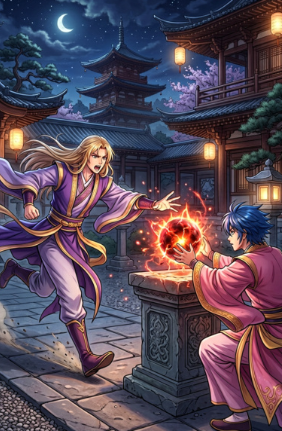
Faust aims for the Nascent Soul realm. He doesn't believe he has the capability to go higher and is satisfied if he can achieve that level, one that commands respect across the whole continent, he'll be able to pass on peacefully in the future. So, in preparation for his younger sister entering the sect, Faust pushes for his breakthrough and enters the Inner Sect of the Clear Mirror Sect, taking the new disciple induction mission. He thinks its going to be just like the new disciples from the past three selections. However... The disciples of this selection are full of prodigies from prestigious clans and talents from around the continent, matching or even surpassing the great sects that put the Clear Mirror sect to shame in ordinary years. Even Heavens Gaze is fixated on the new disciples, signalling a heaven's favoured among them. With countless stories of the heavens favoured, Faust is drenched in sweat as he worries for the fate of Clear Mirror sect. Will his plan to live leisurely and raise his family into a fledgling Nascent Soul clan be alright?
Xianxia Senior Brother of a Heavens Favoured is a clever, grounded Western xianxia that flips the usual “chosen one” fantasy sideways, putting the real emotional weight on Faust: a diligent senior brother who does not want to shake the heavens, only to survive them, manage a sect full of disasters, and quietly build a future strong enough to protect his family.
Who This Book Is For
This book is for readers who love cultivation fiction but are tired of every protagonist being a reckless miracle machine with a golden finger, an immortal ghost, ten secret bloodlines, and the social instincts of a flaming sword.
It is especially suited for xianxia fans who enjoy sect life, realm progression, junior-senior dynamics, resource management, martial politics, mission arcs, cultivation foundations, and the comedy of a sensible person being forced to supervise people who behave exactly like genre protagonists. Faust is not compelling because he is destined to become the strongest being in existence by next Tuesday. He is compelling because he has a realistic goal, a cautious temperament, a disciplined approach to cultivation, and the misfortune of being surrounded by the sort of young geniuses who normally drag entire sects into calamity.
Readers who enjoy “competent adult in a world of main-character chaos” storytelling will probably have the best time here. The novel’s central pleasure is watching Faust try to maintain order in a xianxia environment where heaven-favoured disciples, prestigious clans, reckless prodigies, sect hierarchies, and suspiciously convenient opportunities all keep threatening his very reasonable plan to live comfortably and raise his family into a modest Nascent Soul clan.
Who This Book Is Not For
This may not be the right novel for readers who want an instant power fantasy where the protagonist crushes everyone from chapter one, finds ancient treasures every five minutes, and declares war on the heavens before breakfast. Faust’s appeal is more measured. He is strong, smart, and capable, but the story’s tone is less about instant domination and more about earned competence, social awareness, and practical survival.
It may also not fully satisfy readers who want perfectly polished prose from the opening chapters. Public reader feedback repeatedly suggests that the story improves over time, but also that the early writing can feel slightly awkward, with some trope-heavy side characters and descriptions that may need editing. Readers willing to give a promising serial room to grow will likely be more forgiving than readers who expect a fully refined traditional novel from page one.
3 Reasons to Recommend It
Reason One: It refreshes xianxia by moving the spotlight away from the obvious chosen one.
The title tells you the trick immediately, and it is a good one. This is not simply “the heaven-favoured protagonist rises.” It is about the senior brother near that gravitational disaster. That shift changes everything.
In most xianxia novels, the heaven-favoured figure is the center of the world. They stumble into inheritances, offend aristocrats, collect beauties, awaken impossible physiques, and somehow turn every minor errand into a continental incident. Xianxia Senior Brother of a Heavens Favoured asks a much funnier and more interesting question: what does that look like from the perspective of a responsible cultivator who actually understands consequences?
Faust’s situation gives the story its distinctive flavor. He is not a nobody, and he is not a helpless bystander. He is an Inner Sect disciple with skill, ambition, and a plan. But his plan is not world conquest. He wants to reach Nascent Soul, earn respect, protect his family, and live long enough to enjoy the results. That modesty makes him stand out in a genre addicted to cosmic escalation.
The result is a xianxia that feels familiar without feeling stale. You still get sect recruitment, realms, prodigies, young masters, mysterious old powers, dangerous missions, and escalating stakes. But instead of placing us inside the head of the most absurdly blessed person in the room, the story lets us follow someone smart enough to recognize that heaven-favoured people are not just lucky — they are hazardous weather events.
Reason Two: Faust is a strong protagonist because his competence feels earned.
Faust’s greatest advantage is not a cheat system. It is not a cosmic bloodline. It is not an immortal grandfather whispering spoilers into his ear. His strength comes from preparation, caution, analysis, and a willingness to do the slow work that xianxia protagonists often skip.
That makes him refreshing. He thinks about cultivation as foundation, not just breakthrough. He understands that social relationships matter. He reads situations before acting. He is powerful enough to be respected, but not so arrogant that the world bends automatically around him. Public reader reactions repeatedly point to this quality: Faust feels smart, dedicated, and grounded in a way that distinguishes him from more exaggerated genre heroes.
This is important because xianxia can become numbingly repetitive when every protagonist succeeds because fate keeps cheating on their behalf. Faust’s appeal is different. He succeeds because he has built himself carefully. He may benefit from good timing or fortunate circumstances, but the story frames those moments against a background of discipline and practical judgment. That makes his victories more satisfying.
He also gives the novel a subtly comic emotional anchor. Faust does not want to become the center of heavenly drama, which of course makes him the perfect person to be dragged into it. His reluctance is not cowardice; it is wisdom. In a genre where half the cast treats danger like a personal branding opportunity, Faust’s desire for stability feels almost radical.
Reason Three: The story balances cultivation action with sect-life humor and social texture.
One of the best signs for a xianxia serial is whether the world feels like more than a ladder of realms. Xianxia Senior Brother of a Heavens Favoured has the ingredients to make its sect environment enjoyable: senior and junior disciples, recruitment trials, class and clan differences, inner-sect pressure, dangerous missions, cultivation politics, and characters whose personalities clash in ways that create comedy as well as conflict.
The Clear Mirror Sect setup is especially useful because it gives the story a home base. Faust is not wandering randomly from ruin to ruin. He has institutional responsibilities. He has juniors to deal with. He has a sister to worry about. He has a sect whose future may be destabilized by the arrival of prodigies and a heaven-favoured disciple. That gives the novel a stronger social framework than many progression stories.
The action also has promise. Chapter titles and available excerpts point toward missions involving spirit beasts, dragons, demonic sects, trading, travel, and imperial-capital politics. That suggests a story expanding outward from sect management into broader xianxia stakes, while still keeping Faust’s grounded perspective as the stabilizing force.
The humor is another major selling point. The novel seems aware of the absurdity of xianxia conventions without becoming a pure parody. It plays with familiar tropes — heaven’s chosen candidates, ring-grandpa energy, reckless prodigies, prestige clans, young geniuses — but it still takes the cultivation world seriously enough for the stakes to matter. That balance is difficult to pull off, and when it works, it makes the story feel both affectionate and fresh.
One Drawback
The biggest drawback is that the early execution may feel rough around the edges. Some readers praise the pacing and premise, but others point to awkward phrasing, repetitive description, trope-heavy character behavior, and side characters who can feel exaggerated before they develop. For a Royal Road serial that is still ongoing and relatively young, that is not unusual, but it does matter.
The story’s best qualities appear to strengthen as it progresses, so readers who judge entirely from the first few chapters may not see its full appeal. This is a novel with a strong concept and a highly readable protagonist, but it may need editorial polish before it feels as smooth as the best professional cultivation fiction.
Editor’s Review
Xianxia Senior Brother of a Heavens Favoured succeeds because it understands that the most interesting person in a cultivation story is not always the one blessed by heaven. Sometimes it is the person standing nearby, sweating through his robes because he knows exactly what happens when heaven starts playing favorites.
That is the brilliance of Faust as a protagonist. He is not written as a wide-eyed underdog screaming that he will defy fate. He is not a destiny-drunk prodigy who confuses arrogance with ambition. He is a cultivator with a plan. A modest plan, by xianxia standards: reach Nascent Soul, earn continental respect, raise his family’s future, and live comfortably without provoking cosmic disaster. In another genre, this would be ordinary ambition. In xianxia, it is almost comically sane.
The novel’s core joke — and its core tension — is that sanity may not be enough. Faust enters the Inner Sect and takes on a seemingly routine induction mission, only for the new disciple selection to produce an absurd crop of prodigies. The Clear Mirror Sect, apparently not used to this density of talent, suddenly finds itself surrounded by the kind of people who normally come with prophecies, inheritances, dead clans, mysterious masters, and enemies above their weight class. Faust knows the stories. He knows what heaven-favoured disciples do to the places around them. His concern is not jealousy. It is risk assessment.
That makes the story more interesting than a standard chosen-one climb. The heaven-favoured figure may be the obvious spark, but Faust is the reader’s lens into the machinery of the world. Through him, cultivation becomes less about shouting at clouds and more about long-term planning. Realms matter. Foundations matter. Social positioning matters. Sect responsibility matters. Survival is not only a question of who has the bigger technique, but who understands when not to use it.
This gives the novel a satisfying adultness that many xianxia stories lack. Faust is not humorless, but he is practical. He is not weak, but he is not recklessly drunk on his own strength. He is capable of seeing junior disciples not just as rivals, comic relief, or future love interests, but as liabilities, responsibilities, and potential catastrophes. That perspective turns familiar sect-life scenes into something fresher. A recruitment trial is not merely an opportunity for young geniuses to show off. It is also a logistical, political, and existential headache for the people who must manage the aftermath.
The story’s best quality is this inversion of genre expectation. Traditional xianxia often rewards the protagonist for being unreasonable: offend the stronger enemy, steal the treasure, break the taboo, survive through luck, repeat. Xianxia Senior Brother of a Heavens Favoured finds humor and drama in a protagonist who understands why that behavior is terrifying to everyone else. Faust is not there to stop the genre from happening. He is there to survive it.
That gives the novel strong comedic potential, but it is not only a comedy. The cultivation framework is handled with enough seriousness to keep the story from floating away. The realms, sect hierarchy, missions, and power differences create real pressure. Faust’s competence is enjoyable because the world around him is not harmless. He can plan well and still be blindsided. He can understand the rules and still be dragged into situations shaped by people who appear to have plot armor.
The supporting cast seems designed to embody different xianxia energies. There are prodigies, clan talents, reckless young disciples, eccentric companions, and the unmistakable presence of a heaven-favoured orbit. Some readers have criticized certain side characters as tropey, and that criticism is fair enough. But the tropiness also appears to be part of the point. The story is built around the collision between recognizable xianxia archetypes and a protagonist who reacts to them like someone who has read the disaster reports.
That said, the novel works best when the characters begin to grow beyond the joke. Faust is already strong enough to hold the story together, but the long-term success of the serial will depend on whether the “heaven-favoured” and the surrounding disciples become more than genre commentary. The early signs are promising: readers note improvement over time, and the best reviews praise the character interactions, pacing, and increasing engagement. Still, the story’s biggest challenge will be transforming parody-adjacent archetypes into people readers care about on their own terms.
The prose is serviceable and often readable, though not invisible. Public reviews point out repetition, awkward phrasing, and descriptive roughness, and those issues may be noticeable to readers who are sensitive to style. But they do not appear to destroy the core experience. More importantly, the author seems to have a strong grasp of pacing. Several reader comments praise the way scenes move, the way the plot avoids dragging, and the way the story becomes easier to invest in as the chapters continue.
For Western readers interested in xianxia, this is a particularly useful entry because it understands the genre from inside the trope machine. It is not embarrassed by cultivation fiction. It likes the sects, the realms, the dramatic young talents, the ancient methods, and the martial absurdity. But it also has enough self-awareness to ask: what if the real protagonist was the competent senior brother trying to keep the whole thing from exploding?
That question gives the book its charm. Faust is not anti-xianxia. He is xianxia with a budget report, a family plan, and stress-induced spiritual sweating. He knows that Nascent Soul is already a monumental dream. He knows that founding a stable clan is a worthy life goal. He knows that chasing immortality without the right foundation is how people become cautionary tales. In a world of heavenly ambition, his groundedness feels almost heroic.
The novel also has room for genuine thematic weight. Beneath the humor is a question about talent. What does it mean to be gifted? Is it fate, luck, raw energy, ancient backing, social capital, or the slow accumulation of understanding? A heaven-favoured disciple may shake the world, but Faust’s discipline, self-knowledge, and strategic mind make him impressive in a quieter way. The story becomes less about whether he is “the real protagonist” and more about whether being steady, thoughtful, and prepared can rival the violence of destiny.
That is a compelling premise, especially for readers tired of cheat-code ascension. Xianxia Senior Brother of a Heavens Favoured does not reject power fantasy. It simply makes power feel more interesting by placing it in the hands of someone who understands its costs. Faust may not want to defy heaven, but heaven may be inconsiderate enough to involve him anyway.
For readers who want perfectly polished prose and an immediately refined cast, this may require patience. For readers who enjoy cultivation fiction with a smart male lead, sect-life structure, trope-aware humor, and a strong “competent senior brother surrounded by walking disasters” premise, this is one of the more promising new Royal Road xianxia serials to watch.




 千斤顶
千斤顶










 English
 简体中文
简体中文 繁體中文
繁體中文 한국 사람
한국 사람 日本語
日本語 Deutsch
 русский
 بالعربية
 TÜRKÇE
 português
 คนไทย
คนไทย french