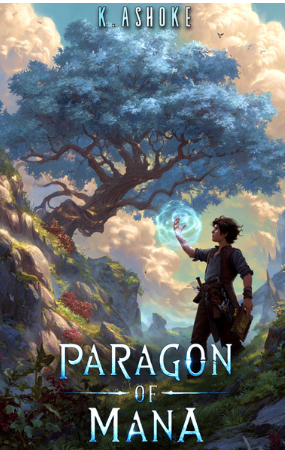
Ethan died, and was reborn into a world of Classes, Skills, and Mana. Reincarnated as Ember Blackstone, a descendant of a prestigious family of knights, he believed he had won the lottery. But the high society of ascendants can be cutthroat. With his lacklustre talent, he should have been ignored, left to fade into quiet obscurity. Yet, against all expectations, his skills and rank advance faster than anyone. Ember dreams of magic and a fulfilling life with his loving family. But when tragedy strikes, he has to fight to make ends meet. To keep his dream alive and protect those he loves, Ember must rise beyond the limit and become more mana than a man.
Paragon of Mana is a slow-burn reincarnation progression fantasy that blends LitRPG mechanics, noble-family drama, magical coming-of-age, and earned power growth into a polished, character-forward story for readers who enjoy watching a mage being built from the ground up.
Who This Book Is For
This book is for readers who love reincarnation fantasy where the protagonist does not simply wake up overpowered and start conquering the world by chapter three. Paragon of Mana is for the audience that enjoys the process: childhood, family bonds, early training, skill discovery, social hierarchy, magical theory, class systems, and the gradual shaping of a future powerhouse.
It is especially well suited for fans of Royal Road-style progression fantasy who want a story with a gentler opening, a coherent magic-and-skill framework, and a protagonist whose growth feels tied to effort, environment, and emotional motivation. If you enjoy noble houses, knightly heritage, academy or school-life potential, mana systems, reincarnated protagonists with adult awareness, and the long satisfaction of watching raw talent become disciplined mastery, this is very much in your lane.
Who This Book Is Not For
This may not be the right novel for readers who need immediate high-stakes action, instant power fantasy gratification, or a protagonist who becomes dominant within the first handful of chapters. Paragon of Mana takes its time establishing Ember’s childhood, family, early limitations, and the structure of its world. Readers who dislike infancy-to-childhood arcs in reincarnation fiction may find the early pacing too patient.
It may also not be ideal for readers who want a completely trope-breaking story from the beginning. The setup uses familiar genre building blocks: reincarnation, noble birth, mana, skills, classes, hidden potential, and gradual advancement. The pleasure comes less from radical reinvention and more from careful execution.
3 Reasons to Recommend It
The progression feels earned rather than handed out
One of the most promising things about Paragon of Mana is that it does not rush Ember into greatness. The novel understands that progression fantasy is most satisfying when growth has texture. Ember may advance faster than expected, but the story still gives attention to practice, limitation, family background, training, and the mechanics behind improvement. That makes the power curve feel more grounded than a simple cheat-skill fantasy.
The result is a story that rewards readers who enjoy the “craft” of becoming powerful. Mana is not just a flashy resource bar. Skills are not just numbers. Advancement feels like a life path, something tied to discipline, social expectation, inheritance, and personal desire. For progression fantasy fans, that kind of structure is a major draw.
Ember’s family dynamic gives the story emotional warmth
Many reincarnation stories treat the new family as a temporary prologue before the “real” adventure begins. Paragon of Mana appears more interested in letting those relationships matter. Ember’s connection to his loving family gives his ambitions emotional grounding. He does not merely want magic because magic is cool; he wants a fulfilling life, security, and the strength to protect what he loves.
That emotional foundation makes the slower opening work better than it otherwise might. The family scenes, noble-house expectations, and early childhood perspective create a softer contrast against the harsher future implied by the story’s warnings and genre tags. When tragedy enters the picture, it does not feel like a random plot device. It strikes because the story has taken time to show what Ember stands to lose.
The world has strong long-form fantasy potential
The combination of Classes, Skills, Mana, noble families, knights, high society, and ascendant politics gives the novel a sturdy foundation for expansion. This is not merely a “boy learns magic” story. The listing suggests a world where status, rank, talent, bloodline, and power systems all intersect. That is exactly the kind of setting that can support a long serialized progression arc.
There is also an appealing tension between Ember’s supposed lackluster talent and his unusual rate of advancement. That contrast creates a natural hook: is he an anomaly, a hidden prodigy, a system-breaking outlier, or something stranger? The story’s title suggests that mana itself may become central to his identity, and that promise gives the novel a clear long-term fantasy engine.
One Drawback
The biggest drawback is the slow start. For some readers, the childhood arc will feel cozy, intimate, and necessary; for others, it may feel like the story is taking too long to reach its central conflict. If you are looking for immediate battles, rapid class evolution, major antagonists, or world-shaking stakes right away, Paragon of Mana may test your patience before it fully reveals the scale of its ambitions.
Editor’s Review
Paragon of Mana is the kind of Royal Road novel that seems to understand a very specific pleasure of progression fantasy: the pleasure of foundations. Not the climactic duel, not the legendary title, not the moment when the protagonist bends reality through overwhelming power, but the quieter, more intimate phase before all of that—the years when a life is being shaped, a talent is being questioned, and a future monster of mana is still small enough to be protected.
That patience is both the novel’s identity and its gamble. K. Ashoke does not appear to be writing a reincarnation fantasy that sprints past childhood as quickly as possible. Instead, the story lingers on Ember Blackstone’s earliest experiences in a world of Classes, Skills, and Mana. For readers who love the texture of slow-burn progression, this is a strength. The book gives its magic system room to breathe. It allows family, training, social position, and personal limitation to become part of the protagonist’s development rather than mere decoration.
Ember himself is a strong fit for this kind of narrative. As Ethan reborn into a prestigious knightly family, he begins with advantages, but not the effortless dominance that often flattens reincarnation fiction. His apparent lack of exceptional talent creates a useful friction. He is privileged, yes, but not secure. Loved, but not invulnerable. Ambitious, but not instantly capable. That gives the story a more satisfying dramatic shape than a pure wish-fulfillment ascent.
The novel’s best early promise lies in the tension between expectation and anomaly. Ember should be forgettable. He should be dismissed. He should fade into the background of noble society. Instead, his skills and rank begin moving faster than they should. That kind of contradiction is exactly what progression fantasy thrives on. It gives readers a mystery hidden inside the power curve. We are not only watching numbers rise; we are watching a world slowly realize that something about this child does not fit its rules.
The family element also gives Paragon of Mana more heart than many mechanically driven LitRPGs. Ember’s dream is not abstract supremacy. He wants magic, yes, but he also wants a life worth living with the people he loves. That matters. It means the inevitable hardships are not just obstacles on a power ladder; they are threats to something emotionally legible. The story’s warmth makes its later darkness more effective because the reader understands what is being endangered.
From a genre perspective, the book sits comfortably at the intersection of reincarnation fantasy, LitRPG, noble-house drama, and magical coming-of-age. Western progression readers will recognize the ingredients immediately: classes, skills, rank, mana, family status, hidden potential, early training, and the long road toward mastery. But familiarity is not necessarily a weakness here. The appeal is in execution. The prose is readable, the premise is clean, and the emotional setup gives the mechanics a human anchor.
The main question is whether the novel can sustain its early promise once the larger world opens up. A slow childhood arc can be compelling when it is building toward something meaningful, but it depends heavily on payoff. Readers will want the school-life elements, military or war threads, noble politics, and magical advancement to eventually converge into a plot with sharper stakes. The foundation is there. The challenge will be turning foundation into momentum.
Still, as an ongoing progression fantasy, Paragon of Mana has the qualities that make a serial worth following: a likable protagonist, a structured power system, a supportive but vulnerable emotional core, and a central promise of transformation. The phrase “become more mana than a man” is not just a catchy line; it gives the story a mythic direction. It suggests that Ember’s journey will not simply be about gaining power, but about changing the nature of what he is.
For readers who prefer explosive openings, this may feel too gentle. For readers who love watching power grow from seed to storm, Paragon of Mana offers a promising start. It is not trying to dazzle by skipping the climb. It is inviting you to watch every step of the ascent.




 千斤顶
千斤顶










 English
 简体中文
简体中文 繁體中文
繁體中文 한국 사람
한국 사람 日本語
日本語 Deutsch
 русский
 بالعربية
 TÜRKÇE
 português
 คนไทย
คนไทย french