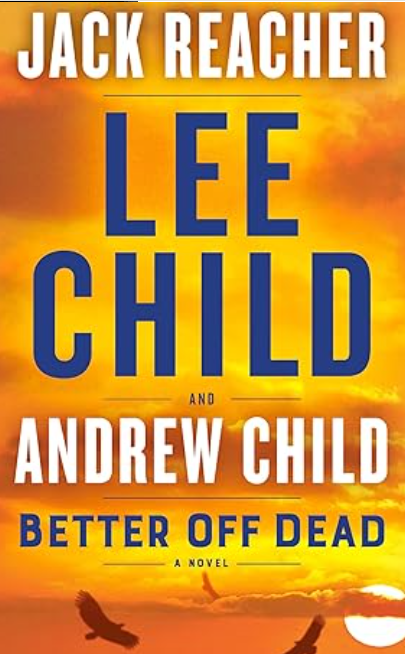
Digging graves had not been part of my plans when I woke up that morning. Reacher goes where he wants, when he wants. That morning he was heading west, walking under the merciless desert sun—until he comes upon a curious scene. A Jeep has crashed into the only tree for miles around. A woman is slumped over the wheel. Dead? No, nothing is what it seems. The woman is Michaela Fenton, an army veteran turned FBI agent trying to find her twin brother, who might be mixed up with some dangerous people. Most of them would rather die than betray their terrifying leader, who has burrowed his influence deep into the nearby border town, a backwater that has seen better days. The mysterious Dendoncker rules from the shadows, out of sight and under the radar, keeping his dealings in the dark.
One-Line Positioning
A lean, sun-scorched Jack Reacher thriller that plays like a modern Western: brutal, fast-moving, and built for readers who want competence, conspiracy, and clean-impact action more than literary flourish.
Who This Is For
This is for readers who come to thrillers wanting momentum above all else. If you like lone-wolf heroes, stripped-down prose, dusty border-town menace, and a plot that keeps tightening as the body count rises, Better Off Dead is very much in your lane.
It is especially well-suited to longtime Reacher fans who enjoy the character for what he has always represented: a wandering force of order in lawless places. Reacher enters the novel in classic form, walking into danger with no plan except instinct, physical confidence, and a refusal to let bad people dictate the rules. The setup—an apparent roadside crash in the Arizona desert, a woman with secrets, a missing brother, and a shadowy criminal presence in a decaying border town—is exactly the kind of engine this series has always known how to run.
It is also a solid entry point for readers who are Reacher-curious but not yet deeply invested in the series mythology. Publishers Weekly’s starred review specifically noted that even first-time Reacher readers could be pulled in by the smart writing, vivid action, and dramatic twists, which speaks to how accessible the book is on a pure thriller level.
Who This Is Not For
This is not the book I would hand to someone looking for the most emotionally layered or stylistically ambitious thriller of the year. If you want lush prose, densely interior characterization, or a crime novel that lingers over psychology and atmosphere more than forward motion, Better Off Dead may feel too spare, too functional, and too committed to the Reacher machine.
It may also disappoint readers who want every Reacher installment to rank with the absolute best of the series. While the trade praise emphasizes the strong action, clean pacing, and reliable entertainment value, Kirkus was noticeably more reserved, arguing that the prose is blunt rather than memorable and that the book works best for a specific niche of thriller readers rather than for everyone. That gap in response is useful to know going in: this is a satisfying franchise thriller, but not necessarily a transcendent one.
3 Reasons to Recommend
It understands exactly what readers want from a Reacher novel.
One of the hardest things for a long-running thriller franchise to do is preserve its core appeal without feeling mechanical. Better Off Dead largely succeeds because it never loses sight of the Reacher formula’s essential promise: drop a dangerous, hyper-capable drifter into a hostile environment, let him read the room faster than everyone else, and then unleash him on a problem that is both dirtier and bigger than it first appears. That remains a potent engine here. The desert opening is immediate, the central mystery is legible, and the stakes escalate with the kind of no-nonsense efficiency that makes these books hard to put down. Official synopsis materials lean heavily into that feeling of risk, secrecy, and shadowy power, and the novel’s setup delivers the sort of high-concept simplicity this series thrives on.
The action still lands with real force.
Even readers who debate the finer points of the writing style tend to agree on one thing: the Childs know how to move a scene. Publishers Weekly praised the novel’s vivid action scenes and dramatic twists, and that feels exactly right. Better Off Dead is not interested in reinventing thriller choreography; it is interested in making impact feel clean, fast, and inevitable. Reacher’s violence has always worked best when it feels less like spectacle than like outcome—when the book convinces you that, from the moment the wrong people choose the wrong fight, the ending is already written. This novel still has that quality. The fights have a satisfying finality to them, and the story keeps generating the kind of threat environment Reacher was built to dominate.
The border-town Western flavor gives it a strong sense of place.
What helps Better Off Dead stand out from more generic franchise thrillers is its setting. The Arizona-border backdrop, the sun-blasted emptiness, the failing town under the influence of a hidden kingpin, and the sense that law is present only as theater all give the book a distinctly modern Western identity. That tone matters. It lets the novel feel archetypal in a good way: one stranger, one wounded ally, one poisoned town, one monster in the shadows. The official description’s portrait of Dendoncker’s grip on the town and Michaela Fenton’s search for her twin brother adds a layer of paranoia and moral grime that suits Reacher perfectly. It is a classic American thriller landscape—broad, hot, violent, and morally stripped to essentials.
1 Reason to Hesitate
The main reason to hesitate is that the prose and plotting may strike some readers as efficient rather than exceptional.
That is not fatal in a thriller of this kind—many readers actively prefer a clipped, utilitarian style when the pace is good—but it does place a ceiling on how memorable the novel feels once the dust settles. Kirkus openly criticized the writing as plain and the plot as somewhat wacky, even while conceding that it remains an entertaining escape for the right audience. So the real question is not whether the book is “good” in some abstract sense, but whether you value propulsion more than polish. If the answer is yes, this will probably work for you. If not, it may feel like a competent franchise installment rather than a must-read thriller.
Editor’s Take
Better Off Dead is the sort of book that reminds you why the Reacher brand still works. Not because it is elegant. Not because it is emotionally revelatory. And not because it fundamentally reimagines what a Jack Reacher novel can be. It works because it understands the fantasy at the heart of the series: the fantasy of absolute competence dropped into absolute corruption.
That remains a deeply satisfying proposition. Reacher is still a great engine for narrative momentum because he simplifies the moral weather of a thriller. He does not arrive to agonize. He arrives to assess, endure, and, when necessary, destroy. In Better Off Dead, that ethos meshes well with the novel’s harsh Southwestern landscape and its underworld plot. The result is a thriller that feels closer to a late-career Western than to a puzzle-box crime novel—more dust, fists, and menace than elegance or introspection.
Is it the definitive Reacher? No. The strongest critical responses frame it as a seamless, highly readable continuation of the franchise, while the more skeptical ones suggest it is best appreciated by readers already tuned to this specific wavelength. Both views can be true at once. This is not a reinvention. It is a delivery system. And for readers who want that specific Reacher hit—violence with purpose, danger with momentum, and one implacable man walking into a rotten place and refusing to look away—it delivers more often than it misses.




 千斤顶
千斤顶









 English
 简体中文
简体中文 繁體中文
繁體中文 한국 사람
한국 사람 日本語
日本語 Deutsch
 русский
 بالعربية
 TÜRKÇE
 português
 คนไทย
คนไทย french