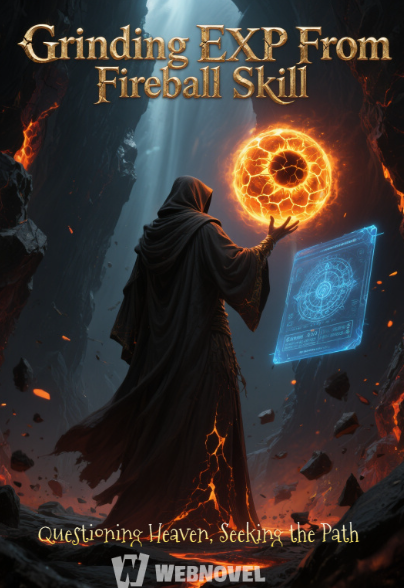
Is it hard to become a mage? Are those who master magic truly one in ten thousand? Just grind it out!!! Minor Fireball, Fireball, Greater Fireball, Explosive Fireball, Chain Fireball, Meteor Fireball… Great Sun Nuclear Blast! Novice Apprentice, Mage Apprentice, Novice Mage, Mage, Archmage, Legendary Mage, Saint Mage… God of Magic! …… “Wait, am I already invincible?”
One-Line Positioning
A candy-coated progression fantasy that asks a wonderfully shameless question—what if becoming an all-powerful mage was less about destiny and more about grinding your Fireball skill until the world simply had to take you seriously?
Who This Is For
This is for readers who love progression fantasy in its purest, most addictive form: visible growth, escalating spell tiers, clear power milestones, and the deep satisfaction of watching a seemingly humble build turn absurdly overpowered. If you enjoy stories where the appeal lies not in moral complexity but in momentum—one more level, one more upgrade, one more breakthrough—this novel knows exactly how to scratch that itch.
It is also a strong fit for readers who prefer mage-centered power fantasies over swords-and-steel combat. The novel’s hook is refreshingly specific. Instead of giving the protagonist a dozen flashy systems to juggle, it leans hard into the fantasy of taking one familiar spell and pushing it far beyond its expected ceiling. There is an undeniable pleasure in that kind of design. It feels focused, game-like, and instantly readable.
Who This Is Not For
This is probably not for readers who need elegant prose, airtight internal logic, or psychologically rich characterization to stay invested. If your favorite fantasy novels live or die by literary polish, subtle emotional arcs, or intricate political worldbuilding, this one may feel too straightforward, too functional, and too openly engineered around progression dopamine.
It may also be a poor fit for readers with a low tolerance for uneven translation or inconsistencies in naming and power terminology. Several visible reader responses praise the pacing and core concept, but others specifically complain about rough translation, messy tier labels, and moments where the protagonist’s decision-making feels less clever than the premise promises.
Three Reasons to Recommend It
The central hook is instantly marketable and genuinely fun.
“Grinding EXP From Fireball Skill” is the kind of title that tells you exactly what you are getting—and, more importantly, why that might be fun. The premise is shamelessly gameified in the best possible way. The novel understands that repetition is not a weakness in progression fantasy when repetition itself becomes the engine of anticipation. Every new Fireball variation, every rank-up, every step from apprentice to something godlike taps into the reader’s desire to see a simple mechanic pushed to glorious excess. Based on the official synopsis alone, the book’s pitch is crystal clear: a minor spell becomes the foundation for overwhelming magical supremacy. That clarity is a strength.
It delivers the clean pleasures of weak-to-strong fantasy without pretending to be something else.
A lot of web novels stumble because they seem embarrassed by their own power-fantasy DNA. This one is not. It embraces its identity as a grind-heavy mage progression story and builds its appeal around escalation, not subtlety. That confidence matters. For the right audience, the appeal of this kind of novel is not surprise in the literary sense; it is payoff. You keep reading because you want to see the next spell tier, the next leap in status, the next moment when the protagonist realizes he has already outgrown the limits of the world around him. Reader comments suggesting that the story becomes more enjoyable as it goes and that the pacing improves over time support that sense of accumulative payoff.
The mage fantasy has a broad, almost universally readable appeal.
There is something inherently satisfying about a fantasy novel built around magical specialization. Fireball is one of the oldest and most recognizable spells in the genre, which makes it the perfect anchor for a broad-audience power fantasy. The novel turns familiarity into escalation: the more ordinary the starting point, the more dramatic the eventual transformation. That structure gives the book a very accessible entry point, even for readers who are not deep genre veterans. You do not need to memorize a dozen factions or decode an elaborate cosmology to understand the appeal. You just need to understand one deliciously simple proposition: what happens when an ordinary offensive spell stops being ordinary?
One Reason to Hesitate
The biggest caveat is polish.
Even readers who enjoy the concept have raised concerns about translation quality, inconsistent naming or tier systems, and moments when the protagonist’s choices feel less convincing than the setup deserves. That does not automatically kill a progression fantasy—many readers will happily power through rough edges if the leveling loop is strong enough—but it does define the reading experience. If you are the kind of reader who gets pulled out of a story by clunky phrasing, unclear terminology, or logic gaps in character behavior, this may frustrate you more than it rewards you. The book seems easiest to enjoy when approached as a high-concept, fast-consumption power fantasy rather than as a polished fantasy novel in the traditional publishing sense.
Editor’s Verdict
“Grinding EXP From Fireball Skill” looks built for readers who want fantasy as a compulsion machine: a story that turns progression into pleasure and specialization into spectacle. Its best quality is not elegance but commitment. It takes a simple, even slightly ridiculous idea—what if the road to magical godhood began with grinding Fireball over and over again?—and commits hard enough that the premise becomes the point.
That is why the novel works, at least in concept and likely for its target audience. It understands a truth many successful web serials know by instinct: readers will forgive a lot if the growth is satisfying, the premise is sharp, and every chapter promises a measurable step upward. This is not the sort of book you recommend as a definitive fantasy achievement. It is the sort of book you recommend to someone who wants to open a serial, binge fifty chapters, and feel that primal progression-fantasy rush of watching numbers, ranks, and destructive capability spiral upward.
In other words, this is not prestige fantasy. It is sticky fantasy. Addictive fantasy. The kind of book that survives on momentum, clarity of premise, and the deeply reliable joy of seeing a mage break the world one upgraded Fireball at a time.




 千斤顶
千斤顶










 English
 简体中文
简体中文 繁體中文
繁體中文 한국 사람
한국 사람 日本語
日本語 Deutsch
 русский
 بالعربية
 TÜRKÇE
 português
 คนไทย
คนไทย french